To make a rolling bassline for trance, you program short, evenly spaced bass notes on a 1/16th grid, keep them locked to a four-on-the-floor kick, and run the bass through a compressor keyed to that kick so the two alternate instead of stacking. Add an octave jump or a filtered note every four bars so it does not go numb on a six-minute track. The whole thing takes about an hour in any DAW once you have the patch.
Updated for October 2026
Most of the difficulty is not the MIDI. It is making the sub survive the drop without turning to mud, which is a gain staging and sidechain problem more than a sound design one. So this guide goes in order: patch, tempo, rhythm, movement, low end, then arrangement.
Table of Contents
- What You Need
- Step-by-Step
- Step 1: Choose a Strong Trance Bass Sound
- Step 2: Set the Trance Tempo and Groove Set your project tempo first, then let every other timing decision follow from it. Uplifting trance usually sits at 136 to 140 BPM; progressive and hard house often run slightly faster, around 140 to 150. Do the maths once so you never guess at note lengths again. At 138 BPM, one beat lasts about 435 ms, so a 1/8 note is roughly 217 ms and a 1/16 note is roughly 109 ms. Every note in a rolling line needs to be shorter than the gap it lives in, which is why 80 to 100 ms is the useful range for 1/16 note length at that tempo. Now place your kick: one hit on every beat, positions 1, 5, 9 and 13 on a 16-step grid. That is the four-on-the-floor pulse, and it is the reference the bassline is written against. Give the kick a short length, roughly 200 to 300 ms at 138 BPM, because a long kick tail is the most common reason the bass ducks late and sounds out of time. On quantizing: keep the rolling bassline tight to the grid. Rolling is a rhythmic effect, and if the bass is loose the whole thing smears. If you want human feel, add 5 to 10 ms of push or pull to the offbeat hits only, and leave the main accents exactly on the grid. Quantizing afterwards is painful because every release and filter tail moves with it. Step 3: Write the Rolling Bassline Rhythm
- Step 4: Add Octave Movement and Note Variation
- Step 5: Shape the Sound for Forward Motion
- Step 6: Process and Balance the Low End
- Step 7: Test and Arrange the Bassline
- Common Mistakes
- Frequently Asked Questions
- What makes a trance bassline feel rolling?
- Should I use a saw bass, reese bass, or another sound?
- How do I write a rolling bassline without it sounding repetitive?
- Do I need sidechain compression for a trance bassline?
- How many notes should a trance bassline have per bar?
- Can I make a rolling bassline with a sample pack?
What You Need
Five things, and none of them expensive:
- A DAW. Ableton Live, FL Studio, Logic Pro, Reaper, Cubase or Studio One all do everything in this guide. Nothing here is plugin-specific except the sidechain routing at the end of step 6.
- A synth with a sustain knob you control. Serum, Sylenth1, Massive, Pigments or a free synth such as 3xOsc or Sytrus all work. What matters is one clean fundamental and one midrange layer you can filter, not the number of oscillators.
- MIDI editing at 1/16 resolution. A piano roll is enough. If your DAW shows only 1/8 grid, change the grid division before you start, because a rolling line written on an eighth grid cannot be corrected later without rewriting it.
- A compressor and a saturator. One compressor keyed to the kick is mandatory. A saturator or soft clipper is what separates a professional rolling bass from a sine wave with a filter on it.
- A rough idea of tempo and key. Classic trance sits between 136 and 140 BPM, and 138 is the sweet spot. Pick the key before you design the patch so the sub frequency lands somewhere sensible rather than somewhere that shakes a speaker.
One thing worth deciding early: whether the bass sits in a low register (roughly 40 to 60 Hz for the sub) or a mid register (roughly 100 to 130 Hz). Low sub feels heavy on a big system and vanishes on small ones. Mid bass is the safer default for a first rolling line.
Step-by-Step
Step 1: Choose a Strong Trance Bass Sound
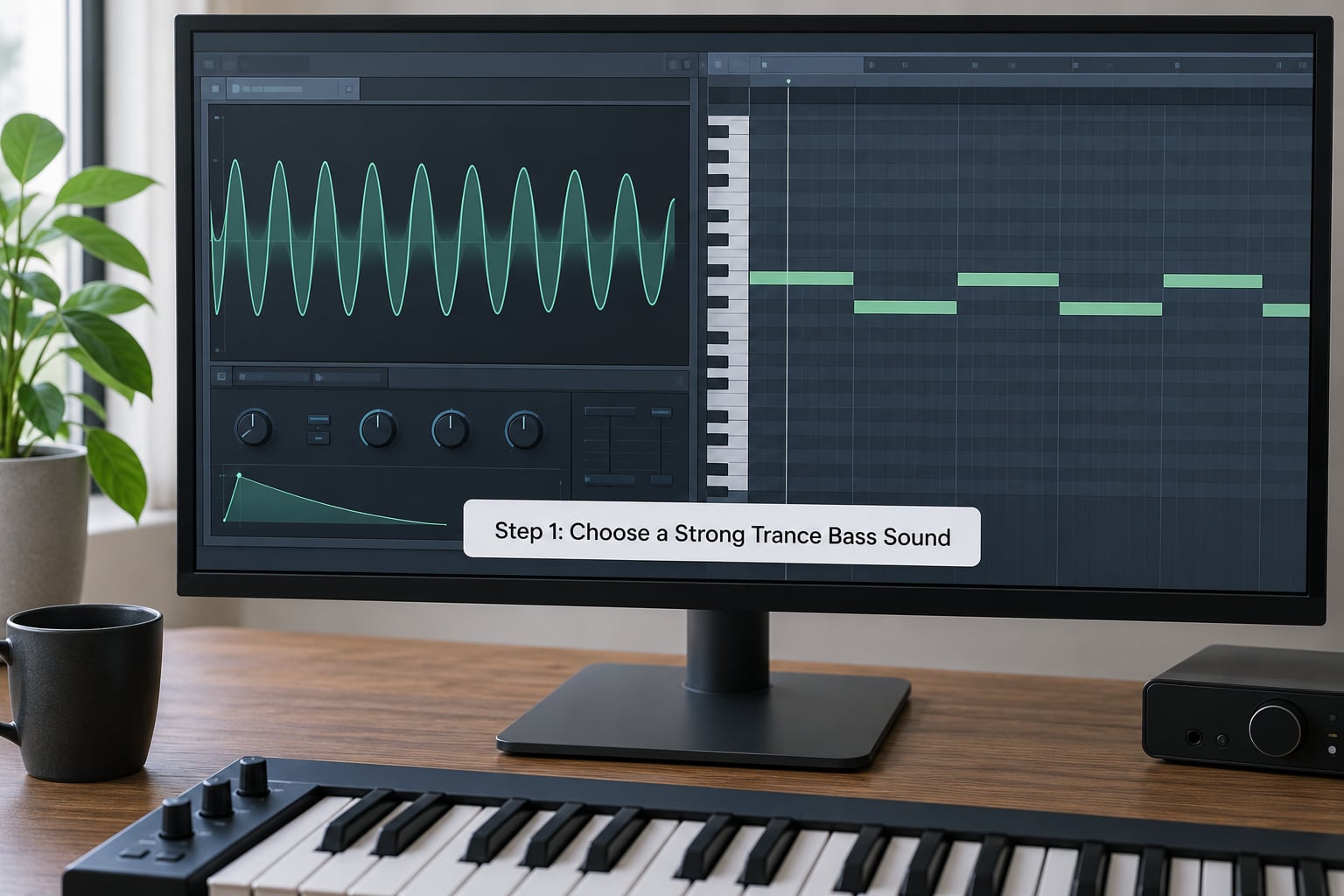
A good trance bass patch is two sounds stacked: a sine or triangle oscillator for the fundamental, and a filtered saw for bite. That combination gives you weight on small speakers and character on big ones, and it is the reason a rolling line survives sidechain compression without turning to mush.
Start with the sub layer. One oscillator, sine wave, no detune, played one octave below your root note. Give it a fast attack of 3 to 8 ms and a short amp release of 40 to 60 ms so each note is discrete rather than smeared into the next one. Long releases are the single most common reason a rolling bass sounds like a blob instead of a pulse.
Then the mid layer. One saw oscillator, 5 to 7 voices of unison, detuned 10 to 25 cents. Low-pass it somewhere between 500 Hz and 2 kHz with moderate resonance, and set the amp release to 100 to 150 ms so it hangs for a moment after the kick hits. Where you put that filter is the difference between an uplifting trance line and a distorted warehouse one.
Alternatives worth trying. A reese bass (two detuned saws through light distortion) is wider and more aggressive, and it suits hard house and techno more than melodic trance. A square wave gives a cleaner, more modern fundamental with less filter sweep needed. A sampled bass gets you character fast but needs the transient re-tuned to match your kick, which is more work than it looks.
How do you know the patch is right? Play one note, hold it for two bars, and listen with the kick muted. If the fundamental is unclear or the note dies before the bar ends, the patch is not finished yet.
Step 2: Set the Trance Tempo and Groove
Set your project tempo first, then let every other timing decision follow from it. Uplifting trance usually sits at 136 to 140 BPM; progressive and hard house often run slightly faster, around 140 to 150.
Do the maths once so you never guess at note lengths again. At 138 BPM, one beat lasts about 435 ms, so a 1/8 note is roughly 217 ms and a 1/16 note is roughly 109 ms. Every note in a rolling line needs to be shorter than the gap it lives in, which is why 80 to 100 ms is the useful range for 1/16 note length at that tempo.
Now place your kick: one hit on every beat, positions 1, 5, 9 and 13 on a 16-step grid. That is the four-on-the-floor pulse, and it is the reference the bassline is written against. Give the kick a short length, roughly 200 to 300 ms at 138 BPM, because a long kick tail is the most common reason the bass ducks late and sounds out of time.
On quantizing: keep the rolling bassline tight to the grid. Rolling is a rhythmic effect, and if the bass is loose the whole thing smears. If you want human feel, add 5 to 10 ms of push or pull to the offbeat hits only, and leave the main accents exactly on the grid. Quantizing afterwards is painful because every release and filter tail moves with it.
Step 3: Write the Rolling Bassline Rhythm
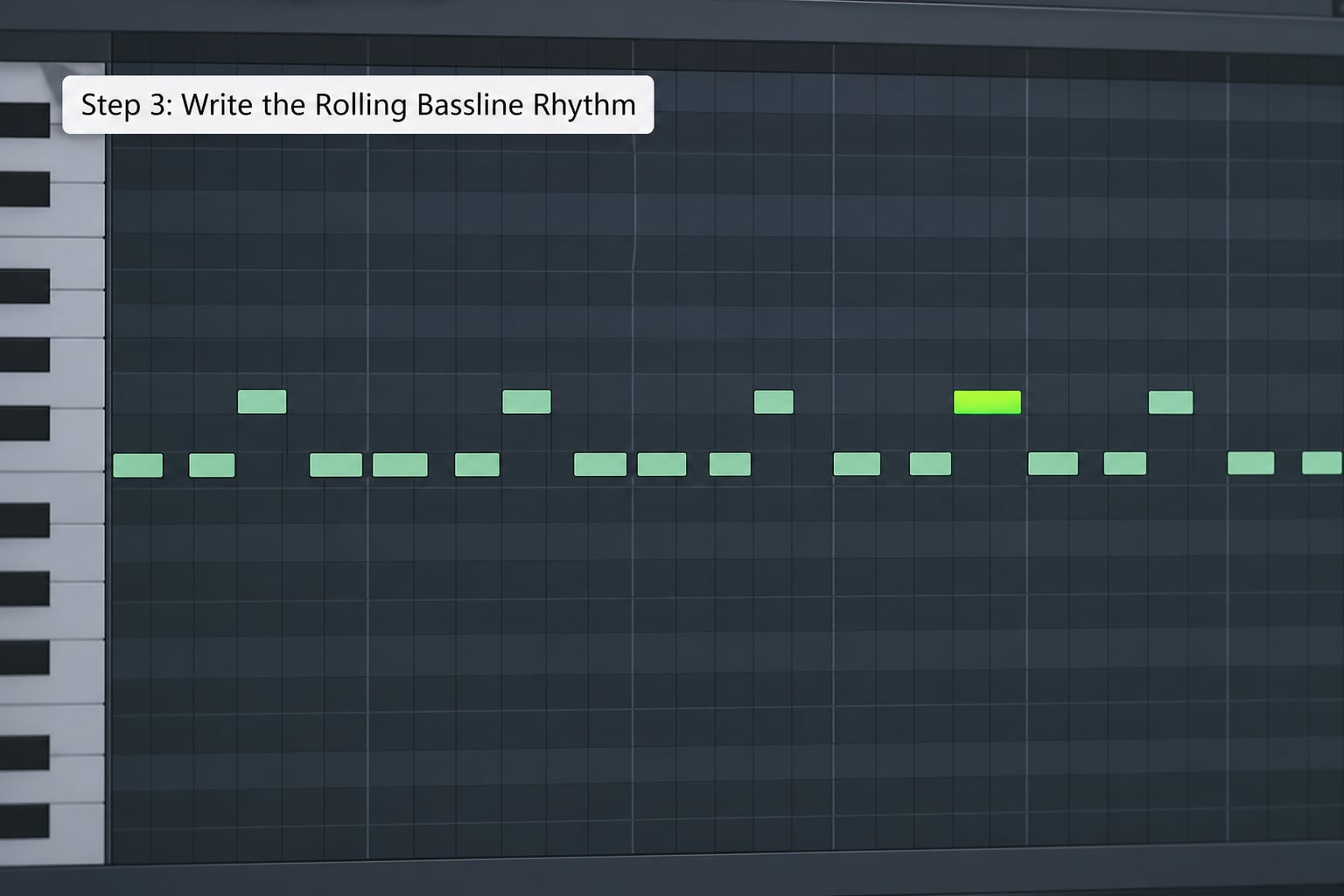
The classic rolling trance pattern is simple: a bass note on every 1/8 offbeat, which on a 16-step grid means hits on positions 3, 7, 11 and 15. Doubling that to every 1/16 (all odd positions) gives you the rolling sound people mean when they use that word, and it is denser, so it needs a heavier sidechain.
Here are the five core patterns, with X marking a bass hit and . marking silence:
| Pattern | 16-step grid | Energy | Sidechain | Use it when |
|---|---|---|---|---|
| Offbeat (donk) | ..X…X…X…X. | Medium | Light, 3 to 5 dB | Uplifting trance, melodic sections, breakdowns |
| Double offbeat | ..X.X…X.X…X.X | Medium-high | Moderate, 6 to 8 dB | Progressive trance, groove-heavy drops |
| 1/16th rolling | X.X.X.X.X.X.X.X. | High | Heavy, 8 to 12 dB | Hard house, French house, driving techno sections |
| Octave jump | ..X…X…X…X. with root/8ve alternating | High | Moderate to heavy | Builds and drop entrances, 16-bar phrases |
| Syncopated | ..X..XX…X..XX. | High | Moderate | Psytrance variations, when you want movement without density |
A concrete four-bar example. Bar 1: offbeat pattern on the root, notes 1, 3 and 5 in the key. Bar 2: same rhythm, still on the root. Bar 3: same rhythm but drop to the fifth for the last two hits. Bar 4: same rhythm, jump an octave up on the last hit and let the filter open with it. Loop that and it reads as a progression rather than a loop.
Vary it without losing the pulse by changing one thing at a time: the octave, the note, the velocity, the filter, or the note length. Change two at once and your ear loses the reference and the pattern stops rolling.
Step 4: Add Octave Movement and Note Variation
Movement is what separates a rolling bassline from a test tone. The rule is small changes, placed on phrase boundaries, never random ones.
Octave jumps work best on the last hit of a four-bar phrase, or the first hit of a new phrase, which lands right after a small gap. Jumping mid-phrase at the same speed as everything else just sounds like a mistake. Keep the jump to one octave, and drop the velocity by 5 to 10 on the higher note so it sits behind the one below it.
For notes, stay on the root and the fifth of your chord, and add the b7 sparingly on one bar out of four if the progression is minor. A rolling bassline that plays a full melody stops being a bassline, and it will fight the lead for the same frequency range.
Velocity is the cheapest variation you have. Drop the downbeat hits from 110 to 95 and lift the syncopated ones from 100 to 115, and the line suddenly has a shape without a single extra note.
Step 5: Shape the Sound for Forward Motion
A flat 16-note loop gets boring by bar 8, and that is a sound design problem rather than a writing problem.
Sync an LFO to the tempo and route it to the mid layer’s filter cutoff at a slow rate: one cycle every bar or every two bars, at 15 to 20 percent depth. That slow opening and closing is what listeners read as forward motion. Faster rates sound like a jet sweep and get old quickly.
Then automate the cutoff itself. Bring it down slightly in the breakdown and open it across the eight bars before the drop, so the bass sounds like it is waking up rather than simply appearing. A 20 percent open at the drop is plenty.
Sample variation, where available, is worth using on the mid layer only. A tiny pitch or filter offset per note breaks up phase buildup that accumulates over 64 repetitions.
Short transitional effects do more work than they get credit for. A 60 ms reverse cymbal or a short riser on the bar before a new phrase tells the ear something is about to happen, and it costs you nothing in the low end.
Step 6: Process and Balance the Low End
This is where most rolling basslines fail, so give it time. A line that sounds perfect in the piano roll can fall apart once the kick and the drop are in.
Gain stage first. Solo the bass and set its peak around -6 dB below the kick’s peak, then bring both up together. If you can hear the bass distorting before the compressor is on, turn one of them down rather than turning the master down.
Then use two compressors instead of one. On the sub layer, run a hard sidechain: ratio around 8:1, 8 to 12 dB of gain reduction on each kick hit, release tuned so the bass recovers just before the next note. On the mid layer, run a much lighter one: ratio around 4:1, 3 to 5 dB of reduction. Squelching the mid layer as hard as the sub is the most common cause of that over-pumped, breathless feel.
Sidechain routing differs by DAW. In Ableton Live, put an envelope follower (Compressor, mode Envelope Follow, with Sidechain set to the kick) on the bass track. In FL Studio, Fruity Peak Controller on the kick with Fruity Balance on the bass, mapping volume inversely. In Logic Pro, use the compressor’s Sidechain menu and choose the kick. In Reaper and Cubase, create an audio or MIDI sidechain route from the kick bus to the bass insert. The settings are identical; only the routing differs.
Saturation goes on the mid layer only. Never saturate the sub: soft clipping adds upper harmonics around 200 Hz and 400 Hz, which is exactly the band where kick and bass mud up. A gentle tape-style saturation on the mid at low mix is enough to give the line its edge.
Then carve. Keep the sub below about 80 Hz. Give the kick its fundamental in the 50 to 65 Hz region and notch the mid layer around 200 to 300 Hz where it collides with the kick body. High-pass the mid layer around 250 Hz so it decorates the drop rather than adding to the rumble. Everything below 120 Hz should be mono, which you can check with a correlation meter or by soloing the low band and listening for any loss of level in the centre.
Finally, automate the volume. The bass should sit slightly under the kick in verses and gain 1 to 2 dB through the drop. This is more effective than any EQ curve at making a drop feel bigger.
Step 7: Test and Arrange the Bassline
Run a quick checklist before you build anything around it:
- Play it with the kick, then without. It should still make sense in both, because breakdowns usually strip the kick out.
- Check the low end in mono. If it collapses or thins, something below 120 Hz is stereo.
- Loop it for eight bars without touching anything. If your attention drops, you need variation, not a louder mix.
- Compare it on a small speaker. If the low end vanishes, add mid-bass presence around 300 to 500 Hz rather than boosting the sub.
Then vary it on three levels. Micro variation every 4 bars: velocity shift, one octave jump, or a filter tweak. Section variation every 16 to 32 bars: change the pattern itself, drop to the offbeat for eight bars, or remove the mid layer and leave only the sub. Structural variation across the arrangement: bass out during the breakdown, bass at reduced level through the build, full weight at the drop.
When a line needs more space, take notes out rather than turning the volume down. When it needs less movement, shorten the note length before you remove notes. When it needs more attack, raise the mid layer’s filter cutoff and reduce its release.
Common Mistakes
Muddy low end. Usually a frequency collision at 200 to 400 Hz, not too much bass. Notch the mid layer there, or high-pass it around 250 Hz. Listening test: solo the 150 to 400 Hz band with everything playing, and if it is the loudest muddy part of the mix, that is your problem band.
The bass has no weight. The classic complaint, and usually the sub is too quiet or buried under the kick. Raise the sub layer’s level until it is clearly audible on headphones, then check it on a phone speaker. If the sub note is below 40 Hz, move everything up an octave: nobody hears it on the systems most people use.
Notes run into each other. Amp release is too long. At 138 BPM, cap the sub release at 40 to 60 ms and the mid at 100 to 150 ms. If notes blur together even with those values, your note length is too long for the grid.
The groove feels static. Add movement on phrase boundaries rather than everywhere: an octave jump on the first beat of a new four-bar phrase, a filter opening across eight bars. Listening test: skip to bar 33. If nothing there is different from bar 5, the pattern is static.
Too much modulation. LFO depth above 20 percent, or a fast rate, turns a trance bass into a trance siren. Set the rate to one or two cycles per bar and cut depth until you stop noticing the sweep.
Kick and bass fight. A long kick tail delays sidechain recovery, so the bass comes back late and sounds behind the beat. Shorten the kick to 200 to 300 ms and raise the sidechain release until the bass is back to full level just before its next note.
It sounds like a preset. Presets are recognisable because every note is identical. Add velocity variation, one filter automation pass and a single octave jump per 16 bars, and it stops sounding like a demonstration.
Too much note variation. If the bass is playing its own melody, it will fight the lead and the track will sound crowded. Strip it back to root and fifth, and let the lead have the tune.
Frequently Asked Questions
What makes a trance bassline feel rolling?
It is rhythm plus relationship, not tone. Short, evenly spaced notes on a 1/8 or 1/16 subdivision create the continuous motion, and a compressor keyed to the four-on-the-floor kick ducks the bass on each hit so the two alternate rather than overlap. If the pulse feels dead, check that the notes are short and tight to the grid, and that the kick is actually triggering the sidechain.
Should I use a saw bass, reese bass, or another sound?
Saw for melodic and progressive trance, reese for hard house and darker styles, square wave for a cleaner modern fundamental, and sine for pure weight. Most rolling lines that work best combine a sine sub layer with a filtered saw on top. The saw alone tends to get muddy once it is sidechained hard; the sine alone has no character to keep the line interesting.
How do I write a rolling bassline without it sounding repetitive?
Vary one dimension per four bars: octave, note, velocity, filter cutoff or note length. Place the change on a phrase boundary so the ear hears it as structure rather than a mistake. Stay on root and fifth, cap the octave jump at one octave, and lift syncopated notes a few velocity points while dropping the downbeat. Over eight bars, three small changes is plenty.
Do I need sidechain compression for a trance bassline?
For a dense 1/16th rolling line, yes, it is close to mandatory, because without it the bass and kick stack in the same frequency range and the low end turns to mud. Run 8 to 12 dB of gain reduction on the sub layer and only 3 to 5 dB on the mid. A sparse offbeat line needs far less, and over-pumping is worse than a little mud.
How many notes should a trance bassline have per bar?
Four notes per bar on every 1/8 offbeat is the standard, which on a 16-step grid means hits on positions 3, 7, 11 and 15. Sixteen notes per bar gives the dense rolling sound that hard house and techno use. Somewhere around eight sits in between and suits progressive trance. More than sixteen rarely helps because the sidechain never fully recovers.
Can I make a rolling bassline with a sample pack?
Yes, and it is a fast route to a starting point. One-shots from a trance or hard house bass pack are usually tuned for exactly this. Expect to adjust the amp release so notes stay discrete, re-tune the fundamental so it matches your kick, and set the note length yourself on the piano roll. One-shot is easier than designing the patch, two-shot is easier still.
If you only do one thing from this guide, get the sub and the kick sitting together before anything else. Build the patch, write an offbeat pattern, get the 1/16 note length right at your tempo, and only then add movement. A rolling bassline for trance is mostly rhythm and low-end discipline; everything else is seasoning.