Short version: streaming services hand back roughly 0.0022 to 0.0125 USD per qualified stream before anyone splits anything, and a producer holding 2 to 5 master royalty points usually keeps well under one-tenth of a cent per stream after a distributor takes its cut. On a million streams that master-side income is often under 100 USD, and publishing collections can lift the total only if your credits and splits are correct.
That is the part almost every search result for how much do producers earn from streams leaves out. They quote the artist-level rate and stop. So if you have wondered why a track with a huge play count produced a cheque that would not cover your plug-in bill, you are not bad at maths. The money is being divided between a lot of people, and the figure producers actually receive is a fraction of the headline number.
This guide walks through the real split, what changes it, how to check your own statements, and where the money leaks. All figures are current as of 2026 and illustrative rather than guaranteed, because streaming payouts move as subscriber plans and platform terms change.
Table of Contents
- Producer Stream Earnings at a Glance
- What Counts as a Producer’s Stream Income?
- What Affects the Amount Producers Earn Per Stream?
- How Much Can One Stream Earn?
- How to Calculate Your Own Rate
- How Much Do Top Streaming Producers Make?
- How to Check Your Actual Royalty Statements
- Ways to Save
- Frequently Asked Questions
- Conclusion
Producer Stream Earnings at a Glance
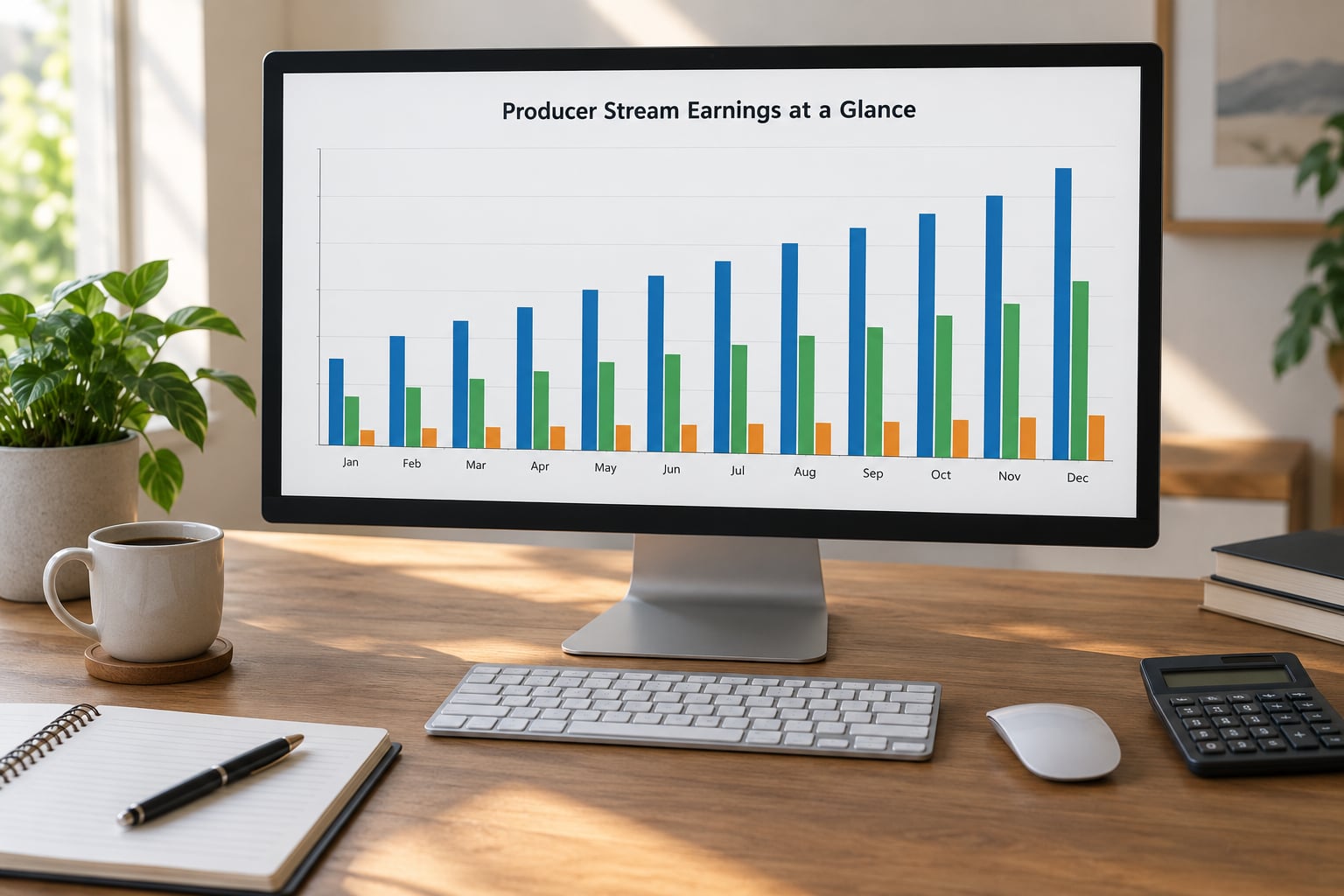
There is no single universal rate for how much do producers earn from streams, because there is no fixed price per play. Subscriber and advertising money goes into a monthly pool, and each track receives a share of that pool in proportion to its share of total listening. Your income then depends on contractual percentages layered on top of that share.
The table below uses a blended average payout of 0.0038 USD per stream, the figure published for Spotify Premium in January 2026 payout comparisons, and shows what gross revenue looks like at four release profiles before any split. Treat these as illustrations of scale, not quotes.
| Release profile | Qualified streams per quarter | Illustrative gross DSP revenue | Average revenue per stream | How it differs from selling |
|---|---|---|---|---|
| One new single, small audience | 12,000 | about 46 USD | 0.0038 USD | No ownership transfer; income continues monthly |
| A release that found an audience | 250,000 | about 950 USD | 0.0038 USD | Pool share shifts with your listening share |
| A breakout track | 2,000,000 | about 7,600 USD | 0.0038 USD | Still a share of a growing pool, not a fixed fee |
| A catalogue averaging steady plays | 12,000,000 | about 45,600 USD | 0.0038 USD | Older releases often earn more per play over time |
Notice how nothing in that table depends on selling anything. A record sale transfers ownership and ends future income from that unit. Streaming pays a share of a pool every month, forever, which is why catalogue volume matters more than any single release.
Estimates change frequently by service, listener territory, subscription type, release age and your ownership share, so treat every rate in this article as dated rather than permanent.
What Counts as a Producer’s Stream Income?
Producer streaming income is not one payment. It arrives through at least four separate systems, and most producers only ever see one or two of them.
Master sound recording royalties
This is the money most people mean when they say streaming royalties. When someone plays your master recording on a DSP, the platform pays the label or distributor, and the distributor pays out according to master royalty points. Your distributor reports this to you, usually with a lag of several months.
Performance royalties on the composition
Your PRO collects these when your song is played on radio, television, in bars and in some streaming contexts. The payout comes from ASCAP, BMI, SESAC, GEMA or a similar society depending on where the listener is, not from your DSP dashboard.
Mechanical royalties
The Mechanical Licensing Collective handles these on behalf of songwriters and publishers in the United States, created by the Music Modernization Act. It pays out on a schedule driven by how many streams your composition receives across reporting periods.
Digital performance royalties for sound recordings
SoundExchange collects broadcast digital performance royalties for sound recordings in the United States. Rates are set by the Copyright Royalty Board under the Phonorecords IV agreement, and the Allocation for Music Producers Act created the pathway for producers to claim a share of that money where they hold qualifying producer rights.
Sync, neighbouring rights and everything else
A track placed in a film, advertisement or game generates a sync fee that dwarfs streaming, negotiated separately. Several European countries also pay neighbouring rights to producers and performers directly, which is worth chasing if your listeners are concentrated there.
The reason a producer sees only part of a displayed DSP payout is simple: it is split. Producer points, songwriter shares, artist shares, featured-artist percentages, label overhead, publisher administration and distributor commission all come out before the number reaches your bank account.
What Affects the Amount Producers Earn Per Stream?
Two tracks with identical stream counts can pay very different amounts. These are the variables doing the work.
- Paid versus ad-supported listening. An ad-supported session pays out far less than a premium subscription, and every platform mixes these differently.
- Listener territory. A premium stream in the United States, United Kingdom or Switzerland can be worth several times one from India or Latin America. A track with a Brazilian audience earns a fraction of one with a North American audience.
- Plan mix. Family, student and partner plans contribute less per user than an individual premium subscription, so a platform with heavy family-plan growth can see per-stream value drift down while subscriber counts rise.
- Release age. Older catalogue tends to earn more per play as the pool grows, while a brand new release often sits in the discovery phase.
- Royalty type. Performance, mechanical and digital performance royalties are separate systems with separate reporting, and only some of them appear on your DSP statement.
- Contract terms. Advances, cross-collateralisation and recoupable balances mean early income can go to recouping a fee before you see a penny of it.
- Distributor commission. A 15 to 20 percent administration fee is normal and comes off the top before points are applied.
- Currency conversion. Royalties are collected in local currency and converted, so exchange rate movement affects a payout you already earned.
- Which rights you own. Owning the master, owning the composition, or owning both changes everything, and selling one without the other leaves a permanent hole in your income.
How Much Can One Stream Earn?
One stream is worth somewhere between 0.0022 USD on YouTube Music and 0.0125 USD on Tidal at the artist level, with Apple Music at 0.0078 USD, Amazon Music at 0.0040 USD and Spotify at 0.0038 USD in the same January 2026 comparison. Those are averages across all listeners, which is exactly why they mislead when you apply them to your own catalogue.
What a producer actually keeps
Here is the calculation most sites skip. Take one million streams on Spotify at the 0.0038 USD average, assume a 15 percent distributor commission, and assume you hold 3 master royalty points and a 20 percent publishing share.
- Gross platform revenue: 1,000,000 multiplied by 0.0038 USD = 3,800 USD
- After a 15 percent distributor commission: 3,230 USD distributed to rights holders
- Your master share at 3 points: about 97 USD
- Publishing collected separately through your PRO and The MLC: depends on how much composition performance and mechanical income the track generates
That is a realistic illustration of how much do producers earn from streams on a genuinely successful release. Roughly 97 USD of master-side income from a million streams, before publishing, and your personal rate works out to under one-tenth of a cent per play.
How to Calculate Your Own Rate
Stop using industry averages and use your own statement. Take the net royalties actually paid to you for a reporting period, divide by the qualified streams on that same statement, and you have the only figure that matters to you. Run it again on three consecutive periods, because a single month can be distorted by a playlist spike or a territory shift.
A reusable formula for a release: net royalty paid to you multiplied by 1,000,000, divided by your total streams. It tells you how many streams your current audience would need at current rates to reach a target income, which is a far more honest planning number than a published average.
Streams needed to reach certain gross revenue levels at average rates, before any split:
| Platform | Average USD per stream | Streams for 100 USD | Streams for 1,000 USD | Streams for 10,000 USD |
|---|---|---|---|---|
| Tidal | 0.0125 | 8,000 | 80,000 | 800,000 |
| Apple Music | 0.0078 | 12,821 | 128,205 | 1,282,051 |
| Amazon Music | 0.0040 | 25,000 | 250,000 | 2,500,000 |
| Spotify | 0.0038 | 26,316 | 263,158 | 2,631,579 |
| YouTube Music | 0.0022 | 45,455 | 454,545 | 4,545,455 |
Now apply your own split to those gross numbers, because that is the figure you actually plan around. A producer with 3 master points needs roughly ten times as many streams to reach the same take-home as the artist whose master they hold.
How Much Do Top Streaming Producers Make?
Per-stream claims are useless for planning. Monthly totals are what people actually budget with, and they are far lumpier than the marketing suggests. Producer forums push back hard on clickbait claims of monthly Spotify income, and they are right to be sceptical.
Emerging independent producer
A catalogue of twenty releases averaging 8,000 streams per release per month produces roughly 30 USD of gross revenue. After distributor commission and a 3 point master share, the master-side income is around eight dollars a month, with a small amount of publishing on top. This is real money, but it is not rent.
Regularly releasing producer with a working catalogue
One release holding 250,000 streams a month at a 0.0038 USD average gives about 950 USD gross. With a 15 percent distributor cut and 3 master points, that is roughly 24 USD a month from that track alone. A producer with ten releases in similar shape is still under a few hundred dollars a month from master points, which is why most working producers treat streaming as long-tail income rather than income.
Producer drawing on several royalty sources
Add publishing, performance royalties, digital performance royalties where they apply, sync placements, and services work. That combination is where mid four-figure monthly numbers come from in a good quarter, and near zero in a bad one. Hit-driven placements make the line item spike rather than climb.
The 100 million stream paradox
Run the maths on a track with 100 million streams at 0.0038 USD average: 380,000 USD gross, about 323,000 USD after a 15 percent distributor commission, and roughly 9,690 USD at 3 master points. Producers posting in production forums report totals closer to 30,000 to 50,000 USD for that kind of play count, which only works if the points are larger and publishing plus performance collections are doing much of the work. Nothing is broken. The headline stream number is just far bigger than the money attached to it.
How to Check Your Actual Royalty Statements
The fastest way to stop guessing is to read one statement properly. It takes about twenty minutes.
1. Find the report and the period it covers
Log into your distributor or DSP dashboard and locate the royalty or usage report. Note the reporting period and the payment date, because platform statements usually describe an earlier period than the one that pays out.
2. Separate the numbers before the money
Qualified streams, revenue, commission and net payout appear as distinct fields. Look for a line showing total revenue generated and a line showing what reached you. The gap between them is where commission, splits and recoupment live.
3. Check the territory mix
Reports that break revenue down by country tell you whether your audience is in high-value markets. If most of your plays come from low-value territories, your effective per-stream rate is far below the published average, and no amount of promotion will fix that arithmetic.
4. Confirm what rights the report covers
A DSP statement covers master recording revenue only. Composition income sits with your PRO and The MLC, and sound recording digital performance royalties sit with SoundExchange. If you are only reading one of those, you are reading a fraction of what you are owed.
5. Join the systems you are missing
Register as a songwriter and publisher with your PRO, register your works with The MLC, and claim SoundExchange royalties if you hold qualifying producer rights. Each registration takes an afternoon and pays back for years, and unclaimed money sits with collection societies rather than being held for you.
6. Chase mismatches with evidence
When your name is missing from a credit, take the split sheet, the metadata and the release date to your distributor in writing. Correcting credits mid-catalog is routine, though it applies to future statements rather than ones already paid.
Ways to Save
On an income this small, the fastest gain is not earning more. It is collecting what you are already owed and preventing the slow leaks.
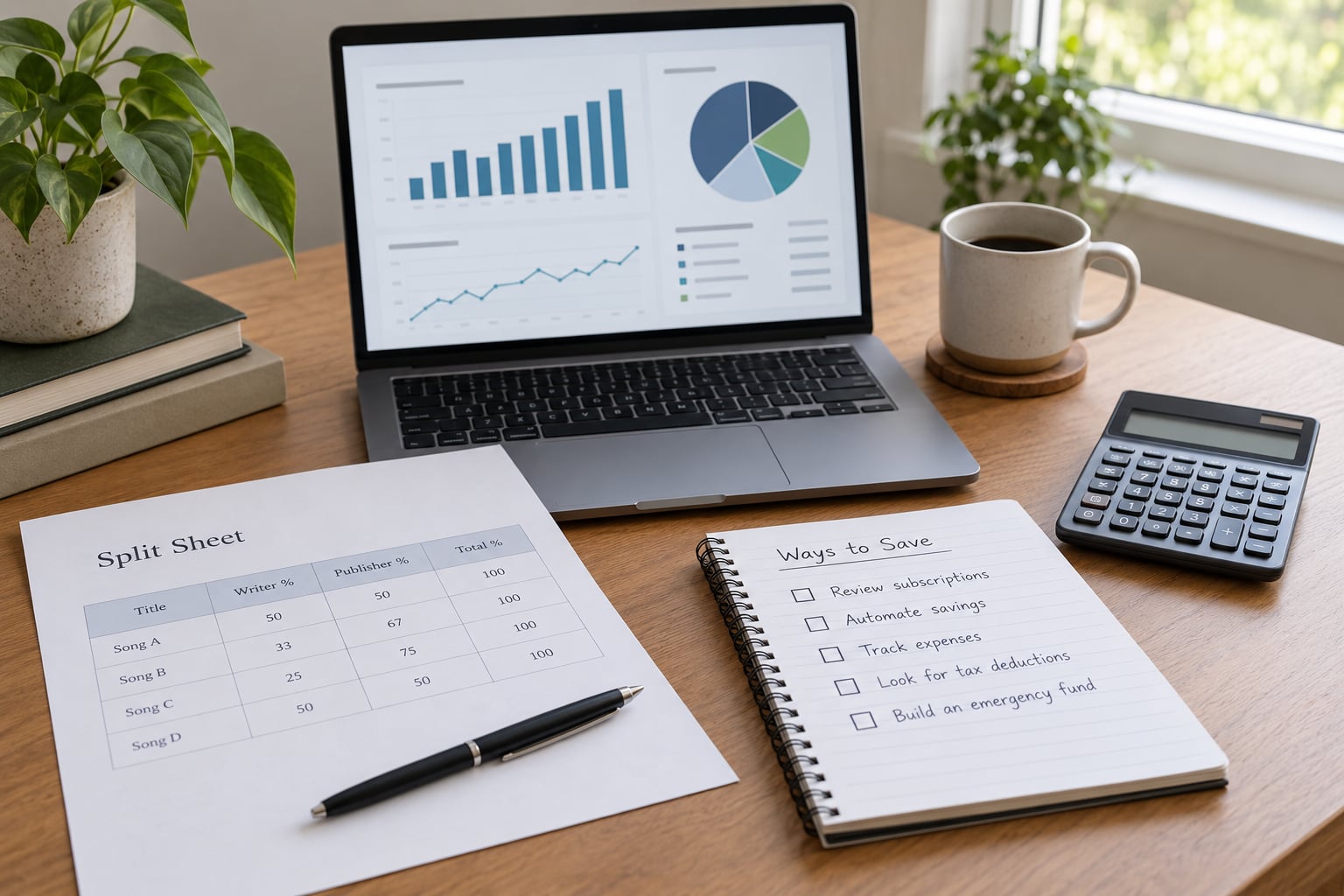
- Verify every split sheet. Get percentages in writing before a release goes out, with the publishing share stated separately from master points. Producers who cannot state their own numbers cannot check their own income.
- Register works correctly, once. Accurate titles, writer credits and identifiers at registration time prevent unmatched royalties that are genuinely hard to recover years later.
- Claim neighbouring rights where you qualify. In much of Europe, producers receive direct remuneration separate from master and publishing royalties.
- Collect publishing even when it feels small. Composition income is the side most producers never register for, and it keeps accruing for the life of the work.
- Negotiate transparent distributor terms. Ask for the exact commission percentage, the payout schedule, the payout threshold and the re-recording fee before you upload anything.
- Keep every statement. Annual and quarterly reports are the only record you have when a figure looks wrong two years later.
- Read the beat sale terms. An exclusive sale or a ghost production deal usually transfers the master and can end your future streaming and publishing income on that track. Forum users describe signing those terms without realising the long-term cost, and it is the most expensive mistake in this article.
- Check unidentified royalties annually. Collection societies publish lists of unmatched works and money, and claims often stay open for years.
Frequently Asked Questions
Do producers get paid for every Spotify stream?
No. A play generally only counts after around 30 seconds of listening, and platforms screen for artificial traffic before crediting it. Spotify also requires roughly 1,000 streams in a rolling period before a track becomes eligible for royalty payouts. After that, each credited stream draws from a shared pool rather than paying a fixed amount, and your share of it depends on your master royalty points.
How do I calculate how much I earn per stream?
Take the net royalties actually paid to you on one statement, divide by the total qualified streams on that same statement, and you have your personal rate. Repeat across three periods and use the average, since playlist spikes distort single months. This figure is always lower than published platform averages because it already reflects your master points, your publishing position and any distributor commission.
Does getting on a Spotify playlist increase royalties?
Not directly. In a pro-rata pool there is no per-play rate to raise, so a playlist works by adding plays, and more plays means a larger slice of the same monthly pool. Editorial placement also helps discovery, which is where the compounding effect comes from. In fan-powered models that route a fixed share of subscription revenue to listeners, placement can change outcomes more directly.
What is the difference between master and backend royalties?
Master royalties come from the sound recording itself and are paid by your distributor or label according to master royalty points. Backend royalties are the publishing share of the composition, collected by your PRO and The MLC from performance and mechanical use. The practical difference is that backend income can keep accruing after master rights are sold, if you retained the composition.
When do streaming producers receive their first royalty payment?
Most distributors pay on a monthly or quarterly schedule with a reporting lag of a few months behind the listening period, and many have a minimum payout threshold you have to clear. PRO, MLC and SoundExchange run their own separate schedules. Your first realistic arrival is usually within three to six months of a release, provided your registrations and payout details were complete from day one.
Conclusion
Streaming earnings depend on rights and contracts, not on one universal rate. A producer with three master points and a twenty percent publishing share on a million streams at average platform rates sees a modest sum, and the same track can pay very differently in different territories and subscription mixes.
So do one thing this week: pull a recent statement, divide your net royalty by your qualified streams, and write that number down. Then confirm your credits and splits, register any missing publishing or digital performance rights, and check that you never signed away the master without keeping the composition.
Once that audit is done, growth in streams is worth chasing, because it multiplies a rate you finally understand instead of one you inherited from a blog post.