Most producers don’t have a talent problem. They have a finishing problem. The blank session feels exciting, so you open a new one. The project you’ve been circling for six weeks needs an EQ pass, a cleaner snare, maybe a whole new bridge, and that is tedious work, so you make a new folder instead. If you want to know how to finish tracks instead of starting new ones, the fix is a system with a finish line, a small active rotation and a stop rule — not more ideas and not more plugins.
One survey of 413 producers, run between December 2025 and March 2026, found 79 percent named finishing their single biggest challenge. The same survey put the gap between intention and output at 7.9 tracks a month intended versus 3.7 actually finished. That 58 percent shortfall is not a talent gap. It’s a workflow gap.
This guide walks through the full process: what to set up before you sit down, the seven steps that take one rough idea to an exported file, the mistakes that stall nearly everyone, and a triage plan for the pile of old projects you already own.
Table of Contents
- What You Need
- Step-by-Step
- 1. Choose One Project and Define the Finish Line
- 2. Set the Reference Track and Target Emotion
- 3. Build the Core Arrangement
- 4. Replace Rough Sounds With Intentional Parts
- 5. How to Finish Tracks Instead of Starting New Ones With a Time Limit
- 6. Mix, Master and Check the Track
- 7. Close the Project and Start the Next Track Deliberately
- Common Mistakes
- Frequently Asked Questions
- Why do I struggle to finish songs?
- What are some tips for finishing songs?
- What is the 3 song rule?
- What is the 80/20 rule in songwriting?
- How do I know when a track is done?
- What should I do with unfinished projects?
- Conclusion
What You Need
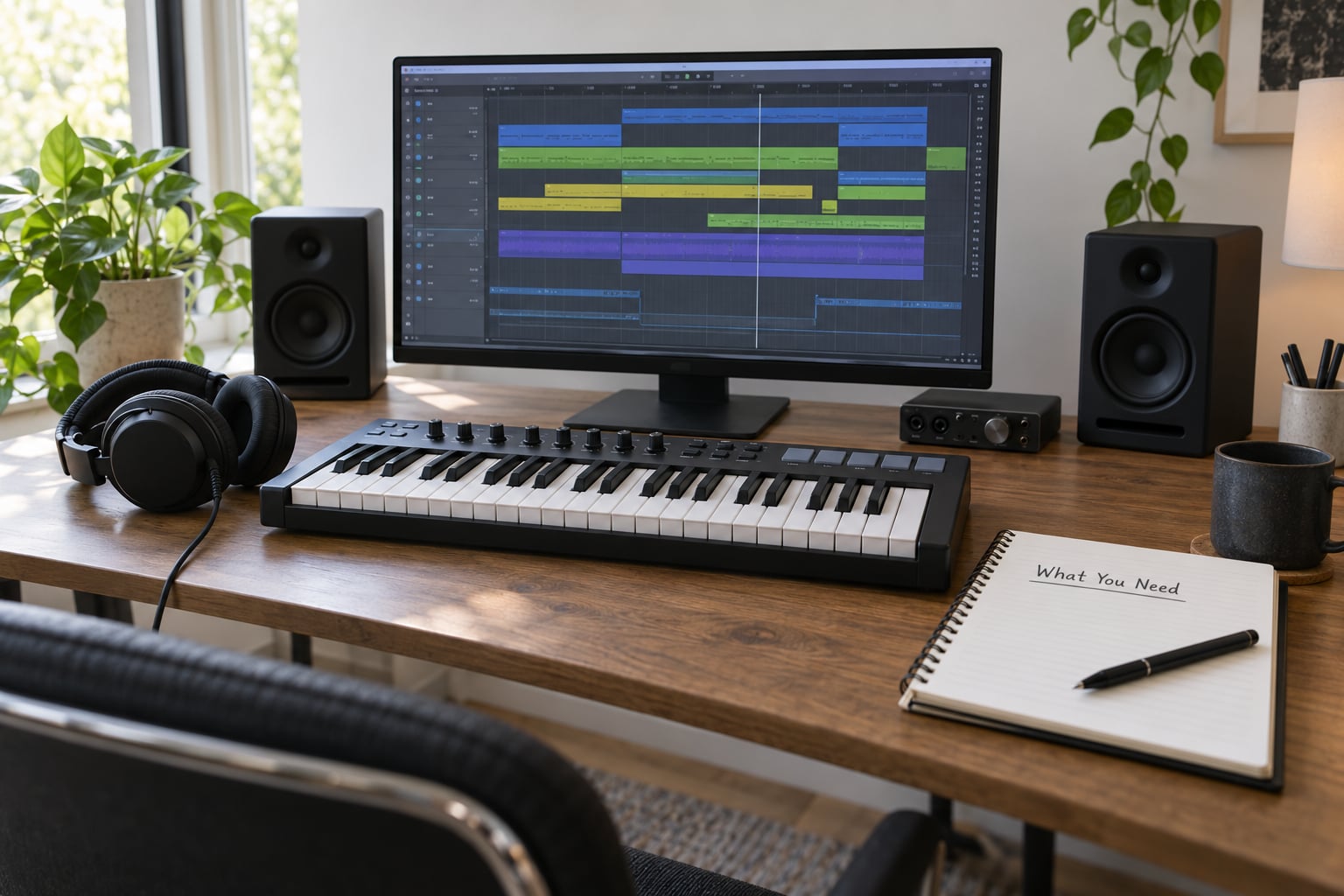
You need almost nothing to start a finishing session, which is exactly why starting keeps winning. Before you open your DAW, put four things in place:
- One selected project. Not the folder, not the newest idea. One project file, opened and loaded before you sit down.
- A reference track. One finished song in the same genre whose energy and structure you’re aiming at.
- A session limit. A real number with a real clock on it. Sixty minutes is enough for most finishing work.
- A definition-of-done checklist. Written down for this project, so “finished” stops being a feeling.
That last item is the one people skip and the one that changes everything. Without a checklist, “done” moves every time you listen. With one, it’s a checkbox you can tick.
Step-by-Step
1. Choose One Project and Define the Finish Line
Open one project and write down what finished means for it. Not “when it sounds good.” Something you can check off.
| Stage | Finished looks like | Time cap |
|---|---|---|
| Sketch | Idea exists as audio or MIDI you can play from the timeline | 1 session |
| Arrangement | Intro, main section, contrast section, outro are all in place | 2 sessions |
| Sound selection | Every part is chosen; no placeholder sounds left | 1 session |
| Mix | Levels, pan, space and mono check done; exports once without clipping | 2 sessions |
| Master and release | Metadata filled, art chosen, file exported and uploaded | 1 session |
If the project is cold — you last opened it four months ago and don’t remember how it was routed — don’t rebuild it. Bounce or freeze the tracks, pull the tempo and key from the session header, and listen start to finish without touching anything. Re-entry, not reconstruction.
Set the deadline at the same time. Pick a real date, write it down, and reverse-engineer from there.
2. Set the Reference Track and Target Emotion
Load one reference track in a second player and keep it running. Then write one sentence describing the target: “tense, driving, night drive, eight minutes.”
That sentence does more work than it looks. When you’re deciding whether to keep a pad or add another layer, the reference and the sentence answer together. Without them, every decision reopens the whole argument.
Producers on the Elektronauts forum push the same idea in a different form: write the chord progression and two distinct parts before you touch percussion. A and B, decided early, means the arrangement has a destination instead of drifting.
3. Build the Core Arrangement
Four blocks is a complete song: intro, main section, contrast section, outro. Most stalled projects have all four possible and none chosen.
The classic trap is the 8-bar loop. A loop is not a song, and polishing one for another week is how projects die. Take the loop, put it under an intro, write a contrasting section with a different rhythm or register, and land it somewhere the track can end.
Community advice on colour-coding your sections in the arranger or timeline comes up constantly in finishing threads, and it’s good advice for a boring reason: a wall of identical grey clips gives you nothing to react to. Sixteen coloured regions read as a song at a glance, and that visual progress is its own reward.
As you go, delete anything that doesn’t serve the sentence you wrote. Not everything good belongs in the arrangement.
4. Replace Rough Sounds With Intentional Parts
Sound hunting is the most convincing form of procrastination. Browsing presets feels like work, costs nothing emotionally, and improves no part of the track.
Fix it with a hard limit: three synths. An ADHD producer writing on the KVR Audio production forum credited most of his turnaround to exactly that constraint, alongside rotating between three songs and never editing while recording. Producers switching to Reaper reported similar gains on the same forum, largely because it’s minimal and keyboard-driven, with less on screen to disappear into.
With three instruments chosen, each part gets a job. Bass holds the low end, one lead carries the melody, one texture fills the space between. When a part has no job, remove it.
The test for each element: mute it, listen, and decide whether the track misses something specific. If you can’t name what goes missing, it goes.
5. How to Finish Tracks Instead of Starting New Ones With a Time Limit
This is where the system either holds or leaks. Set a timer before you start, and give the session one job.
Break the work into 25-minute blocks with one task each: one block for levels, one for the low end, one for effects and space, one for fades and export settings. When a block ends, stop even mid-thought. Momentum from a previous session beats a fresh one almost every time.
Apply the 80/20 rule of done: once a track meets your written checklist, it ships. No exception for “it would sound better with one more pass.” The last ten percent of polish is where projects go to die, and listeners cannot hear it.
Two more rules that help. Work only on the three active projects in your rotation, and never open a new template during a finishing session — not even to test an idea. Park it in a notes file and come back later, when the current track is exported.
If you get bored of a track halfway through, that’s the most common reason projects stall. The fix isn’t a new project. Take a day or two away from it, then come back with the checklist in front of you rather than an open mind.
6. Mix, Master and Check the Track
Mixing and mastering was named as a bottleneck by 12.7 percent of producers in the survey — the second-biggest complaint after perfectionism at 14.5 percent. The reason isn’t skill. It’s that this phase has no visible endpoint.
Give it one. Fixed order, fixed length:
- Levels first. Get every fader roughly right before touching a single plugin.
- Low end. Check kick and bass don’t fight, and that nothing is masking in mono.
- Space. Reverb and delay set, then the mono compatibility check on the master bus.
- Headroom. Watch the output meter. If it’s pinned red, pull it down before mastering.
- Fades and tails. Outro fades, reverb tails, no abrupt cut.
- Export. 24-bit file for release, a reference-matched master at whatever level suits the style you’re aiming at, and metadata filled in before you export.
There’s no universal loudness number that fits every genre. Raise the master until the loudness meter lines up with comparable releases in your style, and check the result on a phone speaker and a decent pair of headphones before you call it finished.
7. Close the Project and Start the Next Track Deliberately
An unfinished session isn’t a project. Before you close the DAW, write down what’s still open — the bridge needs a new kick, the vocal sits too far back — and put it in the track’s notes. That’s what lets you re-enter it in a month instead of starting over.
Then move the folder into your released or archive area. A finished folder you never look at again is worth more than a half-done one that nags at you.
The 3-song rule is the habit that keeps this running: keep exactly three projects in rotation, and when one feels boring, switch to the next one rather than opening a new template. One to write, one to arrange, one to mix.
Finally, deal with the backlog. Go through old folders and apply three rules:
| Verdict | When it applies | What to do |
|---|---|---|
| Revive | You still get a small charge from the idea | Put it in your rotation of three; commit to the checklist |
| Archive | Good idea, wrong moment for you | Store it with a one-line note, revisit once a year |
| Kill | You’ve heard it five times and feel nothing | Move it out of your working drive and stop counting it |
Most of what you’re carrying is in the third row, and that’s fine. The point of triage isn’t to rescue everything. It’s to make the pile stop competing for your attention.
Common Mistakes
Most of these come straight from the survey data, with a fix attached.
| What producers named | The fix |
|---|---|
| Finishing (79 percent) | Definition of done per stage, plus a date on the calendar |
| Project organization (60 percent) | Three folders: to work on, to mix, released |
| Inspiration (48 percent) | Rotate three projects; novelty comes from reworking, not new folders |
| Collaboration (38 percent) | Send one unfinished track to one person each month |
| Perfectionism (14.5 percent) | Ship at 80 percent; the checklist is the arbiter, not your ears |
| Mixing and mastering (12.7 percent) | Fixed-order session with a timer and a single export at the end |
| Sound selection (10.9 percent) | Three synths, no new preset packs during a finishing block |
| File organization (10 percent) | One template, one naming convention, one archive folder |
Beyond the survey: never edit while capturing ideas. Record raw first, walk away, then work on it — that’s the single most repeated piece of advice across finishing threads.
Stop comparing your session to producers whose work took a team and a year. And expect the crash after shipping. It feels like an empty slot, so you fill it with a new project, and the cycle repeats. Plan a short break instead, then open the rotation folder.
If ADHD or ADD makes this harder, the same rules apply with shorter blocks. 15 minutes instead of 25, one task per block, and a written list at the top of the notepad you tick as you go. External deadlines beat internal motivation for most people; a release date someone else knows about is worth more than any amount of willpower.
Frequently Asked Questions
Why do I struggle to finish songs?
Because starting is novelty and finishing is analysis. Opening a fresh session gives immediate reward, while arranging, mixing and mastering ask you to sit with one decision for longer than feels interesting. Perfectionism, self-doubt and preset browsing add to it. Producers surveyed named finishing as their biggest challenge 79 percent of the time, more than any technical skill.
What are some tips for finishing songs?
Write a definition of done for each stage before you start. Keep a rotation of exactly three active projects. Limit yourself to three synths. Time-box every session and give it one task. Never edit while capturing ideas. Ship at 80 percent quality. Triage the old backlog into revive, archive or kill. Put a real release date on the calendar and work backwards from it.
What is the 3 song rule?
Keep exactly three projects in active rotation at any time: one you’re writing, one you’re arranging, one you’re mixing. When the current track gets boring, you switch to the next project rather than opening a new template. It works because new sessions are the most tempting escape from finishing, and the rule removes that escape hatch by giving you something else to do.
What is the 80/20 rule in songwriting?
It means the last 20 percent of polish is where projects die. Once a track meets your written definition of done, you export and release it, even though you think one more EQ move or arrangement variation would improve it. Listeners don’t hear that final 20 percent. Treating the checklist as the finish line, rather than your ears, is what converts a project into a released track.
How do I know when a track is done?
Use a stage checklist instead of a feeling. Sketch means the idea exists as audio or MIDI on the timeline. Arrangement means intro, main section, contrast section and outro are all placed. Mix means levels, pan, space and a mono check are complete and nothing clips. When every stage on your list is ticked, you’re done — whether or not it feels perfect.
What should I do with unfinished projects?
Triage them into three groups. Revive anything that still gives you a spark, and put it in your rotation of three. Archive anything that’s a good idea at the wrong moment, with a one-line note about why. Kill anything you’ve played five times and felt nothing. Most of what you carry belongs in the third group, and moving it out frees attention for what you’d actually make.
Conclusion
Finishing is a skill you build with a system, not a personality trait you’re stuck with. The survey numbers look grim in isolation, but they describe a workflow problem, and workflow problems are fixable this week.
Pick one project tonight. Write its definition of done, set a date, move it into a rotation of three, and block a 60-minute session with one task in it. That’s the whole first move. Everything else — triage, time-boxing, the 80 percent ship rule — follows once one track actually leaves the building.