Most evening sessions do not fail for lack of talent. They fail because setup eats the window, the scope is vague, and nobody ever defined what finished looked like. The fix is a time-boxed routine: pick one outcome, cut setup to zero, work in named blocks, and leave a written next step so the following night starts on beat one. A 45-minute session, three nights a week, produces finished tracks. An open-ended hour produces another folder of song starters.
Knowing how to make music with limited time after work is a process problem, not a gear problem. Nothing here needs better equipment. It needs a decision about how long you have, made before you sit down, and a small amount of preparation done on a good day so the tired evenings stay cheap.
Table of Contents
- What You Need
- Step-by-Step: A Short Session System That Works
- 1. Decide What Counts as Progress Before You Start
- 2. Set Up Your DAW and Workspace Quickly
- 3. Use a 90-Minute Session Structure
- 4. Work in Small, Testable Musical Blocks
- 5. Make Fast Decisions With Limits
- 6. Close the Session Deliberately
- Common Mistakes
- Frequently Asked Questions
- How much time should I spend making music after work?
- Can I finish an electronic music track in short sessions?
- What should I do when I am too tired to be creative?
- Is a laptop and MIDI keyboard enough for making music in limited time?
- How do I stay motivated when progress feels slow?
- Should I work on one track or switch between projects?
- Start With One Focused Session Tonight
What You Need
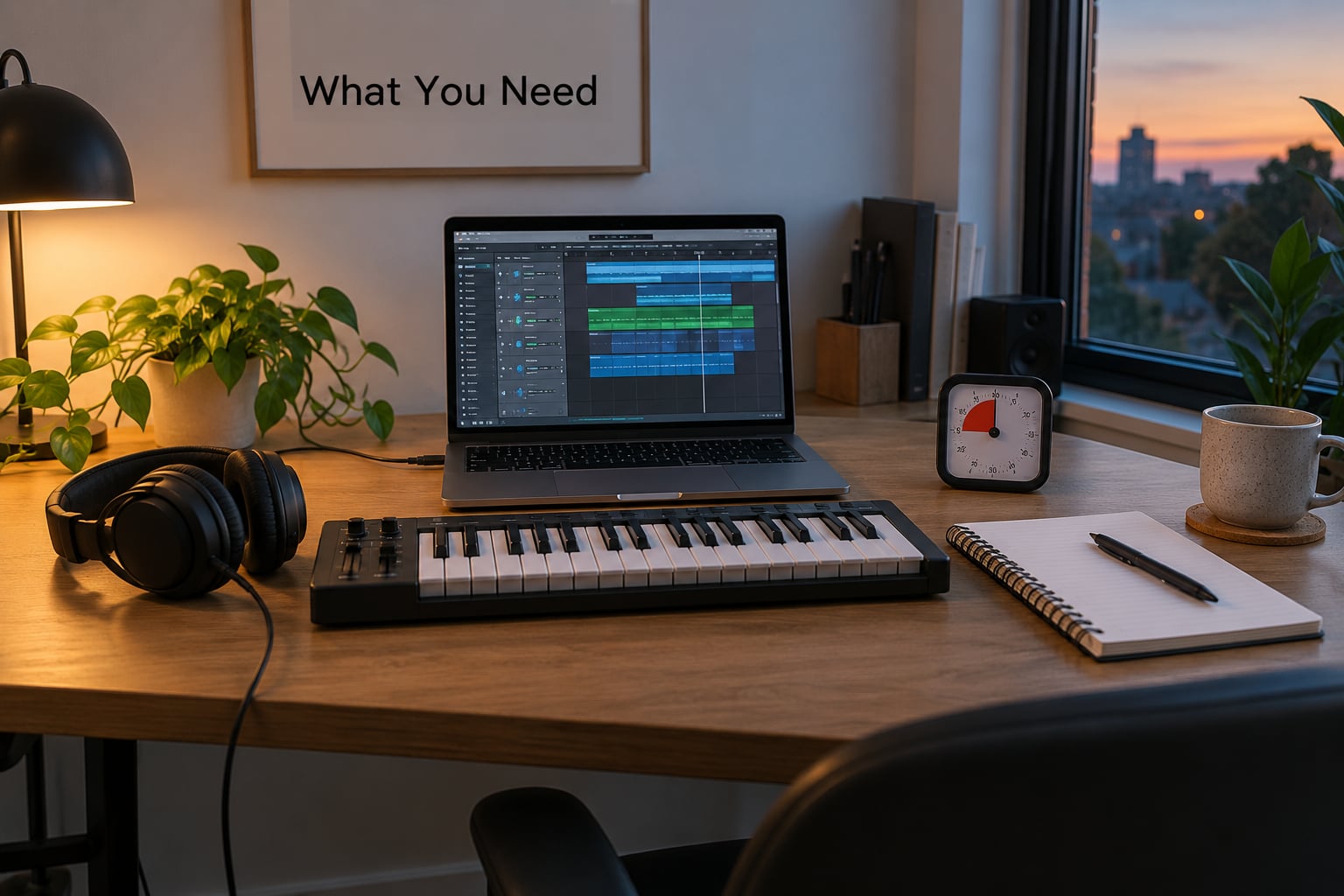
Five things, and only five. Producers who struggle after a day job usually have a decent setup and no process, so the list is short on purpose.
A known time window. Pick the slot you can protect most weeks, not your best possible slot. For most people that is 45 minutes after dinner, three nights a week. For shift workers it is whatever gap the roster leaves, which is often why the framework below has a 10-minute tier.
A template project. One saved file with your session sample rate and bit depth already set, a drum rack loaded, two or three instrument tracks wired, a bus for reference audio, and your go-to effects on send. Every session starts from this file, so the technical decisions are made once instead of nightly.
One reference track. A rough mix of something in the ballpark of what you are making, loaded on the reference bus. Guessing at direction eats 15 minutes on its own; hearing where you are going does not.
A capture habit. Voice memos on the walk home, notes in a phone app, anything. Ideas that arrive at 6 pm and get written down become loops on Tuesday. Ideas that arrive and do not get written down become nothing.
A shutdown note. One line in a text file or notebook: the next action, in plain words. Not a mood, not a plan. A line like tighten the drop on bars 9 to 16, or rewrite the bass pattern, is what makes the next session start on beat one rather than ten minutes of scrolling.
A laptop, a MIDI keyboard and headphones are enough for all of this. Ableton Live, FL Studio, Logic Pro, Reaper and BandLab all handle the workflow described here; the menu paths differ, the discipline does not.
Step-by-Step: A Short Session System That Works
1. Decide What Counts as Progress Before You Start
Write one sentence naming what the session will produce, then stop arguing with yourself about it. A finished eight-bar loop counts. A drum pattern with a velocity pass on it counts. A new arrangement loaded and labelled counts. A finished track does not, and that is the point.
Beginners tend to plan sessions around a track, not a task. A track is too big for 45 minutes, so the goal feels unwinnable and the session drifts into browsing. Plan around the task and the track takes care of itself over several sessions.
This is how to make music with limited time after work in practice: shrink the unit of success until it fits inside the time you actually have.
2. Set Up Your DAW and Workspace Quickly
Budget three minutes and no more. Open the template, save-as with a date in the filename, drag the reference track onto the reference bus, and set monitoring levels so nothing clips.
If the template breaks, fix it tomorrow, not tonight. A slightly imperfect session that happens beats a perfect template that gets rebuilt every week. Notifications off, phone in another room, one window of the reference track, and you are working.
Keep one thing out of the session entirely: sorting. New samples, new presets, reorganising folders. Those feel productive and they produce nothing you can hear. If you want to browse, do it during the first five minutes with a timer running.
3. Use a 90-Minute Session Structure
Here is the shape that works for a standard evening, scaled to whatever you have. Long sessions spread out, short sessions skip phases rather than compressing all of them.
Minutes 1 to 3, open. Read the shutdown note from last time. Write the one-sentence outcome for tonight. Open the template. No browsing, no new project.
Minutes 4 to 10, warm-up task. Something with an obvious end. Chop a sample, redraw the kick pattern, audition three patches and pick one. This gets your hands moving and clears the fog from a tired day.
Minutes 11 to 60, the main block. One task, uninterrupted. This is where new ideas, arrangement and sound design happen. If your attention drops at minute 40, take the break on schedule rather than pushing into the shape of the hour.
Minutes 61 to 75, decisions. Editing, levels, fades, arrangement moves. This is fiddly work, and doing it while you are still alert means you make fewer, better calls.
Minutes 76 to 90, close. Save, render a rough bounce if the session got far enough, write the shutdown note, close everything. Ending on a clean save point is what makes the next session cheap to start.
With 45 minutes, keep the open, cut the warm-up to two minutes, run the main block, and do a four-minute close. With 10 minutes, the whole session is the open, one small edit, and the shutdown note.
4. Work in Small, Testable Musical Blocks
Break the track into pieces you can audition on their own. Eight bars is a good default. A loop you can mute, a section you can loop, a single sound pass you can render out and judge.
Momentum in a short session comes from completing things, not from starting them. Three finished eight-bar ideas beat one ambitious intro that never gets past the filter sweep. When the session ends, you can hear what you did, and hearing it is what makes you want to come back.
Arranging eight bars at a time also makes sessions portable. If one night goes sideways, you have pieces that can live in a different project later instead of dying inside a folder you will not open again.
5. Make Fast Decisions With Limits
Every choice you defer is a choice you pay for twice. Set a ceiling before you start: ten minutes to pick a sound, five minutes to fix a transition, one pass on a mix level.
When the timer goes, take the option you have and move on. Second-guessing is the single biggest time sink in short sessions, and it feels like careful work while it is actually delay. Version 9 of a mix you are still polishing is almost never better than version 4 you finished and exported.
Keep a rule for the whole project: rough mix in the session, proper mixing in a longer block on a weekend when your ears are fresh. A rough mix is for arrangement decisions, not for judging yourself.
6. Close the Session Deliberately
Five minutes, every time. Save the project, and if the session produced anything usable, render a rough bounce so you have an audio file outside the DAW. Name the file consistently; dates work well.
Then write the shutdown note. One sentence, a specific action, written in the imperative. Add a second line about anything that confused you, so the next session starts with that already answered.
This routine is the part people skip, and it is the part that decides whether you have a body of finished work in a year or a graveyard of near-misses. It also takes some pressure off, because you are not asking a tired version of yourself to remember what you were thinking. The note remembers for you.
Common Mistakes
Starting from an empty project. A blank session with no plan is why a 45-minute window produces 20 minutes of sound selection. Fix: one in-progress project, opened by default, named for the task. New ideas get voice memos, not new folders.
Treating sample hunting as session work. Browsing a large library feels productive. In ten minutes you will audition forty sounds and keep none. Fix: choose three candidate folders before you sit down, and allow browsing only inside the timed warm-up window.
Switching between detail and big picture. Editing a hi-hat and rearranging a chorus use opposite kinds of attention. Switching costs you several minutes each time. Fix: one task type per session, decided in advance.
Skipping breaks in long sessions. Two hours without a pause is two hours of increasingly bad decisions, and the bad ones are the ones you keep. Fix: break at the end of the main block, five minutes, away from the desk.
Judging the work before it exists. Evaluating a rough mix against a commercial reference is comparing your Tuesday to someone’s finished Friday. Fix: decide in advance that rough mixes are not for review, and that week-ending playback is a habit, not a verdict.
Two more worth naming. Track count is a vanity metric; a folder of 60 half-built projects reads as failure, while 10 finished tracks reads as a body of work. And the one-track rule matters: hobby producers who juggle five projects at once make no progress on any of them, because the switching cost is paid five times.
Frequently Asked Questions
How much time should I spend making music after work?
Most people do best with three to four sessions a week, 45 to 90 minutes each, and that is more sustainable than one long weekend block. A 10-minute minimum session on a bad day beats a skipped night, because the habit matters more than any single session. Protect the slot you can keep on your worst week, not the one that looks best on paper.
Can I finish an electronic music track in short sessions?
Yes, but only if you define finishing narrowly from the start. A finished track can be short, based on one strong idea, and mixed to a modest standard. Plan the arrangement in eight-bar blocks so each session ends with a piece you can hear. Producers who finish small tracks in evenings report the backlog shrinking, which is the opposite of what happens without a time box.
What should I do when I am too tired to be creative?
Do not aim for creative work. Switch to technical or administrative tasks that need no taste: file naming, exporting stems, cleaning up a sample folder, backing up projects, or writing the shutdown note for tomorrow. A ten-minute session of housekeeping keeps the habit alive on the nights when you have nothing left, and it removes friction from the next good evening.
Is a laptop and MIDI keyboard enough for making music in limited time?
For everything in this guide, yes. A laptop, a MIDI keyboard and headphones cover writing, arrangement and rough mixing, and the constraint is rarely the gear. Most after-work sessions are lost to setup and indecision, not missing hardware. Spend the effort on a template project and a fixed session structure first; buy anything else only after three months of consistent work.
How do I stay motivated when progress feels slow?
Count finished things, not hours. Keep a list of released or exported tracks and add a line whenever you finish one, even a short one. Hours logged feels like effort; a growing list of finished work is the actual evidence. Also lower the bar on purpose by working in eight-bar blocks, so you complete something small most sessions and the slow weeks are still productive.
Should I work on one track or switch between projects?
Work on one. Juggling several projects multiplies switching costs and leaves every one of them unfinished, which is how the folder of song starters gets built. Keep unfinished ideas as voice memos or a single ideas list, and pull from that list when the current track is finished. If a track stalls for more than two or three sessions, park it deliberately rather than drifting.
Start With One Focused Session Tonight
Do not rebuild anything this week. Open your DAW, save one template project, and write a single sentence on a sticky note describing what the next 45 minutes will produce. Put a timer next to the keyboard, work only on that one thing, and end by writing the next action in a text file.
That is the whole method behind how to make music with limited time after work, and it works on a laptop in a shared room. Repeat it three times, and you will have a finished track by the end of the month instead of another folder of ideas.