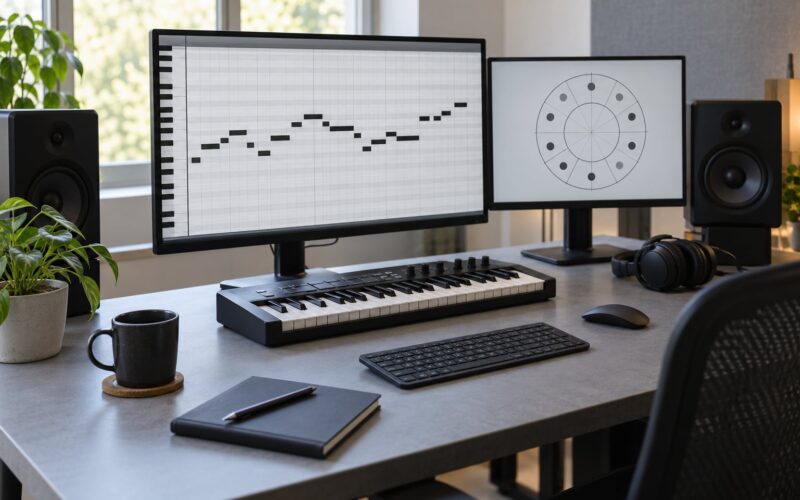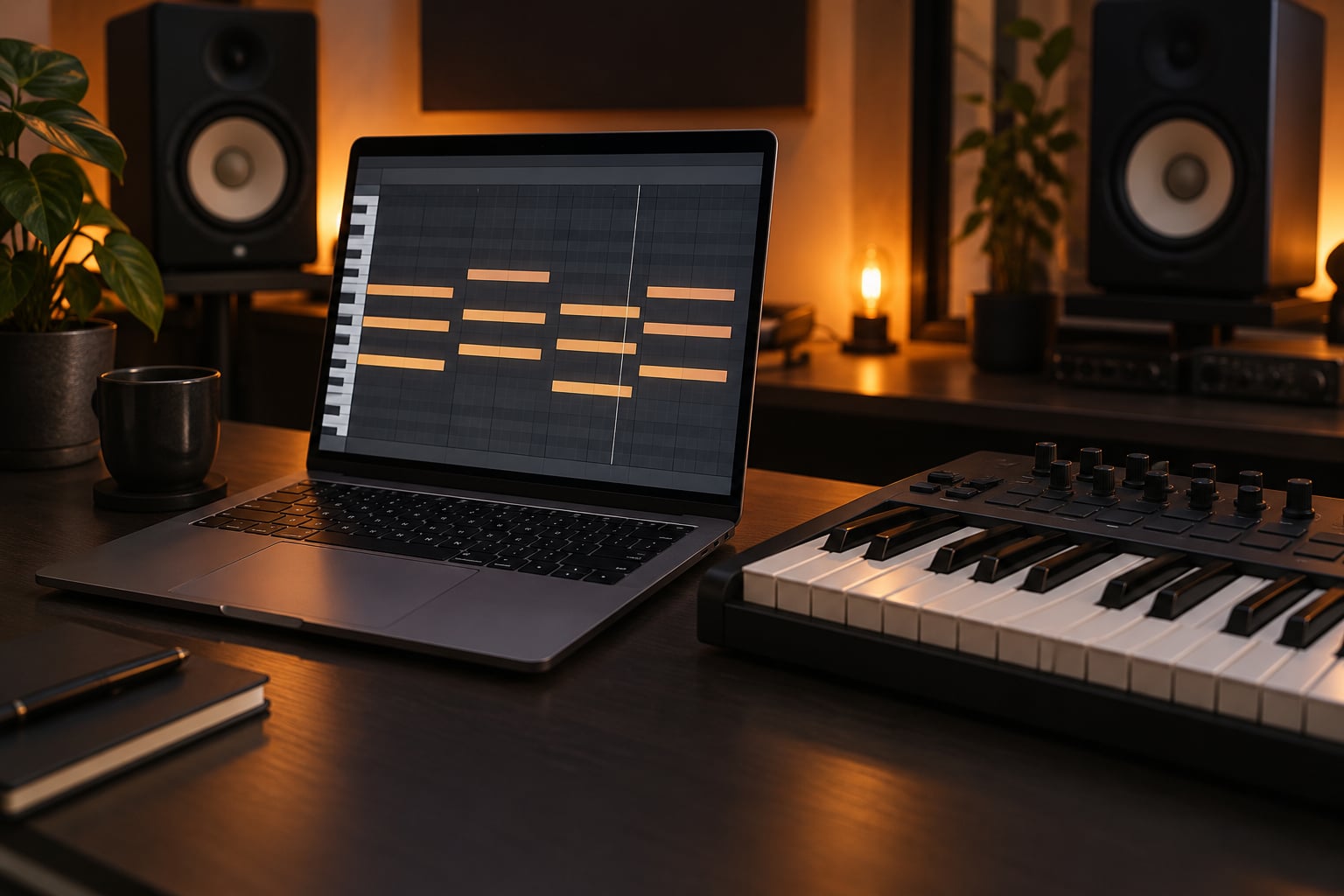
To add tension with suspended chords, take one stable chord in your progression, remove its third note, and put either the second (sus2) or the fourth (sus4) in its place. The root stays put, so the harmony keeps moving forward while the colour turns open and unresolved. Once the third comes back, the release lands harder than a plain major or minor would. It takes about ten minutes per section in a typical session.
Most producers meet suspension in guitar songs and never use it in a DAW. That is a waste, because a suspended chord is really just a voicing change — the same notes with one swapped, and no new instrument required.
Table of Contents
- What You Need
- Step-by-Step: How to Add Tension with Suspended Chords
- 1. Choose the moment that needs more tension
- 2. Borrow a stable chord and suspend one note
- 3. Keep the voicing open and controlled
- 4. Add rhythmic repetition or delayed entrances
- 5. Automate tension without overdoing it
- 6. Resolve the suspended sound deliberately
- Common Mistakes
- Frequently Asked Questions
- What is the difference between a sus2 and a sus4 chord?
- Can I add suspended chords to an existing EDM progression?
- Do suspended chords always need to resolve to a major chord?
- Will a suspended chord work in a minor-key track?
- How do I add suspended chords without making the mix muddy?
- When should a suspended chord resolve before a drop?
- Conclusion
What You Need

Four things, and you probably already own all of them. First, a progression you are happy with, ideally four chords. Second, one sustained or repeating sound to suspend — a pad, a plucked sequence, a stab on an offbeat. Third, some way to shape it over time, usually a filter. Fourth, a reverb send you can throw into at the right bar.
The technique is DAW-neutral. Where I name a menu below, it is because that is where I personally do it: clip envelopes in Ableton Live 12, automation clips in FL Studio. The idea transfers to Logic or Reaper even though the click path differs.
Step-by-Step: How to Add Tension with Suspended Chords
1. Choose the moment that needs more tension
Suspension works best where the track is already repeating. A four-bar build, a held vocal phrase, the eight bars before a drop, the turnaround between two sections. In each of those spots the harmony has stopped saying anything new, and a colour change reads as a lift.
Pick one spot. Not the whole track. The most common mistake is suspending every chord at once, which flattens the contrast the technique is supposed to create.
2. Borrow a stable chord and suspend one note
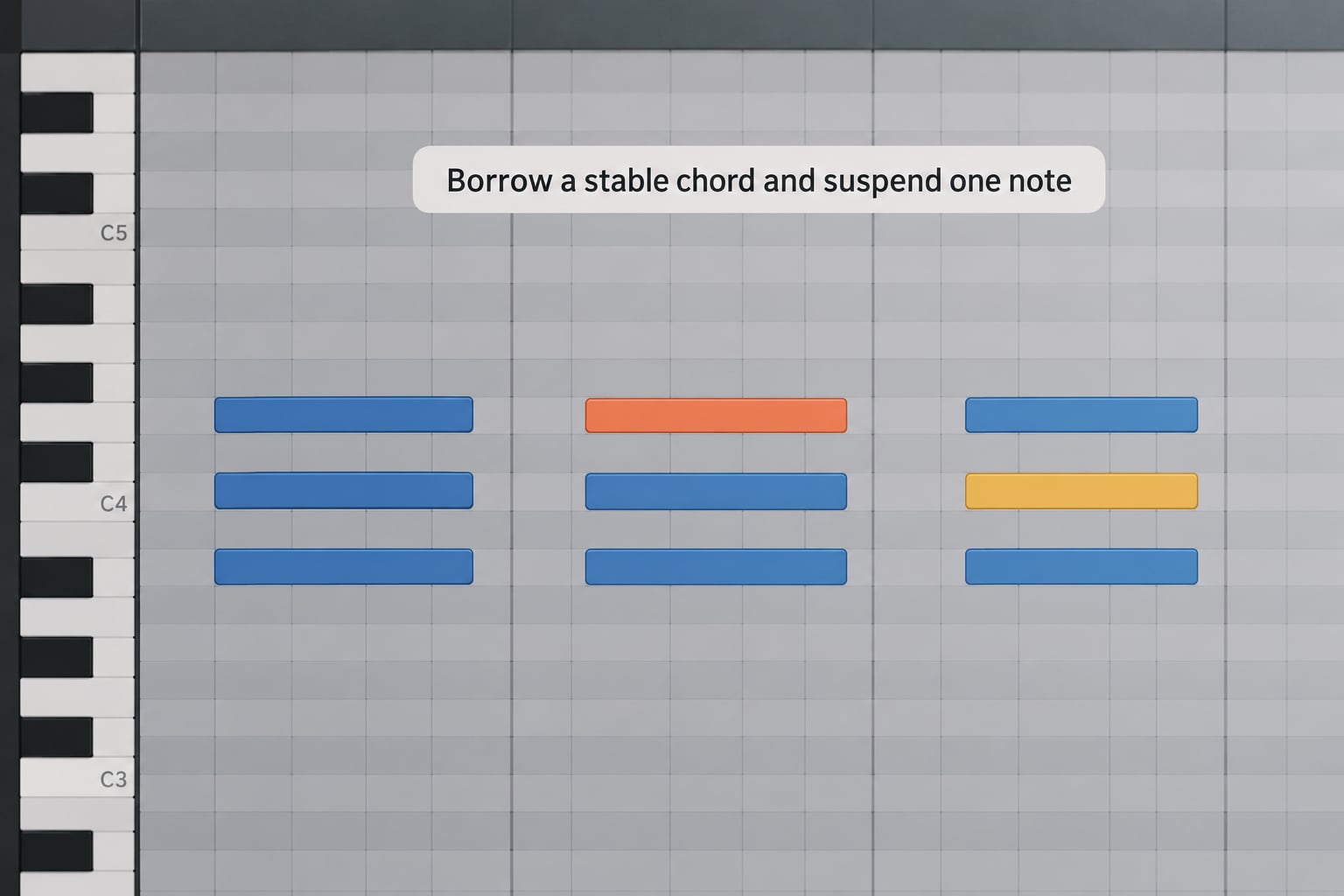
Find the third of the chord. A major triad is root, third, fifth; a minor triad is the same with a lower third. Delete that third and you have a chord that cannot declare major or minor, which is the whole point.
Now add either the second above the root for a sus2, or the perfect fourth above the root for a sus4. A C major triad is C, E, G. The third is E. Remove E and you are left with C and G. Drop a D in and it is Csus2 (C, D, G); drop an F in and it is Csus4 (C, F, G).
Six swaps worth memorising, covering most progressions you will write in this style:
- Csus2 (C D G) — take C major (C E G), remove the E, add a D. Bright and floating.
- Csus4 (C F G) — take C major, remove the E, add an F. Heavy and yearning.
- Asus2 (A B E) — take A minor (A C E), remove the C, add a B. Wistful and open.
- Asus4 (A D E) — take A minor, remove the C, add a D. Drifting and unresolved.
- Fsus2 (F G C) — take F major (F A C), remove the A, add a G. Soft and airy.
- Gsus4 (G C D) — take G major (G B D), remove the B, add a C. A hopeful lift, the standard turnaround chord in a lot of pop and EDM progressions.
The semitone mechanics matter more than the label. In a sus4, the fourth sits a half step above the major third, so it is magnetically pulled down into it. In a sus2, the second sits a whole step below the minor third, so it more often rises into place. That is why sus4 wants a firm landing and sus2 can hover.
3. Keep the voicing open and controlled
A close voicing stacks the notes in one octave; an open voicing spreads them. For a sus chord, open wins. Put the root in the low hand around C3 to G3, the fifth in the middle, and the suspended note up around C4 to F4. The gap is what makes it sound like air instead of a chord.
Watch two things. If the suspended note lands near another chord tone in the same register, those voices beat against each other and the chord turns sour — either move one an octave or cut one with a filter. And if the root sits below roughly 80 Hz alongside your sub, drop the root out of the suspended voicing entirely and let the bass carry it. The tension survives; the mud does not.
4. Add rhythmic repetition or delayed entrances
A single sustained sus chord is a colour. A sus chord repeated is tension. Play it as eighth notes, or as syncopated stabs that leave gaps, and the ear starts waiting for the resolution instead of just hearing an ambiguous harmony.
Across a build, raise the density in stages. Eighths in bar one, sixteenths in bar two, a roll in bar three, then a short gap right before the drop. That gap is where the anticipation actually peaks. Echoes and delayed re-entries work too, provided the delay sits on a subdivision that feels like part of the groove rather than an echo pasted on top.
5. Automate tension without overdoing it
Automation is what separates a good use of suspension from a gimmick. Open the filter across the build so the suspended note gets brighter and more exposed as the section climbs. Ride the volume up into the last two bars, then duck it at the drop so the release has somewhere to go.
A short reverb throw on the final suspended chord before the drop is the single most effective trick in this whole guide. In Ableton Live 12 that is a send automation on the track’s reverb return; in FL Studio it is the same idea drawn as an automation clip. Pitch drift of a few cents upward, or a slow LFO on the filter, adds unease without changing the notes at all. Keep every change gradual — a sudden jump reads as a mistake rather than a decision.
6. Resolve the suspended sound deliberately
A direct resolution — Gsus4 landing hard on G major — is the most obvious payoff, and it works in a pre-chorus. A delayed resolution, where the third sneaks in two beats late or on the next downbeat, feels more human and less formal. A false resolution, where the suspended chord slides to a different root entirely, is the strongest option when the section needs to go somewhere unexpected.
Leaving it unresolved is legitimate too. In a minor-key breakdown or an ambient outro, holding Dsus4 with no third for eight bars keeps the track suspended in the same way the mix is. The rule is not always resolve. The rule is that the listener should feel you meant it either way.
Common Mistakes
Muddy low end. Two sources fighting under the same note. Fix: move the root an octave up, or remove the root from the suspended voicing and let the sub bass hold it.
Weak tension. Usually too short, or buried. A suspension that resolves after one beat barely registers. Hold it for a full phrase, then resolve on a strong downbeat so the landing is unmistakable.
Abrupt transitions. If the sus chord arrives on an offbeat with nothing leading into it, the change reads as an error. Start the suspension early in the bar or let the previous chord ring underneath it.
Suspending everything. When every chord in the progression is suspended, the progression stops moving and the track sounds unresolved rather than tense. Suspend one chord per section, ideally the first or the last.
Wrong spelling. Keeping the third somewhere else in the voicing turns your sus chord into an add chord. Csus4 is C, F, G — adding an E to that makes it a Csus4(add9) colour at best, and mud at worst. Take the third out properly.
Changing the track’s identity. A sus4 lifted from a folk progression can drag a heavy drop track into a completely different world. Check the mood before you commit: if the section should feel unsettled, the suspension helps; if it should feel heavy, use sus2 or a smaller colour change instead.
Frequently Asked Questions
What is the difference between a sus2 and a sus4 chord?
A sus2 replaces the third of a chord with the second above the root, so C major (C E G) becomes Csus2 (C D G). A sus4 replaces it with the perfect fourth, giving Csus4 (C F G). The sus4 sits a semitone above the major third and pulls hard downward into it, so it feels dramatic and yearning. The sus2 sits a whole step below the third and often rises or hovers, which reads as brighter and more open.
Can I add suspended chords to an existing EDM progression?
Yes, and it is the quickest way to improve a progression that feels static. Take one chord, remove its third, and add the second or fourth above the root. C, G, Am, F becomes Csus2, G, Am, Fsus2 with no change to the bassline. Start in a build or a pre-chorus where the harmony is repeating, and leave the drop section alone so the contrast still lands.
Do suspended chords always need to resolve to a major chord?
No. A sus chord resolves most naturally to the chord it came from, which may be major or minor, and leaving it unresolved is a valid choice in ambient, lo-fi and EDM writing. A sus4 over a minor root often resolves to the minor third instead. What matters is that the movement is deliberate: if the section should feel finished, resolve; if it should float, hold the third back.
Will a suspended chord work in a minor-key track?
It is one of the best tools for minor keys. Asus2 (A B E) and Asus4 (A D E) sit over a minor tonic and keep the sadness while adding a lifted, unsettled quality. Because the suspended note replaces the minor third, listeners briefly hear an A major chord, which is brighter than the surrounding harmony. That momentary major colour is a familiar emotional lift in breakdowns and pre-choruses.
How do I add suspended chords without making the mix muddy?
Keep the low hand clean and put the suspended note where there is space. Keep chord tones roughly an octave apart rather than seconds, cut or raise any sustained note within an octave of another, and stay above about 80 Hz for the chord itself so your sub bass owns the bottom. If a chord tone still clashes, filter one of the two rather than lowering both.
When should a suspended chord resolve before a drop?
Resolve late, not early. Hold the suspension for most of the build, then put the third back on the downbeat of the drop itself, or on the last hit of the build, so the release arrives with the kick. A common build is a suspended chord on bar one of a four-bar phrase, three bars of repetition, then a short reverb throw and the resolution in the final beat.
Conclusion
Open a build you already like, pick the first or last chord of the phrase, and swap its third for the second or fourth. Keep the root in the same place, spread the voicing by an octave or more, and hold the suspended version for a full phrase before the third returns. Repeat the trick a second time in a different section, and the track gets its motion back.