Short answer: do you need acoustic panels to mix well? Yes, if you mix on studio monitors in a hard, reflective room, but not for the reason most people think. Acoustic panels control reflections inside the room so your monitors can tell you the truth about your mix. They do not keep sound out, they cannot fix a badly positioned desk, and they will not rescue cheap monitors.
That distinction matters, because most producers who regret their treatment money bought the wrong thing for the wrong problem. Foam on the wall while the monitors sat two feet apart, a rug that hides nothing, corner traps sized for a live room. So before anything else: here is what panels actually do, how to test whether your room needs them, and what to fix first if it does.
Table of Contents
- Do You Need Acoustic Panels to Mix Well?
- What Do Acoustic Panels Actually Fix?
- Reflections and the smeared stereo image
- Flutter echo and standing waves
- What broadband fabric panels cannot reach
- Do You Need Them in a Bedroom or Semi-Pro Studio?
- How Many Panels Do You Need?
- Where Should You Put Acoustic Panels?
- Can You Tell Whether Your Room Needs Treatment?
- Do Acoustic Panels Make Your Monitors Sound Better?
- Acoustic treatment vs soundproofing
- When You Can Skip Panels for Now
- What to Do First
- Frequently Asked Questions
- Do you need acoustic panels to mix well if you mix on headphones?
- What can I use instead of acoustic panels?
- How many acoustic panels are needed?
- Will adding acoustic panels keep sound out?
- Do acoustic foam panels work for bass?
- What are the disadvantages of acoustic wall panels?
- The Honest Verdict
Do You Need Acoustic Panels to Mix Well?
You need acoustic treatment if your room has hard parallel surfaces, a bare ceiling, and you judge mixes on speakers. You do not need it if you mix entirely on headphones, or if the room is already soft, small and furnished. Panels are one fix among four, and the other three are cheaper.
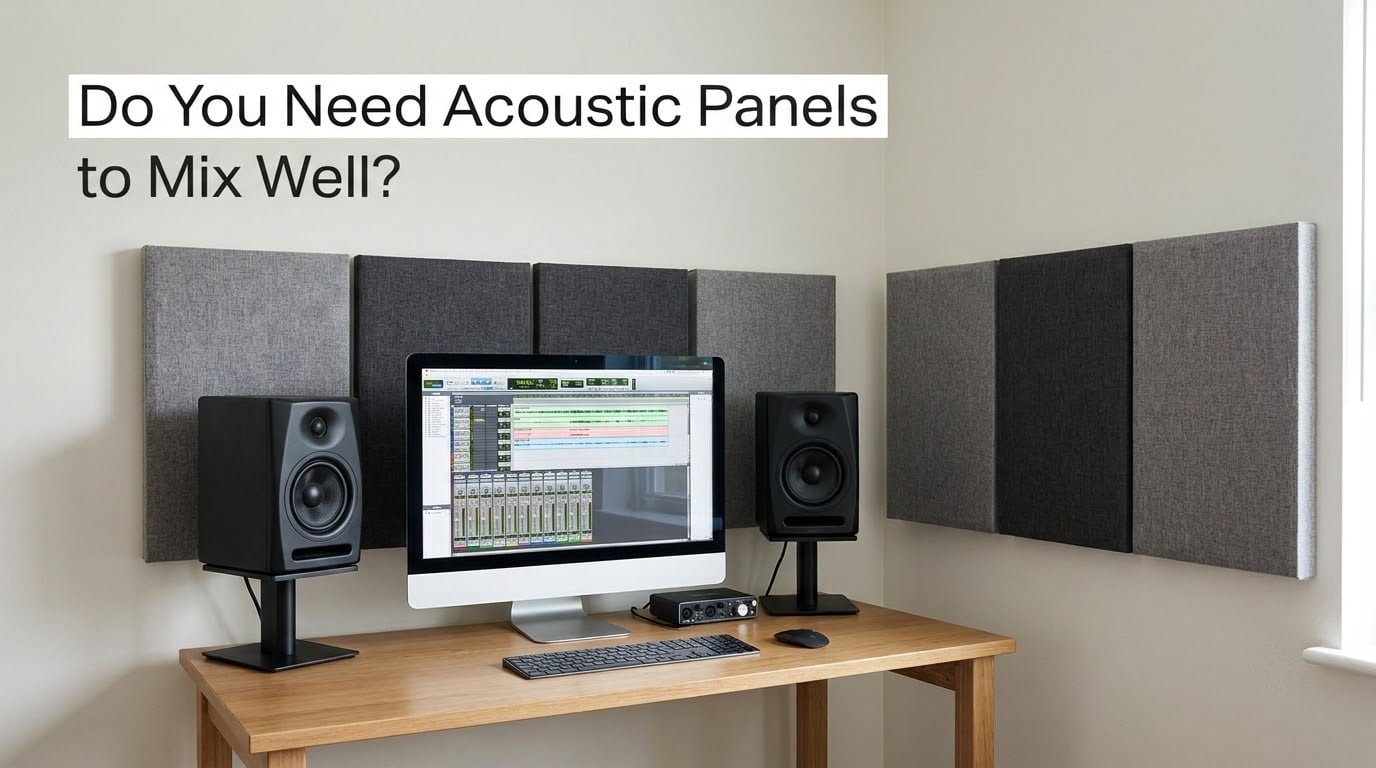
- They fix: early reflections off side walls and ceiling, flutter echo between parallel hard surfaces, and some of the smear those reflections add to your stereo image.
- They do not fix: sound leaking to neighbours, a low-frequency null you sit inside, monitor placement mistakes, or a mix that only sounds good in your room for reasons that have nothing to do with acoustics.
- You can skip them when: you mix on headphones only, the room is carpeted and draped, or you are between projects and not mastering anything.
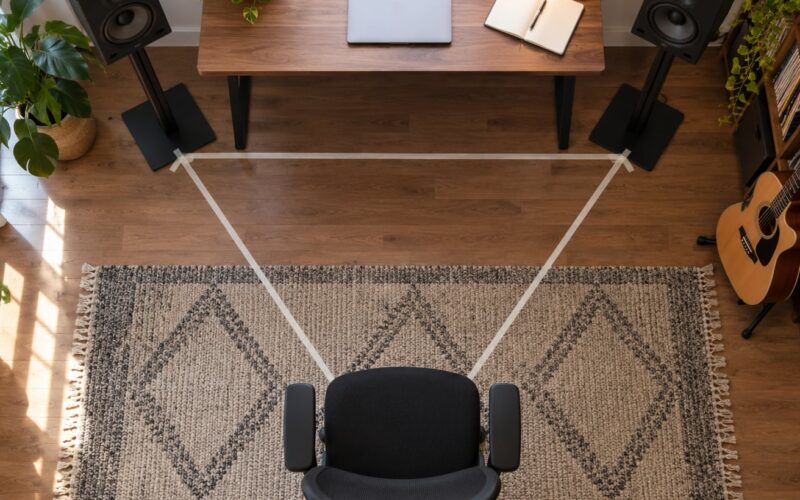
- Usually do this first: move the monitors to an equilateral triangle, pull them off the wall, set the listening chair correctly, then measure. Placement is free and most rooms need it more than panels.
The gear-first instinct is strong and it is expensive. On r/mixingmastering the recurring line is that panels beat another monitor upgrade, and on GearSpace the advice is that mixes will not translate until the room is handled. Both are right about untreated rooms and both ignore the producer mixing on open-back headphones in a rented flat, where no panel is going to be mounted.
What Do Acoustic Panels Actually Fix?
Your monitors do not send sound straight at you. They send it everywhere, and the room adds it back. That room-added copy arrives within about 30 milliseconds and smears the attack of everything, which is why an untreated room makes hi-hats sound sibilant and reverb tails sound shorter than they are.
Reflections and the smeared stereo image
Early reflections off the side walls arrive at your ears a few milliseconds after the direct sound, slightly different at each ear. Your brain partly fuses them into the direct sound, which changes the apparent level and blur. Before treatment, a snare in a hard room often gets a short slap that makes it sound thin or slightly detached; after treatment at the first reflection points, that artefact mostly disappears and the transient reads as one clean hit.
Flutter echo and standing waves
Two bare walls facing each other produce flutter echo, a rapid series of echoes between them that makes tones and reverb tails warble. Low frequencies behave differently: they form standing waves, or room modes, with peaks and nulls fixed in place. SoundGuys frames the untreated case as more than 30 dB of variation between peaks and dips, and another competitor guide puts the small-room figure at 15 to 20 dB below 300 Hz. Both numbers describe the same thing: a null can cancel a bass note completely at your seat.
What broadband fabric panels cannot reach
A 4-inch fabric-wrapped absorber mounted with an air gap behaves differently at different frequencies. It is excellent from roughly 500 Hz upward and reaches into the low hundreds with a thick mineral wool fill, which is why GearSpace veterans warn that a panel absorbing down to about 500 Hz in a small room will leave it boomy. What it will not do is remove a modal null, hold a bass guitar note, or stop 60 Hz energy.
That last one is why corner bass traps are not optional extras. Low frequencies pool where two walls meet the floor and ceiling, and only thick, dense, air-gapped traps in those corners move the needle there. Panels are a midrange-to-high tool; bass traps are the low-frequency tool.
Do You Need Them in a Bedroom or Semi-Pro Studio?
Room type predicts the answer better than room size. A small carpeted bedroom full of soft furniture is a much easier room to mix in than a large bare one, no matter which volume is technically worse for modes. Read your own situation against these.
Hard walls, bare ceiling, monitors close together. Treatment first. This is the classic untreated setup and every problem shows up at once.
Bedroom with a carpet, a bed and curtains. Softer than it sounds. Test it first; you may only need one pair of panels at the first reflection points and a bass trap in the worst corner.
Two bare parallel walls. One of them needs breaking up. Panels on the first reflection points, or a bookshelf or heavy curtain covering part of that wall, both work.
Desk pushed into a corner or against one wall. Repositioning costs nothing and often solves more than four panels would. Fix that before you measure anything.
Rental you cannot drill into. Freestanding panels on stands, a heavy duvet over a movable frame, stacked books, and isolation pads still move the needle. So do open-back headphones and a mono check.
Headphones only. Panels buy you very little. Room treatment helps the loudspeaker path; headphone mixing bypasses it entirely.
Why do some professional studios look untreated? Because they are. Big rooms use concealed bass traps in the wall cavities, a live-end dead-end layout and iso booths, and the visible walls stay bare on purpose. Panels hanging in an untreated room are the visible part of a hidden system, not the whole system.
How Many Panels Do You Need?
There is no single number, because coverage depends on how reflective your surfaces already are. Two formulas get quoted and both are useful when read carefully: room volume multiplied by 3 to 6 percent gives the square footage of absorber to aim for, and 15 to 25 percent of wall surface area is the other common rule of thumb. Higher coverage suits critical listening; lower coverage suits tracking. Placement beats count almost every time.
| Room situation | Priority | Sensible starting coverage | What you should expect |
|---|---|---|---|
| Hard room, close monitors | First reflection points, then corners | Two 2 by 4 panels plus one corner trap | Transient clarity improves noticeably, low end barely moves |
| Bare ceiling above the mix position | Ceiling cloud | One 2 by 6 panel between monitors and seat | Smearing on vocals and cymbals reduces |
| Uneven bass, notes disappearing at the seat | Corner bass traps | Four traps, 6 inches thick, air-gapped | Low end steadies; a true null may only improve |
| Parallel bare walls, flutter echo | Break up one surface | Two panels plus a bookshelf or curtain | Warble in tones and tails goes away |
| Rear wall reflecting at your ears | Rear wall absorber | One wide panel behind the seat | Depth cueing becomes more reliable |
| Soft furnished bedroom | Test first, treat selectively | One or two panels at most | Small gain; over-treatment flattens the room |
One practical note on sizing: thickness matters more than panel count. A 2-inch panel with a 50 to 100 mm air gap behind it works far better than two 2-inch panels stacked on the same spot, because the air gap is what lets low frequencies enter the material instead of bouncing off its face. Use mechanical fasteners rather than construction adhesive for anything heavy, and check the fixings can carry the weight of a filled trap.
Where Should You Put Acoustic Panels?
The mirror trick is the most useful five minutes in room treatment. Sit in your listening chair with the monitors playing, and have someone hold a mirror flat on the side wall between you and one speaker. Wherever you see the speaker reflected is a first reflection point. Put a panel there, then repeat on the other side and for the ceiling.
First reflection points come first because they are the ones you hear directly and twice, and because every extra reflection after those is quieter and less harmful. Getting them right does more for mix translation than a wall of panels elsewhere.
Then work outward. Bass traps go in all four corners, vertically, filling as much of the corner depth as you can manage, which is why triangular corner traps underperform tall rectangular ones. A ceiling cloud sits between the monitors and your head at ear height, or just above it. The rear wall gets a wide absorber or a diffuser behind your chair. The front wall behind the monitors only matters if it is close enough to add its reflection, which is another reason to pull speakers forward onto stands or pads.
Set the listening position before you treat, not after. Roughly 38 percent of the length of the room from the front wall is a common starting point for the sweet spot between the speakers and the rear wall, and it sits you between the worst of the axial modes rather than on top of one. Move your chair first, note how the bass changes, then decide whether you still need traps.
Can You Tell Whether Your Room Needs Treatment?
You can get a useful answer tonight without spending money. Run these in order.
1. Clap test. Stand in different spots and clap once. A dead, dull clap means absorption; a bright, rattling or echoing clap means reflection and flutter problems.
2. Seat-to-seat comparison. Play a bass line at a fixed level, then move your chair forward and back in small steps. If the bass level swings wildly between two positions, you are moving through a mode and treatment will help. If it barely changes, low-frequency problems are not your main issue.
3. Vocal and hi-hat check. Print a solo vocal or a hat-heavy drum bus. If the vocal gets a short slap or the hats double, you have early reflection problems that panels fix well.
4. Walk the room. Play the same track and listen from the doorway, the bed, the corner and the desk. A good room keeps roughly the same balance; an untreated one changes character as you move.
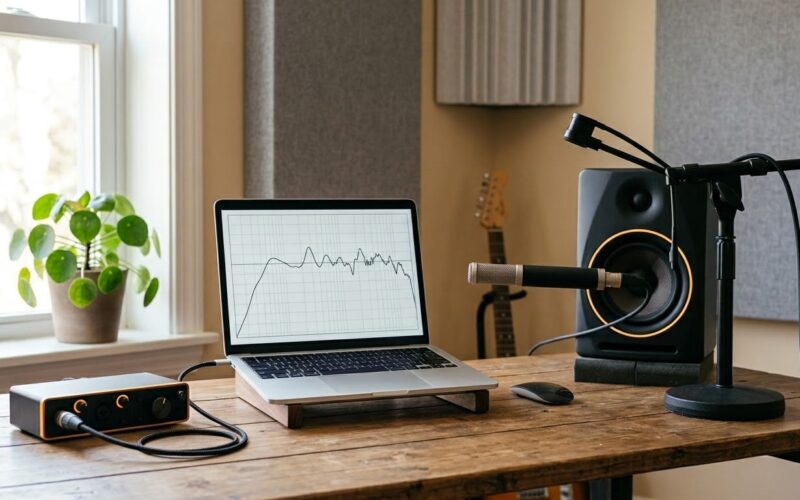
5. Measure it. Room EQ Wizard is free and works with any measurement microphone. Sweep from about 20 Hz to 500 Hz at your seat and look at the peaks and nulls. That curve is the closest thing to a diagnosis you will get without an acoustician.
6. Check other formats. Send a rough mix to your phone, your earbuds and a car system. If your monitors and your phone disagree about the balance, the room is participating in your decisions.
Two honest limits. A single test recording cannot diagnose every frequency or every mode in a room, so use it as a starting point rather than a verdict. And keep levels sane while you test: turn it up enough to judge the balance, not enough to give your ears a reason to stop trusting the next session.
Do Acoustic Panels Make Your Monitors Sound Better?
No. They make them tell the truth. A pair of budget monitors in a treated room usually reveals more than expensive monitors in a reflective one, because reflections, room modes and monitor position all sit in the way of what the drivers are actually doing. If your monitors are placed 30 cm from a wall, speaker boundary interference is boosting the low end before any room mode is even considered.
That is why monitor placement comes first. Then isolation, which stops structure-borne vibration from colouring what you hear. Then calibration, which is a measurement match rather than a preference. Treatment sits alongside all of it and rarely replaces any of it. Cheap monitors plus sensible treatment usually beat expensive monitors in a bad room, but only after placement is right.
Acoustic treatment vs soundproofing
Treatment controls what happens inside the room. Soundproofing controls how much escapes and how much gets in, and it works through mass, isolation and sealing rather than absorption. This is the single most common disappointment in home studios: panels on the wall do almost nothing to keep bass out of the neighbour’s living room. If leakage is your actual problem, you need sealed doors, dense walls and isolation, and no panel brand will pretend otherwise.
When You Can Skip Panels for Now
Some situations genuinely do not need them yet.
A temporary room between projects, where you are bouncing ideas and not mastering anything. A heavily furnished space with carpet, curtains and soft furniture, which already absorbs a reasonable amount. A room that measures reasonably flat at your seat. And a workflow that already checks mixes on several systems, so the room stops being the only judge.
In those cases spend the money in this order instead: monitor positioning, isolation pads, a decent pair of open-back headphones for reference and editing, and a subwoofer that can hand off below about 80 Hz so the small speakers stop trying to produce bass they cannot. Mixing in mono regularly is free and catches balance problems that a stereo image hides.
What to Do First
Work through this in order and stop as soon as the problem goes away.
1. Fix the geometry. Monitors at ear height, an equilateral triangle, pulled forward off the wall, toe-in angled at the listening position. Position your chair near 38 percent of room length from the front wall.
2. Find the reflections. Run the mirror trick on both side walls and the ceiling. Mark what you see.
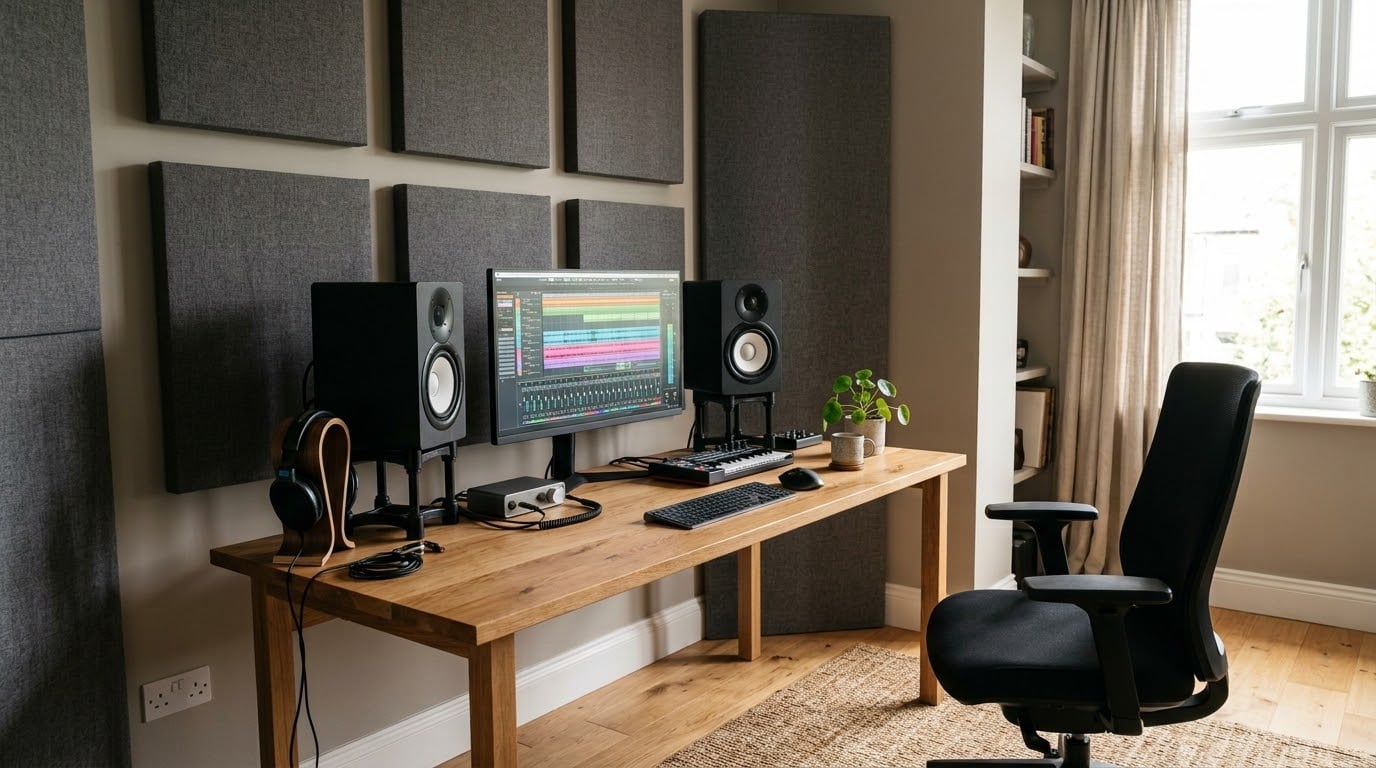
3. Add the first layer. One panel at each side reflection point, then a ceiling cloud, then reassess. Most rooms stop being a problem here.
4. Deal with the low end. If bass still jumps between positions, add traps in the corners with a real air gap, or introduce a subwoofer and cross over below your monitors’ limit.
5. Only then reassess monitors. If a treated room reveals a monitor fault you can now hear, that fault is worth buying a fix for.
When you do buy, check four things. Thickness and density, because thin decorative foam does almost nothing below about 500 Hz, so look for 100 mm mineral wool or rigid fiberglass rather than a surface that looks like a wedge. Air gap allowance behind the panel, 50 to 100 mm if the wall allows. Fixings rated for the filled weight, screwed rather than glued. And fabric you are willing to live with, since you will be looking at it every day. Follow the manufacturer instructions for installation, get landlord permission if you rent, and keep vents, smoke detectors and escape routes clear.
Frequently Asked Questions
Do you need acoustic panels to mix well if you mix on headphones?
Not really. Headphone mixing bypasses the room almost entirely, so the reflections and modes panels absorb never reach your ears. Spend that money on a decent pair of open-back headphones, check your mix in mono, and reference it on a phone and a car system instead. Panels only start paying off once you go back to monitors.
What can I use instead of acoustic panels?
Ranked roughly by how much they help: thick fabric-wrapped mineral wool absorbers work best, followed by heavy lined curtains over a full wall, a carpet plus soft furnishings in a small room, a packed bookshelf acting as diffusion, and stacked absorbers moved from where they are not needed. Foam wedges and egg cartons are the weakest options and mostly decorative at mixing frequencies.
How many acoustic panels are needed?
A common starting point is absorber area equal to 3 to 6 percent of room volume, or panels covering 15 to 25 percent of wall surface. Most untreated rooms improve sharply with four well-placed panels at the first reflection points, a ceiling cloud and bass traps in the corners. Coverage matters far less than position, and thick panels with an air gap always beat more thin ones.
Will adding acoustic panels keep sound out?
No. Treatment absorbs reflections inside the room and improves what your monitors reveal. Keeping sound out is soundproofing, which depends on mass, isolation and sealing of doors, walls and vents. Someone still hears your bass through a treated wall. If leakage is the problem you actually have, panels will disappoint you and you need a different solution.
Do acoustic foam panels work for bass?
Only shallowly. Typical wedge foam is effective from roughly 500 Hz upward and does almost nothing in the low end, which is exactly where untreated rooms cause the most trouble. Thick fabric-wrapped absorbers and corner bass traps filled with dense mineral wool reach lower, and a genuine air gap behind the panel is what lets low frequencies enter the material rather than bounce off it.
What are the disadvantages of acoustic wall panels?
The main one is treating the room until it sounds dead. Mixes then start to feel small and lifeless because there is no early reflection information left to place instruments in space. Panels also cost money, reduce usable wall space, and do nothing about the things people expect them to do, such as stopping sound leaving the room. Track untreated if you need a live sound.
The Honest Verdict
Do you need acoustic panels to mix well? If you mix on monitors in a hard room, yes, and they will do more for your mixes than another pair of speakers would. If you mix on headphones, or your room is already soft and your monitors are well placed, they will not.
Do the free work first: fix the geometry, sit in the right chair position, run the mirror trick, and measure with Room EQ Wizard or check by ear. Buy two thick panels for the first reflection points, a ceiling cloud and corner traps if the bass is uneven, and leave the rest of your budget for headphones and references. Room correction software such as Sonarworks SoundID Reference or ARC helps most at the end of that chain. It cannot fill a null or shorten a long decay, and it never replaces placement.