To structure a progressive house track, you arrange six sections in order — intro, build-up, drop, breakdown, second build-up and second drop, then outro — and manage how many layers are playing in each one. At 120–128 BPM a full track usually runs 240 bars, somewhere between seven and nine minutes. The trick is not the number of sections; it’s the contrast between them. A drop only hits hard if the breakdown before it was nearly empty.
That’s the part beginners miss. Most bedroom producers build a good kick, a bassline and some chords, then leave everything playing for six minutes. Nothing changes, so nothing lands. Getting the arrangement right fixes more perceived quality problems than any amount of mixing, and it works in any DAW — Ableton Live, FL Studio, Logic Pro, Cubase, Studio One, Bitwig Studio or Reason all let you do this once you know which view to build it in.
Table of Contents
- What You Need
- Step-by-Step: How to Structure a Progressive House Track
- 1. Set the tempo, key, and arrangement length
- 2. Design the core drum groove
- 3. Create the main bass movement
- 4. Add chords, pads, and atmosphere
- 5. Write and introduce the main melody
- 6. How to structure the intro, build, breakdown, and drop
- 7. Automate transitions and energy
- 8. Mix, arrange, and refine the final track
- Common Mistakes
- Arranging everything at once
- Overcrowding the drop
- Weak contrast between sections
- Muddy low end
- Repetitive harmony
- Effects left on everywhere
- Fixing arrangement problems in the mixer
- Frequently Asked Questions
- How long should a progressive house track be?
- Should I build a progressive house track from loops?
- Where should I place vocal elements in a progressive house track?
- Can a progressive house track change key?
- Does every section of a progressive house track need different sounds?
- Conclusion
What You Need
You need very little. Most producers who release progressive house regularly started with a laptop, a controller and a sample library. Here’s the honest list.
- A DAW. Any of the ones above. Ableton uses Session View clip launchers, FL Studio uses the Playlist, Logic and Cubase arrange on a linear timeline with track stacks.
- Drum sounds. A kick, a clap or layered clap, closed and open hats, at least one percussion layer. Two distinct kick sounds matter more than ten.
- A bass sound and a synth. One subtractive synth or wavetable instrument covers bass, plucks, pads and leads if you know where the filter and envelope controls are.
- Effects. At minimum: a compressor for sidechain duties, a reverb, a delay, and a resonant filter you can automate.
- Reference material. Three or four tracks in the style you want. Anjunadeep material is the usual benchmark for melodic progressive house.
- Monitoring. Headphones are fine for arrangement. Mixing decisions need speakers or good headphones plus a calibrated plugin.
- A written outline. A bar count per section. Ten minutes with a pen costs nothing and prevents a two-hour loop cycle.
Skip anything you don’t have. Every element above can be substituted — a filtered noise sweep instead of a riser, a chopped vocal instead of a lead synth — and the structure holds.
Step-by-Step: How to Structure a Progressive House Track
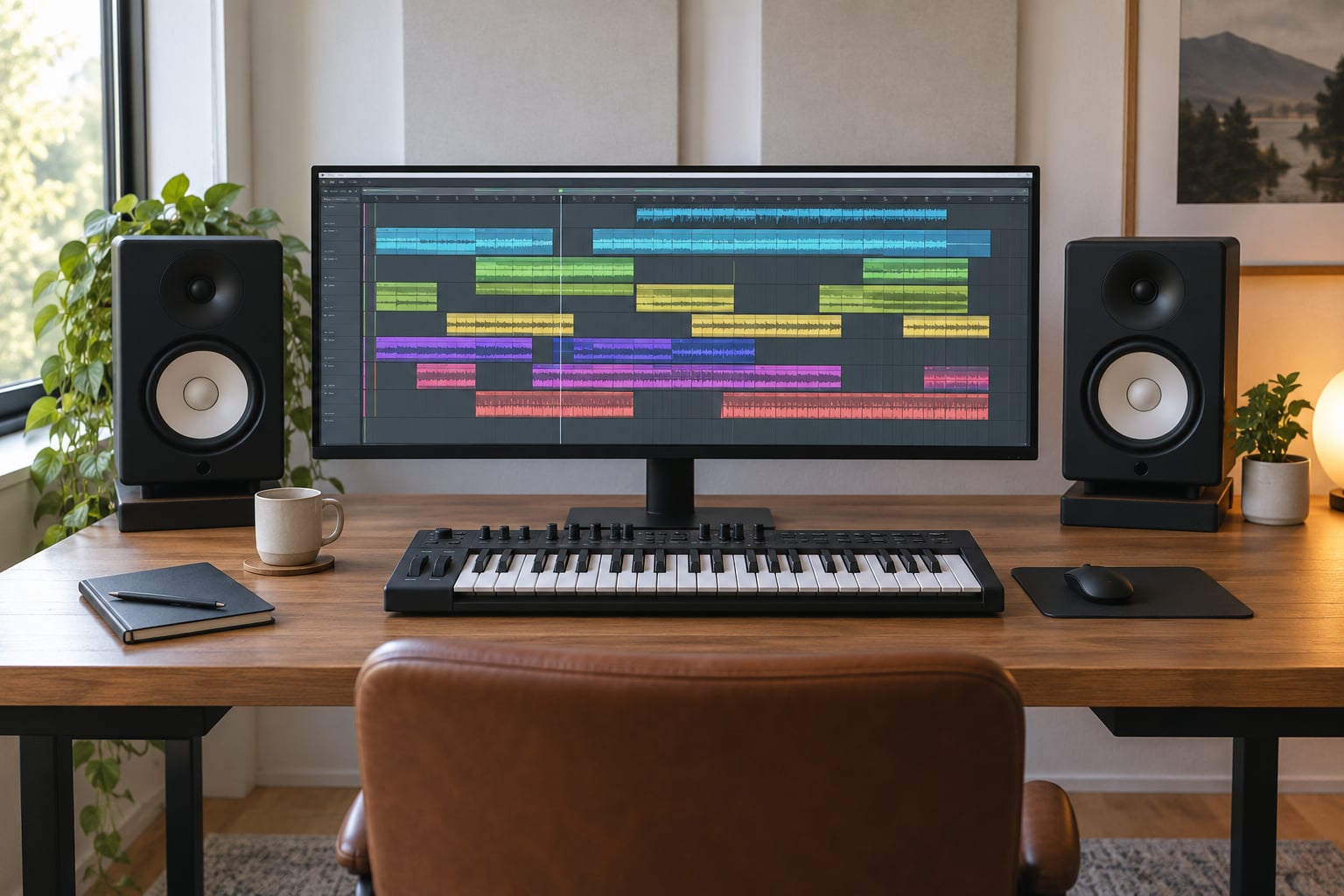
The workflow below runs from an empty project to a finished arrangement, and the order matters. Get the groove and the bass right before you touch atmosphere, and get the whole arc in place before you spend a minute on mix. It works the same in every DAW; only the interface names change. In Ableton, sections are clip launchers on separate tracks and you automate the scene launch. In FL Studio you draw patterns in the Playlist. In Logic or Cubase you use track stacks and marker labels.
Before you start, here’s the full blueprint. Bar counts assume 124 BPM, where one bar is about 1.9 seconds.
| Section | Bars | Approx. time | Energy | Active layers | Lead element |
|---|---|---|---|---|---|
| Intro | 32 | 1:00 | 25% | 2–3 | Filtered pad, light hats |
| Build-up 1 | 16 | 0:31 | 50% | 4–5 | Riser, filter sweep |
| Drop 1 | 64 | 2:05 | 100% | 6–7 | Baseline with kick |
| Breakdown | 32 | 1:00 | 30% | 2 | Pad and melody |
| Build-up 2 | 16 | 0:31 | 60% | 5–6 | Snare roll, riser |
| Drop 2 | 64 | 2:05 | 95% | 7 | Full melody added |
| Outro | 16 | 0:31 | Falling to 20% | 2 | Pad tail |
Two drops at 64 bars each is the standard for club play. If you want a shorter release, cut both drops to 32 bars and the intro to 16 — but keep the ratio of breakdown to drop wider than you think.
1. Set the tempo, key, and arrangement length
Pick your tempo before anything else, because every loop you audition later will be judged against it. Progressive house lives around 120–128 BPM; 122–126 is the comfortable middle where rolling basslines still feel relaxed. Set it and don’t touch it.
Choose a key you can sing or hum. Dorian gives you warm minor chords, Lydian gives leads a floating quality from the raised fourth — both common in the genre. Common progressions are i–VII–iv–v, i–VI–III–VII, and ii–V–I–vi.
Then write the section outline as bar counts before you place a single audio clip. Use the blueprint above as your starting point. Knowing the intro ends at bar 32 means you know the intro has a job to finish, which stops it from wandering for two minutes.
2. Design the core drum groove
Build a four-on-the-floor kick with a clap or snare on 2 and 4, closed hats on eighths, open hat on the offbeat, and one percussion layer for movement. Two bars of that, looped, should be enough to groove to with no melody present.
That test matters. If the groove needs help, adding pads won’t fix it. Play your finished track with the kick soloed, then with the drums soloed, and listen for whether anything disappears. Kick and bass fighting for the same space is the single most common reason a prog house low end sounds undefined.
3. Create the main bass movement
Write a bassline that supports the kick rather than doubling it. Rolling eighths, a root with an octave jump every two bars, or a syncopated pattern that leaves space on the downbeat all work. What doesn’t work is a sub line running straight through the middle of the kick fundamental.
Follow the chord progression, not a single root. Give the bassline its own rhythmic identity so the drop has something moving besides the drums. Then sidechain it to the kick with a compressor: threshold set so the kick triggers it, release around a quarter note at 124 BPM, fast attack. The pumping is not decoration in this genre — it’s what lets a dense arrangement breathe.
4. Add chords, pads, and atmosphere
Sustained chords and pads set the emotional register. In a progressive house track they usually sit in the intro and the breakdown, giving the listener something to hold while the drums are absent. Arpeggios and plucks add motion in the background during drops without competing with the lead.
Automate the pad volume across sections: audible in the intro and breakdown, tucked well down during the drops, and opened up again in build 2. Textures — noise, field recordings, granular washes — go in the intro and the final eight bars of the breakdown. If the full arrangement sounds crowded, this is almost always the layer to cut, not the drums.
5. Write and introduce the main melody
A progressive house melody is usually a motif: two to four notes, often answered by a second phrase. Use a pluck synth for the main version and a pad or vocal for the breakdown version — same notes, different weight, which makes the drop feel like a payoff instead of a repeat.
Introduce it early, in shortened form, before the first drop. Play the first two bars of the motif alone over the intro, then the full phrase at the drop. Repetition with variation is what makes it stick: same register, one changed rhythm, one changed note at the turn. Avoid a melody that lives entirely above 2 kHz with nothing under it, because it will disappear on small speakers and in the club.
6. How to structure the intro, build, breakdown, and drop
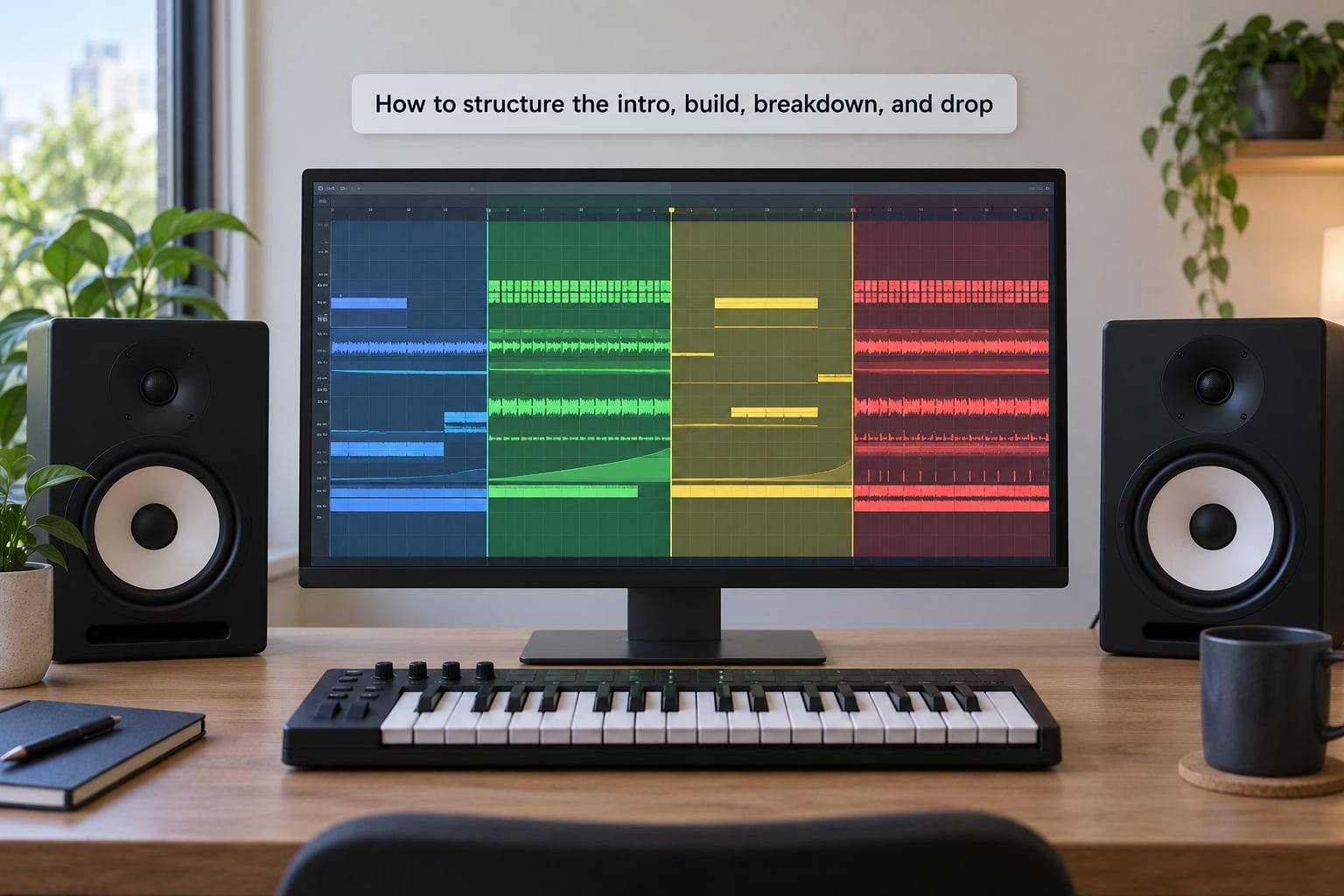
The part beginners find hardest when they structure a progressive house track is the second half. Most write a strong first drop and then repeat it. Once the ingredients exist, translate them into the full arc. Give every section one job: the intro introduces the world, build 1 raises tension, drop 1 releases it, the breakdown takes everything away, build 2 raises tension again, drop 2 releases with more information, and the outro lets the listener leave cleanly.
Contrast comes from removing layers, not just adding them. Entering drop 1 with everything at full level is a small mistake; entering it with a hat riser, a reversed cymbal and a moment of near-silence is a good one. Use drum removal, filter sweeps and reverb throws to make adjacent sections feel different even when they share the same four elements.
For build 2 and drop 2, vary rather than repeat. Common changes: add a counter-melody, swap the arpeggio pattern, bring the lead vocal in for eight bars, remove the clap, or drop the low-pass on the pad at the start of drop 2 so it opens through the section. The second drop should feel familiar and slightly new.
7. Automate transitions and energy
Transitions are where a static arrangement comes alive, and they’re where long sections stop feeling long. The tools are risers, filter sweeps, reverse sounds, delays throws, reverb throws and temporary element removals.
A sixteen-bar build works like this, and it generalises to any build length:
| Bars | What happens | Energy |
|---|---|---|
| 1–4 | Beat returns, hats on eighths, one percussion layer | 50% |
| 5–7 | Hats move to sixteenths, extra shaker or tambourine | 60% |
| 8 | Snare roll, riser and reverse cymbal enter | 80% |
| 9–16 | Full roll accelerates, filter sweeps up, everything cuts | 100% |
Delays and reverbs should throw into the downbeat of the next section, not sit permanently. A high-pass filter opening over eight bars on the pad is the cheapest contrast in the genre. And if a section runs longer than about 16 bars without a change, remove or add something around bar 8. Introducing one new element every 8 to 16 bars is what creates the slow forward pull listeners recognise as progressive house.
8. Mix, arrange, and refine the final track
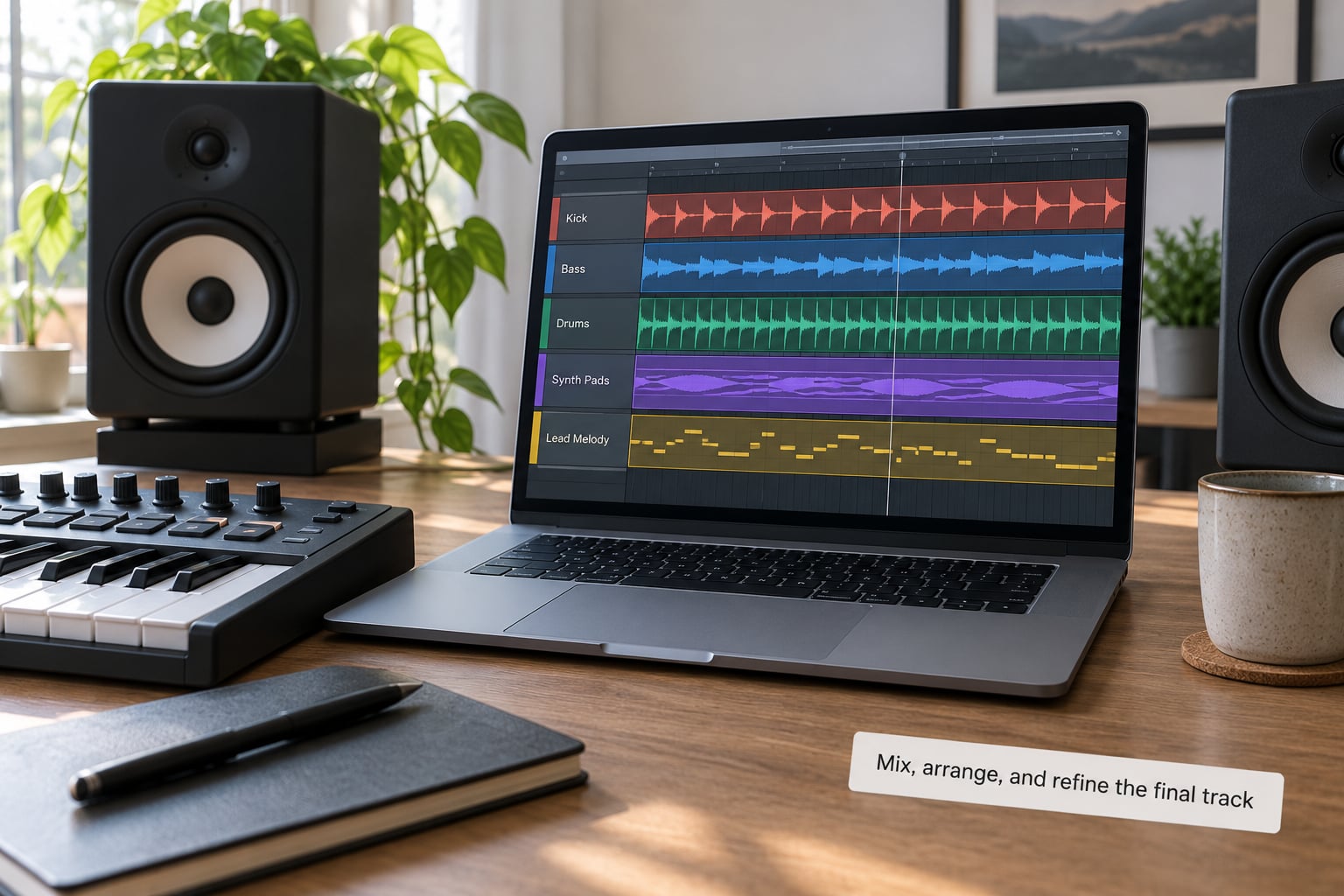
Balance kick, bass, drums, melody and atmosphere as five separate things, each with room to be heard. Check tonal clarity by soloing the mid-range layers — plucks, leads, chords — and confirming nothing stacks in the same octave. Check dynamics across the whole arrangement, not just the drop: a track that’s loud everywhere has no impact anywhere.
Knowing how to structure a progressive house track mostly comes down to deciding what plays and what doesn’t in each block. A riser that plays in every block teaches the listener that risers mean nothing. Keep each transition effect to once or twice per track, and automate throws so they decay before the next block begins. Long reverb tails bleeding into the low end during a drop are the other common one. Export a clean reference at the target loudness for mastering, and keep the master bus unclipped.
If you want the track to work in a DJ set, keep the intro drum-free or near-empty for at least 16 bars and let the outro tail run long enough to blend into the next track. That also happens to be the edit most streaming listeners skip to, so it earns its place twice.
Common Mistakes
Every one of these shows up in the same beginner sessions, and every one has a straightforward fix.
Arranging everything at once
The problem is writing the track linearly, start to finish, so every idea gets added and nothing gets removed. Fix: build a four-bar core loop first, then place sections as blocks on the timeline and fill each block separately. Reference-track analysis is the fastest way to unstick yourself — open a track you like in your DAW and map its section boundaries onto a grid before you write your own.
Overcrowding the drop
Six or more melodic layers in the same octave produce mud no amount of EQ will fix. Fix: give each layer its own register, cap the drop at six or seven active elements, and mute the pad. Focus lands on the melody when nothing else occupies its frequency band.
Weak contrast between sections
If the breakdown still has claps, arpeggios and the full bassline, the second drop has nothing to give. Fix: strip the breakdown to two layers — a pad and one melodic element — and put the reverb throw right before the re-entry.
Muddy low end
Kick and bass occupying the same frequency band is the usual culprit. Fix: sidechain the bass, high-pass anything below about 30 Hz except the kick and sub, and check the kick and sub are not fighting for the same note.
Repetitive harmony
Sixteen bars on one chord with no movement reads as a test tone. Fix: move to a second chord by bar 8, or hold the chord and shift the melody’s register and rhythm instead.
Effects left on everywhere
A riser in the intro, the build and the drop teaches the listener that risers mean nothing. Fix: use each transition effect once or twice per track, and automate throws so they decay before the next section begins.
Fixing arrangement problems in the mixer
Reaching for compression and EQ when the real issue is that nothing changes for four minutes. Fix: play the track back to back and write down the bar number of every moment that made you move. Those are your sections.
A few arrangement tips that cover most cases: keep the breakdown longer than feels right, since restraint reads as confidence; put your motif’s first appearance before the first drop so the drop pays it off; and when in doubt, remove a layer rather than add one.
Frequently Asked Questions
How long should a progressive house track be?
For a club-focused release, aim for seven to nine minutes, which is roughly 240 bars at 124 BPM. That length allows two full drops with a real breakdown between them. Shorter tracks around five to six minutes work for streaming-friendly releases and usually mean one main drop and one short reprise. Longer ten-minute arrangements suit DJ use but need enough new material in the second half to hold attention.
Should I build a progressive house track from loops?
Yes, as a starting point. Most producers begin with a kick, a chord loop and a bass loop, then replace them one at a time as the arrangement takes shape. The trap is leaving the loop running unchanged for a whole track. Cut your loops into sections so you can remove the drums for a breakdown, extend a loop for eight bars, or filter it down in the intro.
Where should I place vocal elements in a progressive house track?
Vocal chops work best in the background of the intro and drop, sitting between the arpeggio and the lead. A full vocal or topline usually belongs in the breakdown, where there is room for it and the listener is looking for relief. Chopped fragments also work well over the last eight bars before a drop, pitched up and reverbed, to pull attention toward the arrival.
Can a progressive house track change key?
It can, but rarely mid-track. The common move is to shift the whole track up or down a few semitones so it sits better in a DJ set, or to move between relative major and minor keys across a long breakdown. A sudden modulation mid-arrangement usually reads as a mistake in this genre because the harmonic language is simple and the listener tracks it easily.
Does every section of a progressive house track need different sounds?
No, and it is better if they share material. Contrast comes from what plays and how it is processed, not from a new sound in every section. The same pad, bassline and melody can appear in the intro, drop and second drop, each time with different volume, filtering and which layers are removed. Introducing one new element every eight to sixteen bars gives enough movement.
Conclusion
Structuring a progressive house track comes down to three decisions: how long each section runs, how many layers play in it, and what you remove when you move to the next one. Set the tempo and key, write the bar counts, build a groove you can dance to with only drums, add a bassline that moves under it, then arrange the six sections around that core. Adjust filter, volume and layer count to make each transition feel earned.
Open your DAW now and do four things: set a tempo around 124, pick a key, get a four-bar drum loop grooving, and write the section outline on paper with bar numbers. Everything else in the workflow follows from those four decisions, and your track will have an arc long before it has a mix.