Yes, you can use sample packs in commercial releases — but only where the pack’s license explicitly grants commercial use. Buy the file, get a permission, not a clearance certificate. What you release is your music; the pack stays on your hard drive, and the terms decide everything else.
That conditional answer is the whole question, and most confusion comes from skipping straight to the word “free”. A pack called free, a pack called royalty-free and a pack sold by a company with a legal department are three different promises. This guide breaks down how sample pack licensing actually works, which uses need extra permission, and what proof to keep before you press distribute in 2026.
Table of Contents
- What Does a Sample Pack License Allow?
- Can You Use Sample Packs in Commercial Releases?
- Can you use sample packs for streaming, sync and client work?
- The two copyrights underneath every sample
- What Does Royalty-Free Mean for Sample Packs?
- Free download packs are not automatically royalty-free
- Can You Sell Tracks Made With the Same Sample Pack?
- How to Check a Sample Pack License
- Where the license file usually hides
- Which Uses Commonly Require Extra Permission?
- Packs built from uncleared source recordings
- What Proof of a Commercial License Should You Keep?
- What to do when a claim lands
- How Can You Reduce Licensing Risk?
- Frequently Asked Questions
- Can I use a sample pack in a song I sell on Spotify?
- Can I use samples from a free sample pack?
- Do I need to credit the creator of a sample pack?
- Can I use a sample pack in a commercial remix?
- Can I use the same sample pack in multiple released songs?
- What if a sample pack license is unclear?
- Conclusion: Check the License Before You Release
What Does a Sample Pack License Allow?
A sample pack license is a set of permissions attached to the files. It tells you who may use them, in what projects, how many projects, and which uses are off the table. It never transfers copyright to you.
These are the tiers you will actually run into:
| License type | What it usually permits | Before you release commercially |
|---|---|---|
| Royalty-free / commercial | Use in your own original music, no recurring royalties on the sample | Green light for streaming, sales and most sync, subject to the redistribution clause |
| Personal use only | Learning, demos, private practice, portfolio | Not cleared for a paid release, a client handover or a monetized stream |
| Non-commercial or educational | School, coursework, non-monetized channels | Stop. Monetized content is commercial use even if you never see money directly |
| Creative Commons | Depends entirely on the specific CC variant | Read the variant. Some CC terms permit derivatives with restrictions that do not suit a paid release |
| Custom or pro-only | Extra rights bought separately, sometimes per seat | You need the extended license, not the standard one, and proof you bought it |
The tier list matters because the label on the product page is marketing copy, while the license text is the actual contract. When they disagree, the license text wins.
Can You Use Sample Packs in Commercial Releases?
Commercial release covers far more than putting a track on a streaming service. If money can move as a result of your music reaching an audience, the use is commercial. That includes ad sync, film placement, video game audio, paid apps and handing stems to a client who pays for the work.
Can you use sample packs for streaming, sync and client work?
Here is the practical verdict grid, assuming the pack carries a genuine royalty-free commercial license:
| Use | Typical verdict | What to confirm first |
|---|---|---|
| Streaming release (Spotify, Apple Music) | Allowed | No redistribution, no unaltered loop-as-track |
| Selling beats | Allowed | Some licenses cap how many trackouts or free-for-profit downloads you can sell |
| Film, TV, ad sync | Often a separate question | Sync permission or an explicit carve-out. Threads on the Image-Line forum confirm many loops are cleared for normal production but excluded from synchronized use |
| Client work and work-for-hire | Usually fine, sometimes capped | Some packs limit client or commercial projects per year |
| Video game audio | Varies by pack | Games often ship large volumes; some licenses exclude them outright |
| Podcasts, YouTube, live DJ sets | Usually allowed | Check for caps and for separate live-performance terms |
| Reselling or repackaging the pack | Never allowed | This is the one rule no commercial license permits |
The two copyrights underneath every sample
Every recorded sound carries two layers. The sound recording copyright belongs to whoever made the recording. The composition copyright belongs to the songwriter and publisher. A cleared sample needs both layers accounted for, and clearing only the master recording leaves you exposed on the composition side.
Pre-cleared packs exist because the seller already handled both layers up front. That is the whole value proposition, and it is why the seller’s sourcing matters more than the label on the file.
What Does Royalty-Free Mean for Sample Packs?
Royalty-free means one payment, and no ongoing royalties owed on what you create from the files. That is the complete meaning. It is a statement about money owed to the pack seller, not a statement about copyright status.
Royalty-free does not mean free of charge. It does not mean attribution-free, unless the terms say no credit is required. It does not mean cleared for sync, client work or unlimited projects, because those permissions are granted separately or capped. And it never means the raw files can be redistributed.
Free download packs are not automatically royalty-free
This is the trap that catches experienced producers. A pack given away free on a download site or file share can carry personal-use-only terms, and free is the first word people equate with unrestricted. Plenty of free packs are perfectly commercial, plenty are not.
Check the license the same way whether you paid or not. Price has never been a reliable signal of permission terms.
Can You Sell Tracks Made With the Same Sample Pack?
Yes. There is no exclusivity in a standard commercial sample pack license. Two producers can buy the same pack and both release tracks using it, and hundreds often do. The second person to use a loop is not infringing anything.
My rule of thumb after years of this is simple: music goes out, tools stay home. Your finished track leaves the studio. The sample files, the pack folder, the presets inside it and the raw multisamples never do.
Two limits still apply even in a permissive pack. Many licenses are per-seat, meaning each person using the files needs their own copy or a seat on your license, and several cap how many commercial projects or trackouts you may sell. Producers working with bandmates often avoid sharing tool files by printing their parts to audio before handing a session over, which keeps licensed material out of a collaborator’s drive.
How to Check a Sample Pack License
This audit takes under a minute if you know where to look. Do it before the track goes out, not after a claim arrives.
1. Find the terms. Check the download page, the store listing, the pack’s own site and the folder you downloaded into. Vendors put license text in wildly inconsistent places.
2. Search the files. Grep the download for “license”, “licence”, “EULA”, “terms” and “royalty”. A PDF or a plain text file named LICENSE is the good case.
3. Read the grant, not the intro. Find the sentence that says what you may do. Marketing copy above it means nothing.
4. Check the limits. Look for caps on commercial projects, client work, trackouts, sync and seats.
5. Check the redistribution clause. Confirm the raw files cannot be resold, shared publicly, reposted or included in another pack.
6. Check attribution. If credit is required, note the exact wording before you release.
7. Check the sync carve-out. If the terms say “non-synchronized” or “no sync”, streaming is fine and picture is not.
Where the license file usually hides
Most packs ship the terms inside the archive, sometimes in a folder called Docs, Legal or README. Some sellers only publish terms on the product page, which is a reason to screenshot that page on the day you buy rather than assume you will find it later.
Which Uses Commonly Require Extra Permission?
Some uses need a different license tier, a written clearance, or a conversation with the rights holder.
- Redistributing the pack, including free reposts and “free for my followers” downloads
- Releasing a loop or one-shot as its own track with no arrangement around it
- Film, TV, advertising and game sync when the terms exclude synchronized use
- Client work and work-for-hire beyond a stated project cap
- Paid apps, paid plugins, subscription libraries and sample-pack products of your own
- Team or classroom use beyond the number of seats you bought
Packs built from uncleared source recordings
The biggest trap is not royalty-free packs sold by reputable sellers. It is packs assembled from other people’s records: loops ripped from commercial songs, output from stem-splitting tools, or loops extracted from YouTube. The seller is not a rights holder, so the license they wrote grants nothing.
Thirty-second routine before you use a pack that looks community-sourced. Ask who recorded the source and whether they owned it. Check whether the seller’s site names a company and a rights contact. Listen for obvious fragments of recognizable recordings, since a clear vocal phrase or a signature drum break is the tell.
There is a recurring creative debate underneath this question, too. Some producers argue that using the same packs as hundreds of other artists is no different from using a preset. That is an originality argument rather than a legal one, and producers on forums like r/WeAreTheMusicMakers land on both sides of it. Legally, sharing a pack is fine. Artistically, it is a choice you make every time you open the folder.
What Proof of a Commercial License Should You Keep?
Keep the evidence that answers a distributor, a label, a client or a rights holder months later. Claims do not surface the week you upload.
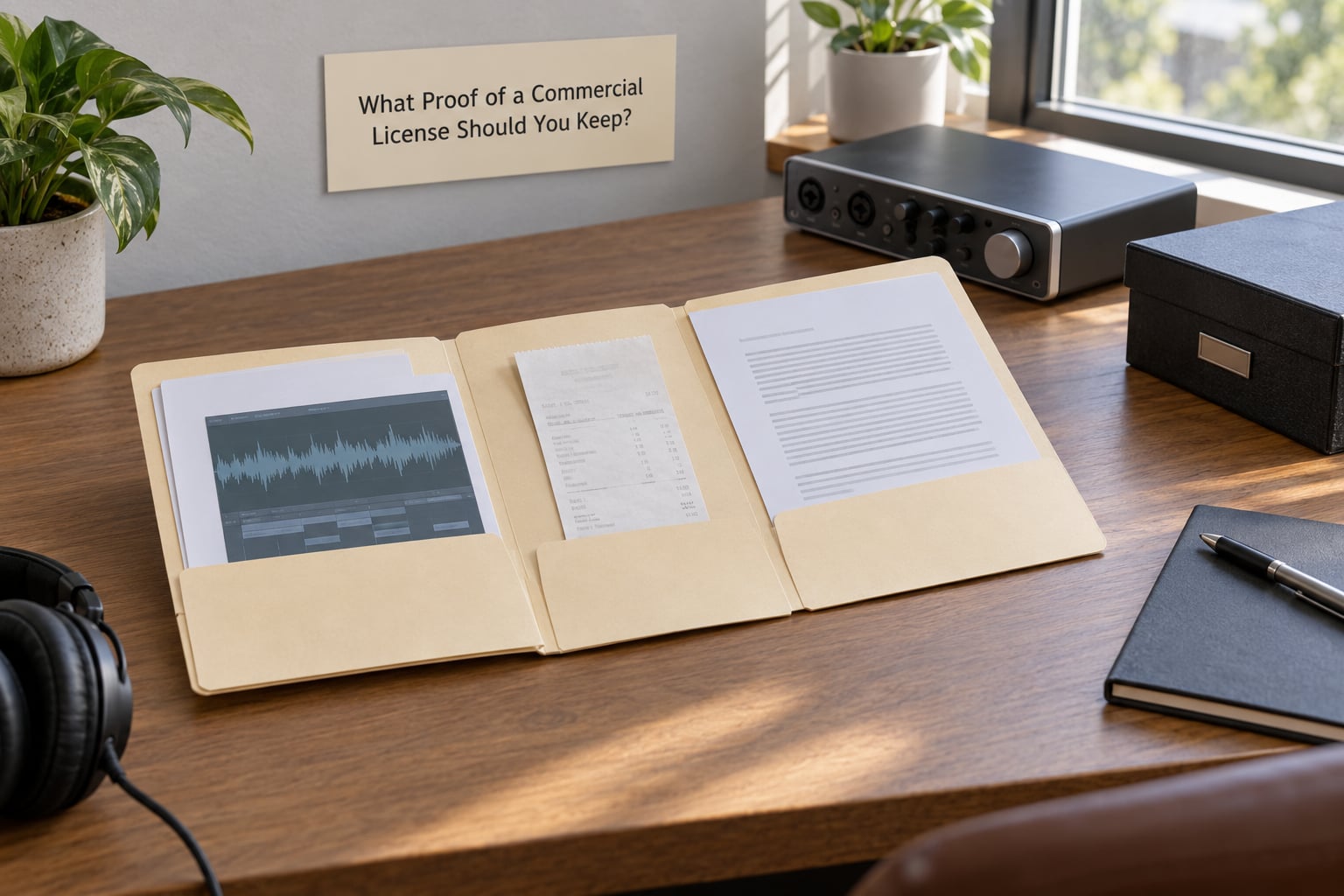
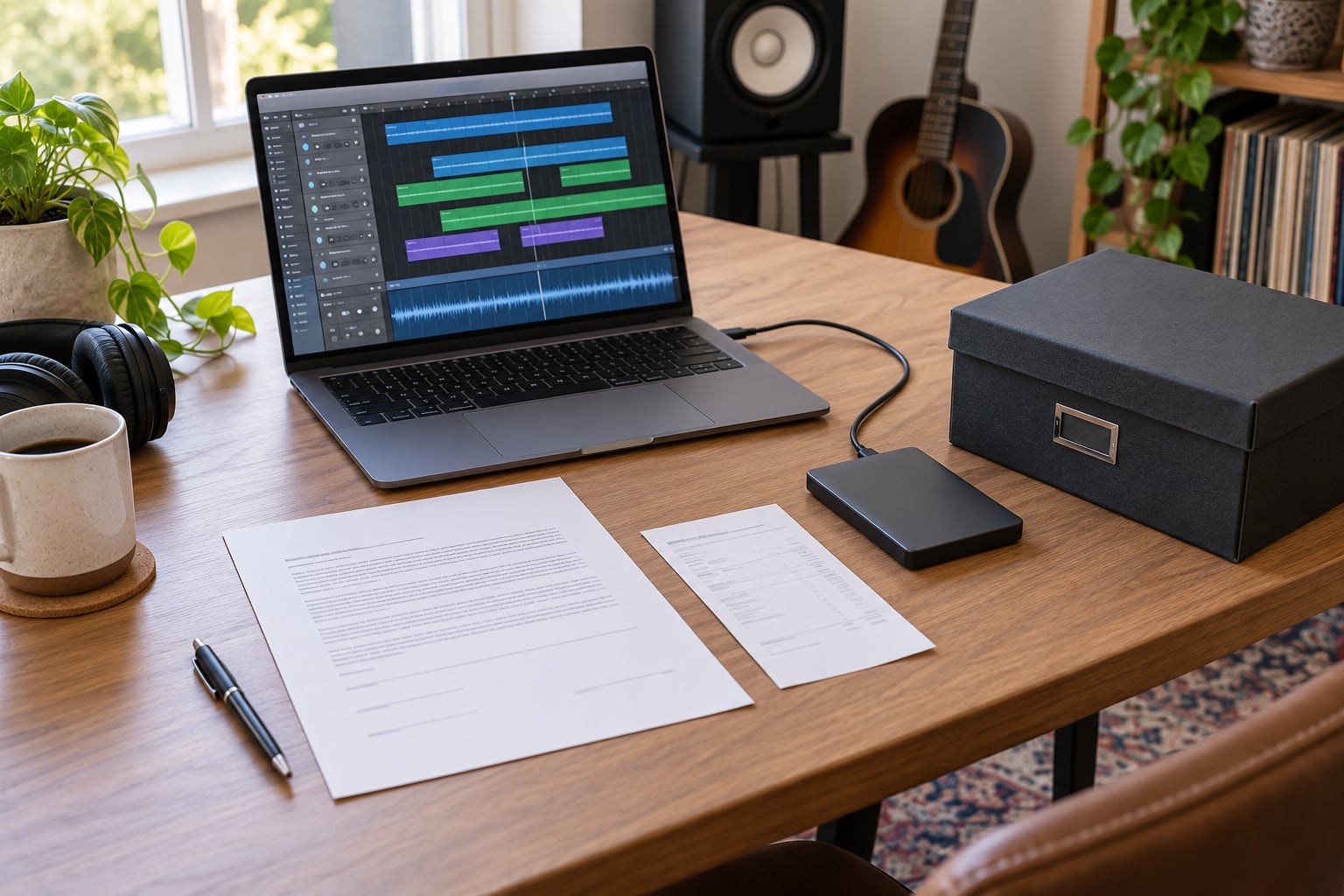
- The license text itself, saved as a dated PDF or screenshot
- The receipt, with the order date and pack name
- The pack name, version and seller recorded in your project notes
- The license file as it shipped inside the download, kept separate from the audio
- A note on the channel used and the number of seats, if the license was per-seat
- The saved project or bounce of the track itself, so you can show what you made
What to do when a claim lands
Producers report rejections and Content ID claims that trace back to sample-pack material, and a lot of that turns out to be a fingerprint mismatch rather than real infringement. When one hits you:
1. Read the claim. Note the claimant, the track and the exact timestamp they are pointing at.
2. Pull up the pack’s license. If it grants commercial use, you have a factual argument ready to paste.
3. Confirm the file’s provenance. If the loop matches a recording you recognize, you may have a real problem, and the distributor’s terms on dispute deadlines matter more than the sample’s price.
4. Dispute through the platform’s process with the license attached. Content ID disputes are decided on documentation.
5. If the claim is against a client project, tell the client before they find out. Producers have lost sync relationships over a delay more often than over the claim.
6. If the loop turns out to be uncleared, replace it rather than argue. Cheaper than the alternative, and usually faster than a takedown appeal.
How Can You Reduce Licensing Risk?
Build the habits once and the risk mostly disappears.
- Buy from sellers who publish a real license, a company name and a support contact.
- Read the terms before you buy, not after you fall in love with a sound.
- Treat free packs with the same suspicion as paid ones.
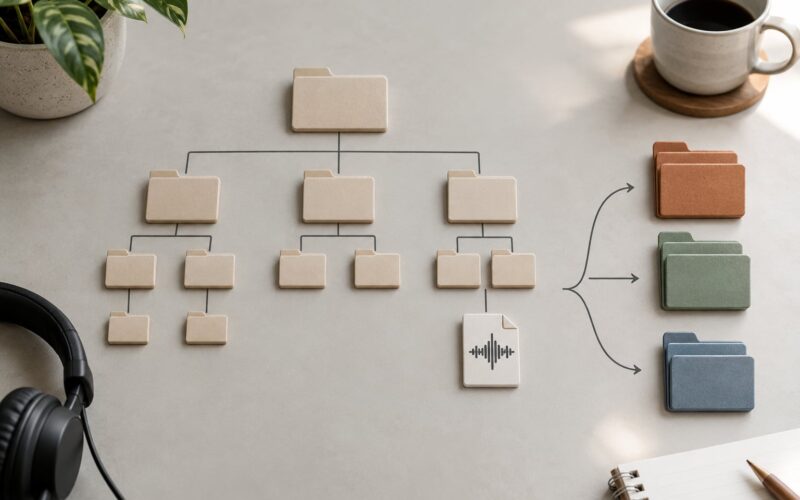
- Keep your project folder clean, so you can trace any sample back to its pack in seconds.
- Check the sync and client clauses before you take commercial work, not after.
- Store documentation off your hard drive too, so a drive failure does not take your proof with it.
- Ask the seller in writing when terms are ambiguous. A reply in your inbox is a usable answer.
Licensing rules vary by country and change over time, so treat this as working knowledge rather than legal advice. When a project carries real money behind it, a music lawyer is worth the hour.
Frequently Asked Questions
Can I use a sample pack in a song I sell on Spotify?
Yes, if the pack’s license grants commercial use. Most royalty-free packs sold for money allow you to release tracks commercially on streaming services, with no royalties owed to the seller. Two limits always apply: you cannot redistribute the raw files, and you cannot release a loop as a standalone track with nothing added. Check the license for caps on projects or trackouts, and save a copy of the terms with your receipt.
Can I use samples from a free sample pack?
Only if its terms say commercial use is allowed. Free describes what you paid, not what you may do, and plenty of free downloads ship with personal-use-only or non-commercial conditions. Monetized streams, client work and ad placements all count as commercial use. Read the license text before you build around a loop, and if there is no license text anywhere, treat the pack as personal use until you get a written answer from the seller.
Do I need to credit the creator of a sample pack?
Read the attribution clause. Most royalty-free packs say no credit is required, some ask for a line in your notes or description, and a few require a split or a visible credit in the artwork. The rule is whatever the license states, not what the pack’s marketing page implies. If credit is required, use their exact wording rather than your own version, and note the requirement in your project file so you can apply it when the track goes live.
Can I use a sample pack in a commercial remix?
Usually yes, if the original track and the remix are both your own work and the pack license grants commercial use. The remix adds no new permission, so the pack’s terms still govern every sample inside it. Watch two clauses: redistribution, which forbids reposting or selling the pack, and project caps, which some licenses limit per release. If the remix contains another artist’s recording rather than your own production, clearance for that recording is a separate question entirely.
Can I use the same sample pack in multiple released songs?
There is no exclusivity in a standard commercial pack license, so many artists can use the same pack and none of them is infringing. What you have to check is whether your license caps the number of commercial projects, trackouts or free downloads per year. Some sellers also require you to keep each release’s documentation separate. Keep a note per track listing the pack and the license, so a question about release number four is a two-second lookup.
What if a sample pack license is unclear?
Stop and ask before you release. Email the seller with a specific question about your exact use, describing the pack, the license version and what you plan to do with it, and keep the reply. Vague terms are commonly resolved by the seller’s own conduct, so their answer is the clearest evidence available. If you get no reply, avoid the material for anything commercial and use something with published terms instead. Ambiguity is not permission.
Conclusion: Check the License Before You Release
Sample packs are absolutely usable in commercial releases. The permission comes from the pack’s terms, and everything else is detail. Before you distribute, open the license, confirm it grants commercial use, check the caps and the sync carve-out, and save a dated copy with your receipt.
Start with the pack you are least sure about. Five minutes reading one license file has saved more releases than any plugin or preset ever did.