Most EDM intros are 8, 16 or 32 bars long, and for club-facing tracks 16 or 32 is the safe default. Short formats like 8-bar openings work when a track starts with energy already, while 32-bar intros give a DJ the room they need to beatmatch. The number matters less than what happens inside those bars and how the intro hands off to the drop.
Producers new to dance music usually get this wrong in one of two directions. They write a 4-bar intro and wonder why it feels rushed, or they loop a single texture for 64 bars and lose the listener before anything arrives. Neither is a tempo problem or a talent problem. It is an arrangement-length problem, and it is very learnable.
This guide walks through what an intro actually is, the bar counts that work by genre, how to convert bars into seconds at any BPM, and how to test the length before you call the track done.
Table of Contents
- How Many Bars Should an EDM Intro Be?
- What Is an EDM Intro?
- The Best Intro Length by EDM Genre
- How BPM and Time Signature Affect Intro Length
- How to Choose the Right Intro Length for Your Track
- 1. Mark the drop first
- 2. Write the intro in 16-bar blocks
- 3. Audition the transition into the drop
- 4. Adjust for where it will be played
- 5. Cut by ear, not by number
- Short Intros vs. Long Intros: When to Use Each
- How to Test and Adjust Your EDM Intro
- How Many Bars Before the Drop?
- Common Intro-Length Mistakes to Avoid
- Frequently Asked Questions
- How many bars should an EDM intro be?
- Is a 32-bar intro too long for EDM?
- How long is 16 bars at 128 BPM?
- What is the difference between an intro and a build-up?
- Should an EDM intro be different for DJ play and streaming?
- What is the rule of 32 in DJing?
- Conclusion
How Many Bars Should an EDM Intro Be?
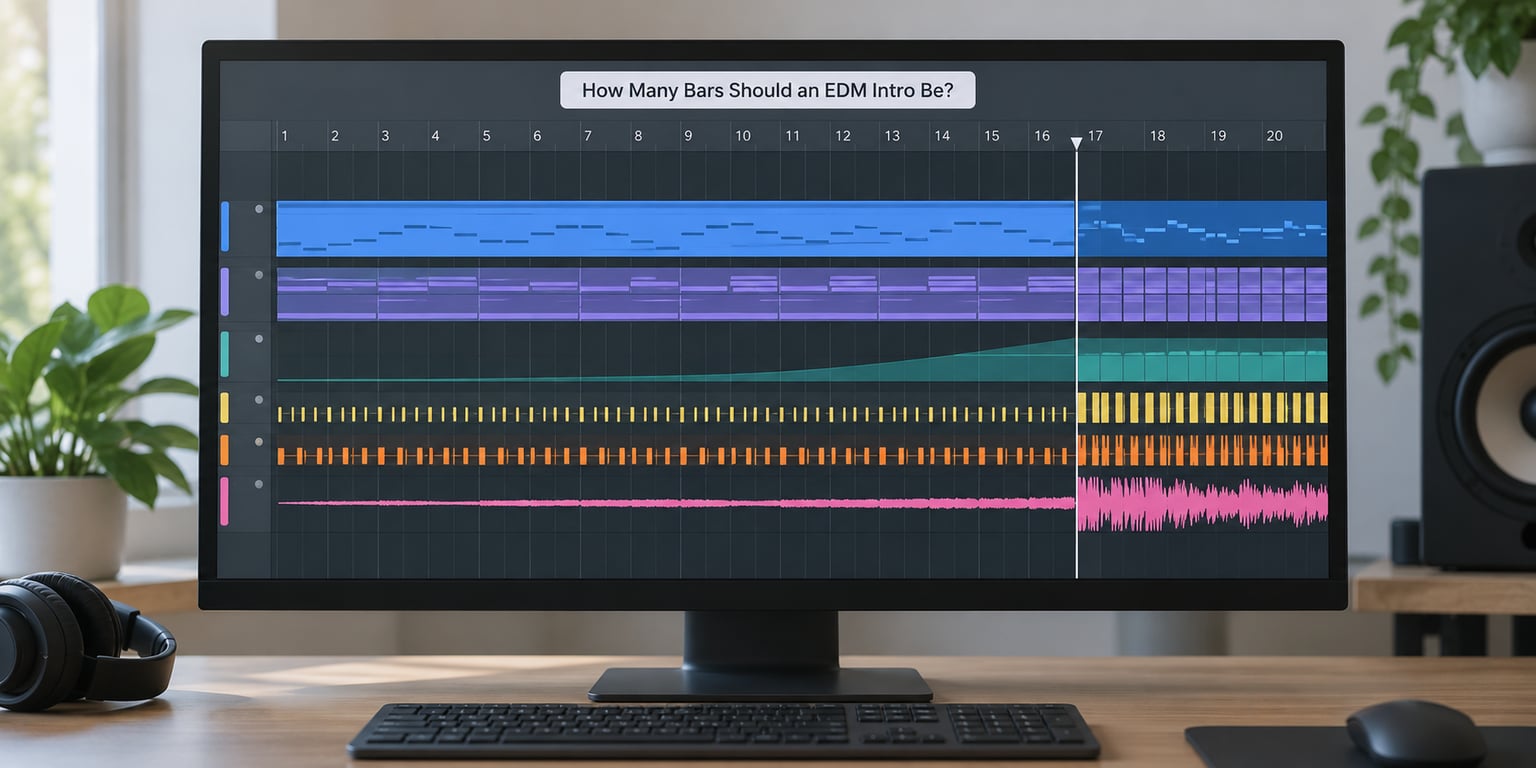
The short answer is 16 or 32 bars for almost every club track, with 8 bars reserved for intros that need to hit the ground running and 64 bars reserved for slow-building ambient openers. If you remember nothing else from this guide, start at 16 bars and extend to 32 if the drop needs more runway.
There is a reason those four numbers keep coming up. Dance music is built from phrases grouped in 4, 8, 16 and 32 bar blocks, because four beats to a bar in 4/4 time divides neatly into every one of those lengths. When an intro is a power of two, a DJ can predict where the sections change without counting, and a listener subconsciously hears a shape rather than a stretch of time.
Producers on r/edmproduction describe the practical rule as doubling. You write a 4-bar loop, then write it again as 8, then again as 16, then again as 32, and stop at the point where the intro has done its job. The doubling is what gives you checkpoints to change something at, rather than one long block that has to be improvised all the way to the drop.
Length also has to earn its place against two outside pressures. A DJ mixing in real time needs enough bars to sync and blend, and a streaming listener skipping after a few seconds needs the first phrase to be interesting. When those two pull in opposite directions, the answer depends on where the track is going to be heard.
What Is an EDM Intro?
An EDM intro is the opening section of a track that establishes atmosphere, groove and identity before the main energy arrives. Its job is to be recognisably the same record as the drop that follows, while leaving enough room for the contrast to land.
Most dance tracks run in 4/4 time, which means one bar, or measure, contains four beats. A phrase is a group of bars treated as one musical thought, and producers build everything out of phrases of 4, 8, 16 or 32 bars. Once you hear a track as nested phrases, the length question becomes much easier to answer.
The intro is not the same thing as three other sections that often get confused with it:
- Build-up. The final push into the drop, usually the last 4 to 16 bars, where tension peaks. It sits at the end of an intro or a breakdown rather than replacing one.
- Breakdown. A mid-track release of energy. It often reuses intro-style material but follows a drop rather than leading into one.
- Drop. The arrival of the main section. Its position is what the intro length is really being measured against.
- Verse or main section. In EDM this is the drop itself, or the first full-energy section. If your track starts at full energy, what you would call an intro may be a single bar of lead-in.
A useful test: if a section would still make sense after the drop has already played, it is intro material. If it only makes sense because of what comes next, you are writing a build-up.
The functional reason intros exist at all is the mixing window. When a DJ brings two tracks up at the same time, the outgoing track has to get quiet on the elements that would clash while the incoming track is still sparse enough to grow into. A longer intro gives them more room to do that slowly, which is exactly why the intro is not just an artistic choice.
The Best Intro Length by EDM Genre
Genre sets the expectation because each one has its own tempo range and pacing history. The table below covers the subgenres most producers actually work in, with the bar counts you will hear most often.
| Genre | Typical BPM | Usual intro length | Notes |
|---|---|---|---|
| Deep house | 118-124 | 16 bars | Slow enough that 32 bars can drift; keep a bassline moving |
| House | 124-128 | 16 or 32 bars | 32 bars split into two 16-bar halves with different layers |
| Progressive house | 126-130 | 16 or 32 bars | Melody often arrives in the second half of the intro |
| Electro | 128-132 | 8 or 16 bars | Short, tight openers suit the bright lead sound |
| Techno | 128-140 | 16 or 32 bars | Something must change at least every 4 bars to hold attention |
| Uplifting trance | 138-142 | 16 bars | Intro usually hands straight to the build |
| Progressive trance | 136-140 | 16 or 32 bars | Longer openings suit the slower melodic arc |
| Future bass | 150-160 | 8 or 16 bars | Half-time feel means bars feel long; keep them sparse |
| Dubstep | 138-142 | 16 bars | Risers and vocal chops carry the middle of the intro |
| Drum and bass | 170-176 | 8 or 16 bars | Fast tempo means 16 bars is already about 22 seconds |
| Synthwave | 80-110 | 16 or 32 bars | Slow tempo means bars feel spacious; 32 bars reads as short |
The pattern is easy to read: faster genres need fewer bars to fill the same amount of time, and slower genres can carry a longer intro before it starts to feel like nothing is happening. Synthwave at 100 BPM gives you 24 seconds of music in 16 bars. Drum and bass at 174 BPM gives you about 11 seconds.
Genre conventions also decide how sparse the intro can be. Techno listeners expect a stripped opening because the track will build through layers over two minutes. House listeners expect percussion early, often within the first four bars, because the drop is built on a groove rather than a reveal.
How BPM and Time Signature Affect Intro Length
Bar count and tempo are separate things, but they combine to give you the duration that actually matters. The conversion is simple:
Seconds = bars x beats per bar x 60 / BPM
In 4/4 time, beats per bar is 4, so the formula becomes seconds = bars x 240 / BPM. At 128 BPM that works out to 1.875 seconds per bar. At 140 BPM each bar is about 1.71 seconds, and at 174 BPM each bar is about 1.38 seconds.
Here is the same intro length expressed in time across the tempo ranges you will actually produce in:
| BPM | Seconds per bar | 8 bars | 16 bars | 32 bars | 64 bars |
|---|---|---|---|---|---|
| 120 | 2.00 | 16s | 32s | 64s | 128s |
| 124 | 1.94 | 15.5s | 31s | 62s | 124s |
| 126 | 1.90 | 15s | 30s | 61s | 122s |
| 128 | 1.88 | 15s | 30s | 60s | 120s |
| 130 | 1.85 | 15s | 30s | 59s | 118s |
| 140 | 1.71 | 14s | 27s | 55s | 110s |
| 174 | 1.38 | 11s | 22s | 44s | 88s |
Because 4/4 divides so cleanly, tempo is the only variable that makes a 16-bar intro feel longer or shorter than another 16-bar intro. That is a perceptual difference rather than a structural one, and it is why the same bar count can feel right in one genre and padded in another.
Time signature matters less in practice. Almost all club music is 4/4, and half-time and double-time feel come from how you layer elements rather than from changing the meter. If you write in 7/8 or 3/4, keep the same grouping logic: build phrases from blocks of 4 or 8 bars of your own metre, and count those blocks rather than the raw bar lines.
How to Choose the Right Intro Length for Your Track
Now the practical part. There is a repeatable process, and it starts before you write a single note of the intro.
1. Mark the drop first
Decide where the drop lands, then count backwards. A widely used arrangement skeleton runs intro from bars 1-32, main section from bars 33-64, breakdown from bars 65-96, build-up from bars 97-104 and the second drop from bar 105. Nothing about that skeleton is mandatory, but it gives you an intro length to aim at rather than an open-ended one.
Working backwards from the drop is the approach many experienced producers recommend, because a track usually makes more sense when the climax exists first and the opening is designed to deliver the listener to it.
2. Write the intro in 16-bar blocks
Build the intro as two or four 16-bar sections rather than one 32-bar block. A MusicRadar tutorial on building a club track intro does exactly this: one 16-bar section that is deliberately minimal, then a second 16-bar section with more instruments, producing a one-minute intro with a clear internal change at bar 17.
3. Audition the transition into the drop
Solo the last four bars of the intro and the first four of the drop and loop them. If the handoff feels abrupt, the intro is either too short to establish enough or already doing the drop’s job. If the drop arrives and nothing about the intro prepared you for it, you need more identity in the second half of the intro.
4. Adjust for where it will be played
If the track is going into DJ sets, aim for 32 bars so there is a real mixing window. If it is going to streaming playlists and radio, most listeners will hear only the first 15 to 30 seconds before they decide, so put something memorable in the first 8 bars even if the intro runs to 32. Radio and streaming edits often compress the intro and jump the drop much closer to the start, which is worth planning for rather than reacting to.
5. Cut by ear, not by number
Play the finished intro on a phone speaker and on proper speakers at low volume. If you lose interest at bar 17, that is where the listener loses interest too. Trimming there is almost always right.
Short Intros vs. Long Intros: When to Use Each
Every length has a cost and a benefit. Here is how the four standard options compare.
| Length | Feels like | Works best for | Main risk |
|---|---|---|---|
| 4 bars | A cue, not an intro | Remixes, live sets, tracks that open straight into the drop | No mixing window for a DJ; the track is hard to blend |
| 8 bars | About 11-16 seconds | Electro, future bass, drum and bass, short-form edits | Too thin to build anticipation for a big reveal |
| 16 bars | About 22-32 seconds | House, trance, dubstep, most club tracks under 6 minutes | Can feel abrupt if the drop is huge and the intro is sparse |
| 32 bars | About 44-64 seconds | DJ-facing club tracks, progressive and melodic styles | Energy tends to dip around bar 16 if nothing changes |
| 64 bars | About 90 seconds or more | Ambient openers, long builds, cinematic progressive tracks | Streaming listeners skip before the drop ever arrives |
The failure mode for each length is predictable. Short intros fail because there is no room for the DJ and no time to set a mood. Long intros fail in the middle, because that is where producers run out of ideas and start looping the same eight bars twice.
There is one more variable worth knowing: non-standard lengths. Lengths like 24 bars are perfectly usable, and producers on r/edmproduction note that they work as long as the DJ knows the track. The practical default is still multiples of 8, since those are the lengths DJs count in, but 24 is a fine choice for a track that is not going to be heavily mixed.
How to Test and Adjust Your EDM Intro
A repeatable check takes about ten minutes and catches most length problems before you export the track for mastering.
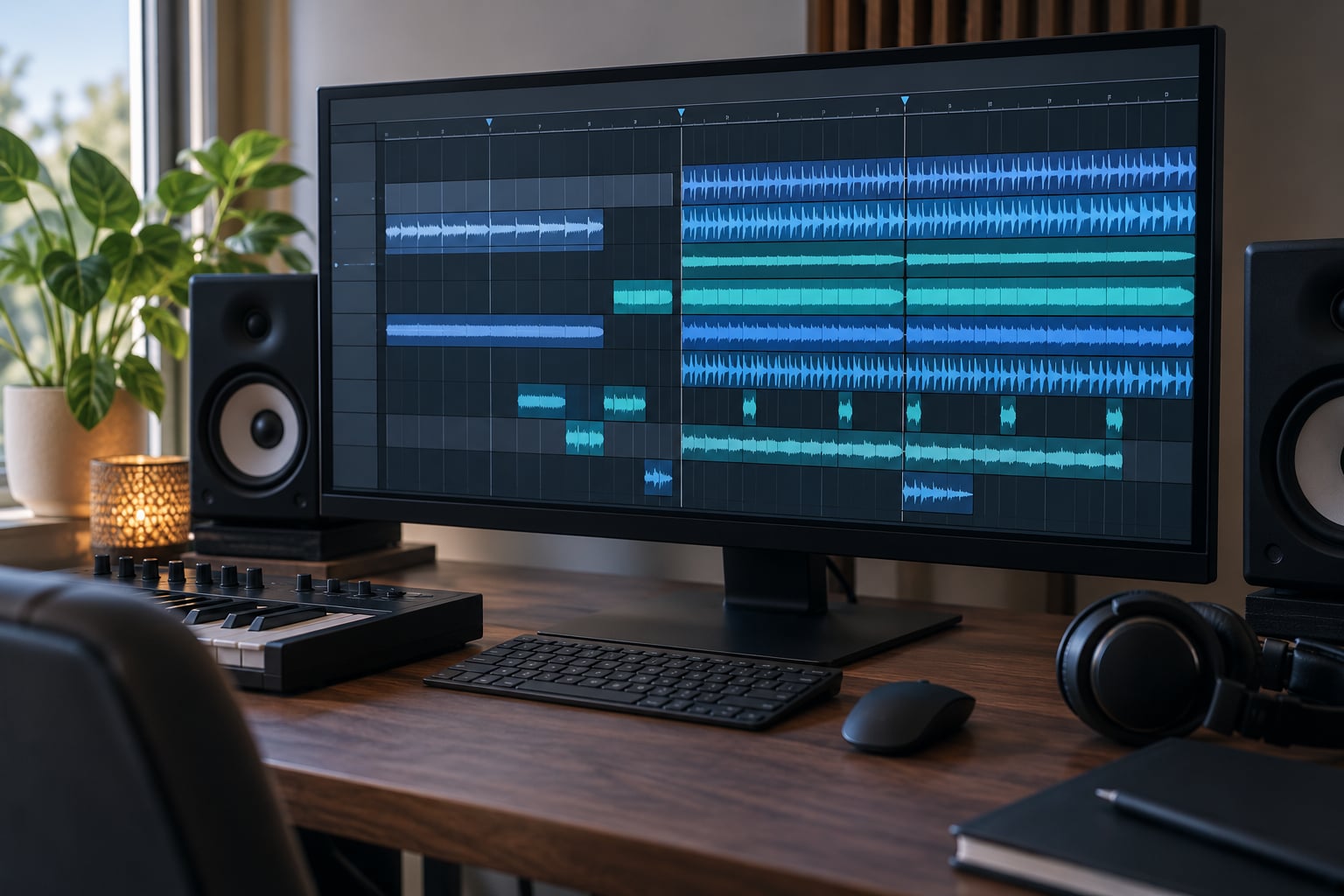
- Label every section. Colour-code intro, build, drop, breakdown and outro. When the labels are visible you can see the bar counts instantly, and an unbalanced intro becomes obvious at a glance.
- Audition with the intro removed. Bypass the intro and play the drop straight away. That drop should still excite you, because the intro has to add anticipation rather than rescue a weak main section.
- Check the first entry. Note the exact bar where the kick or the main hook first appears. If it is later than bar 5, the opening may be too sparse for its genre.
- Automate tension across the whole intro. Filter sweeps, riser volume and reverb throws give a static 32-bar intro a shape. The tension does not have to be loud to be felt.
- Preview the drop transition on loop. Loop bars 25 to the end of the drop and listen five or six times. Anything that irritates you on the sixth pass will irritate a listener on the first.
- Compare at different volumes. A listener on a phone in a car hears far less than you do on monitors. If the intro depends on quiet detail, it will disappear.
- Watch the middle. The energy dip most producers complain about happens around bar 16 in a 32-bar intro. That is exactly where the second new element belongs.
A practical rule from techno production circles is that something new should happen at least every 4 bars: a new element, a kick removal, a hat pattern change, a filter move. Applied to an intro, that gives you four checkpoints across 16 bars and eight across 32, which is plenty to keep a long opening moving.
How Many Bars Before the Drop?
Intro length and pre-drop length are two separate decisions. The intro builds the world, the pre-build tightens it, and the build-up delivers the peak tension immediately before the drop. Each one has a different job, so each can have a different bar count.
A typical club arrangement uses a 32-bar intro, a 16-bar main section, a 32-bar breakdown, a 4-bar pre-build and a 16-bar build-up. That puts the second drop roughly two minutes in, which is the standard length of a festival track that needs to hold a main-stage hour.
For a radio-oriented version, a 16-bar intro followed by an 8-bar build gets you to the drop in about 38 seconds at 128 BPM. The drop is the same; the runway is shorter.
For a streaming-first release, an 8-bar intro with the hook or vocal already present, then a 4-bar build, puts the drop inside 18 seconds. Most listeners will have heard enough to decide by then.
The build-up itself is where producers most often overdo the length. A 32-bar build-up is a long time to sustain tension, and it usually feels better compressed into 8 or 16 bars with the intensity rising across each phrase.
Common Intro-Length Mistakes to Avoid
Defaulting to 16 bars every time. The bar count is an output of the arrangement, not a preset. Write the drop, then write the intro the drop needs.
Adding empty bars with no tension in them. Padding an intro with silence or an unchanged loop is the most common complaint in producer threads. Empty bars read as a mistake, not as space.
Delaying the first beat unnecessarily. Waiting eight bars before the kick arrives wastes the section. Bring the groove in early and strip other elements back instead, which is what subtractive arrangement is for.
Making the drop feel unrelated. If the intro shares no scale, no rhythm or no sound with the drop, the track reads as two ideas stitched together. Borrow one motif from the main section and put it in the intro.
Forgetting how the track will be played. A 64-bar intro is a liability on streaming and a liability for anyone skipping to the chorus. Produce the version you want to exist, then make the edits.
Mixing the intro at full volume only. Balance is easier to judge low, and any masking between the pad and the main synth will only show up on small speakers or a phone.
Writing the intro before the track has an identity. A few producers like starting with the intro to set the mood. Far more get further by finishing the drop first and writing the opening as a way into it.
Frequently Asked Questions
How many bars should an EDM intro be?
Most EDM intros run 8, 16 or 32 bars, and 16 or 32 is the safe default for club-facing tracks. A 32-bar intro gives a DJ enough room to beatmatch and blend, while 8-bar openings suit genres and formats that open with energy already. Start at 16 bars and extend only if the drop needs the runway.
Is a 32-bar intro too long for EDM?
No. At 128 BPM a 32-bar intro lasts exactly 60 seconds, which is close to the one-minute intro many club tracks open with. It only feels too long if nothing changes inside it. Split it into two 16-bar halves, put a new element in the second half, and automate tension across the section.
How long is 16 bars at 128 BPM?
At 128 BPM in 4/4 time, one bar lasts about 1.875 seconds, so 16 bars is 30 seconds and 32 bars is 60 seconds. The formula is seconds = bars x 240 divided by BPM. Use it to check whether the intro you have written matches the duration you actually had in mind.
What is the difference between an intro and a build-up?
An intro establishes atmosphere, groove and identity before any energy release, and it can run anywhere from 8 to 64 bars. A build-up is the final push into the drop, usually the last 4 to 16 bars, where tension peaks. If a section would still make sense after the drop has played, it is intro material.
Should an EDM intro be different for DJ play and streaming?
Yes. A DJ-facing track wants 32 bars so there is a real mixing window, and the listener on a streaming playlist only hears the first 15 to 30 seconds. Put a memorable element in the first 8 bars even if the intro runs to 32, and keep an alternate edit ready that reaches the drop faster.
What is the rule of 32 in DJing?
It is a counting convention rather than a musical law. Count 32 beats, or two 4/4 phrases, back from the point where you want to land the mix so you have time to match tempo and bring the incoming track up in level. Practically it means phrases of 8 or 16 bars, which is why those are the intro lengths DJs can predict.
Conclusion
Start at 16 bars, extend to 32 if the track is going into a DJ set, and check that something changes every 8 bars so the middle never sags. Before anything else, mark where your drop lands and count backwards from it. That one habit answers the question for your track better than any rule of thumb, because the intro is only the right length when it makes the drop land.