How long should a trance track be? Most full-length trance records run 6 to 9 minutes, with club releases landing most often between 6:30 and 7:30. There is no fixed rule, because a trance track’s length is decided by how many bars each section runs, not by a clock you set in advance.
That is the honest answer, and it is also the unhelpful one on its own. So this guide goes further: it converts bar counts into real minutes at different tempos, maps those numbers onto the release formats you actually deliver, and shows you where a track usually needs cutting or extending.
If you are arranging a track right now, work from the bar counts rather than dragging a timeline around until it feels long enough. Updated for October 2026.
Table of Contents
- How Long Should a Trance Track Be?
- What Is the Best Length for a Trance Track?
- How to pick a target length for a conventional release
- How Does Trance Arrangement Affect Track Length?
- What Length Works for Different Trance Subgenres?
- How Long Should a Trance Track Be for Streaming?
- How Long Should a Trance Track Be for a DJ Set?
- How Do You Decide When to End a Trance Track?
- Frequently Asked Questions
- How long should a DJ let a song play?
- How many bars should a trance track be?
- How do I calculate how long my track will be?
- What tempo is trance?
- How long is a typical song intro?
- Can a trance track be too long?
- Conclusion
How Long Should a Trance Track Be?
Six to nine minutes is the working range, and the middle of that range is where most full-length trance releases sit. Shorter versions exist for radio and for some streaming contexts, and longer builds turn up for festival and extended-mix use.
The number you will see quoted most often in producer communities is 6 to 7 minutes for classic and progressive trance. Listeners and DJs in those same threads treat anything past roughly 9 to 10 minutes as a deliberate long-form release rather than a default. Producers also report cutting the final breakdown or the second drop, rather than trimming the intro, when a track runs long.
What nobody does is treat a single duration as universally correct. The same arrangement at 128 BPM and at 150 BPM is a different length in clock time, and a vocal trance track with a full lyric section needs more room than a tech trance track built around one hook. Purpose decides length, and the sections decide the rest.
What Is the Best Length for a Trance Track?
The best length depends on which version you are delivering. Each format has a range that works, and each has a cost you accept by choosing it.
| Version | Typical length | Best for | Trade-off |
|---|---|---|---|
| Radio edit | 3:00 to 4:00 | Airplay, short-form playlists, non-club listening | One breakdown only, so the second half repeats ideas already used |
| Streaming full track | 5:00 to 6:30 | Single releases on streaming services | Repeated 16-bar hooks give listeners a reason to skip |
| Club mix (standard release) | 6:00 to 8:00 | Label releases, Beatport, DJ use | Needs two drops to feel earned rather than stretched |
| Extended or DJ mix | 8:00 to 10:00 | Long blends, headliner and peak-time sets | The extra section has to add something, not just add bars |
| Long-form release | 10:00 and up | Festival slots and dedicated listening sets | Treated as an event piece; streaming listeners rarely finish it |
How to pick a target length for a conventional release
Start at 7:00 for a club mix and treat that as a plan, not a limit. Build the arrangement section by section, count the bars, convert them to time at your tempo, and then decide whether the result suits the use. A track that lands at 6:45 with a full second breakdown is better than one stretched to 8:00 to hit a number.
If you are unsure, the most common delivery is the club mix at 6:00 to 8:00. Everything else on the table is a variation of that arrangement rather than a different song.
How Does Trance Arrangement Affect Track Length?
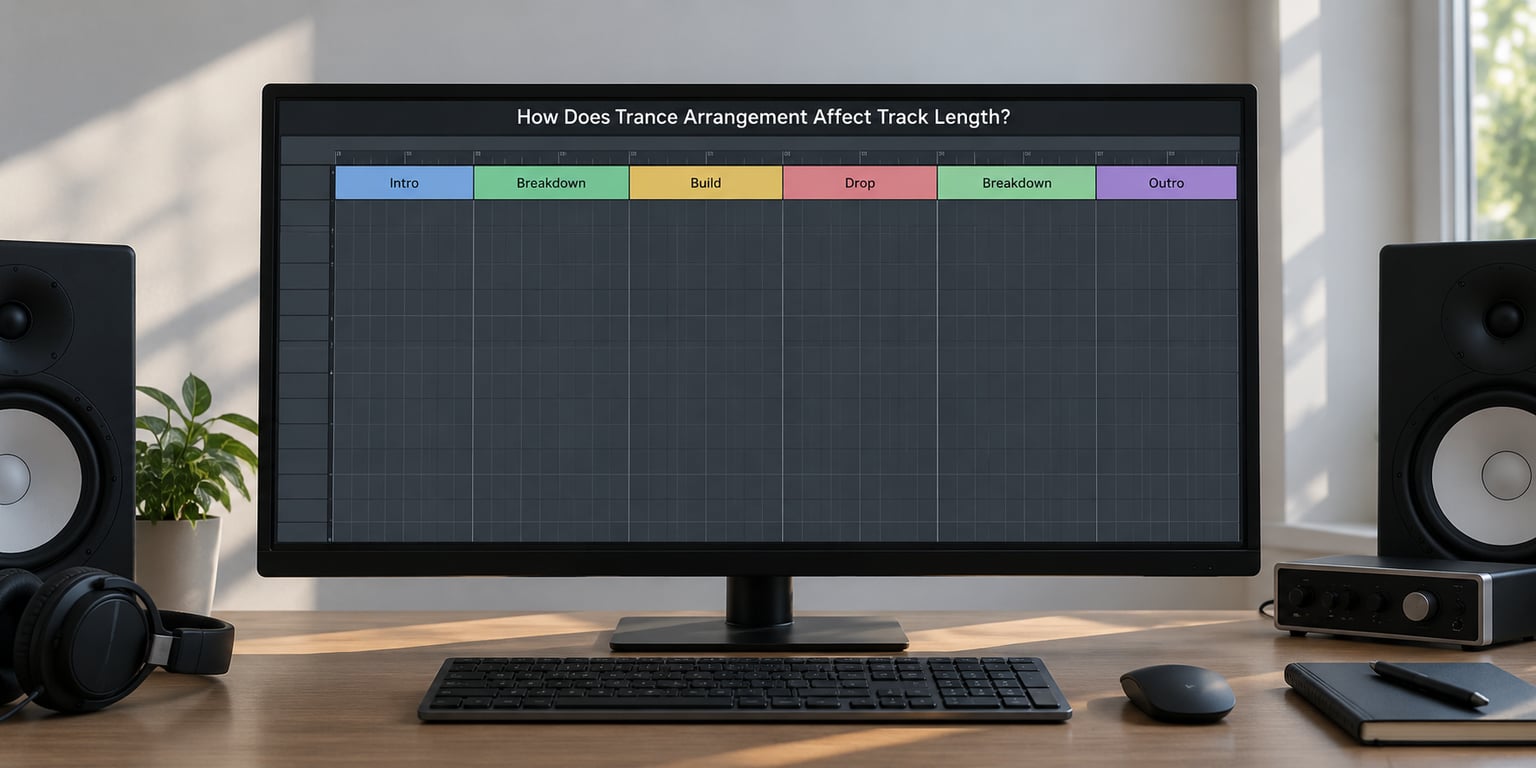
Every section you add moves the runtime by a fixed number of beats. Once you know the tempo, you know exactly what a bar costs you in seconds, and the total length stops being a matter of opinion.
The formula is simple:
Seconds = bars x 4 x 60 / BPM
At 138 BPM in 4/4, one bar lasts about 1.74 seconds. A 16-bar phrase is roughly 28 seconds, a 32-bar section about 56 seconds, and a 64-bar section about 111 seconds. Everything else follows from those three numbers.
Here is a complete 240-bar arrangement mapped to clock time at 138 BPM:
| Section | Bars | Length at 138 BPM | What it does |
|---|---|---|---|
| Intro | 32 | 0:56 | Sets the key and gives the DJ a clean mix-in point |
| Breakdown | 32 | 0:56 | Drums drop out, the lead melody carries the section |
| Build-up | 16 | 0:28 | Layered rise, snare roll, filter sweep into the drop |
| Drop one | 64 | 1:51 | Full arrangement, main payoff of the track |
| Breakdown two | 16 | 0:28 | Shorter reset, usually a variation on the first |
| Build-up two | 8 | 0:14 | Tighter rise than the first for momentum |
| Drop two | 32 | 0:56 | Reprise of the hook, not a new idea |
| Outro | 40 | 1:10 | Long mix-out with drums thinning toward the end |
| Total | 240 | 6:57 | Full-length club mix |
That 240-bar layout gives you 6:57, which sits in the range most releases occupy. It also shows you the two levers: change the total bar count to change the runtime, or change the tempo and keep the bars. Both are honest ways to hit a target. Padding an outro to fill a number is not.
To make a radio edit from the same arrangement, drop the second breakdown, the second build and the second drop, trim the intro to 16 bars, and hold the outro at 32 bars. That comes to 136 bars, about 3:57 at 138 BPM. For an extended mix, add 32 bars of breakdown and 32 bars of drop to the 240-bar layout and you land near 8:50, with enough material to justify every bar.
What Length Works for Different Trance Subgenres?
Subgenres differ less in the number of bars they use and more in the tempo those bars run at. Since clock time depends on BPM, the same 240-bar arrangement can swing by a full minute across the range below.
| Subgenre | Typical BPM | Typical length | Why |
|---|---|---|---|
| Classic trance | 138 to 142 | 6:30 to 7:30 | Melody-first, two breakdowns, long blend-friendly intro |
| Progressive trance | 136 to 138 | 7:00 to 8:30 | Slower, more room for extended breakdowns and harmony |
| Uplifting trance | 138 to 140 | 6:00 to 7:00 | Big emotional hook arrives early, little room to pad |
| Tech trance | 128 to 132 | 5:30 to 6:30 | Denser arrangement, the drop arrives fast |
| Hard trance | 150 to 160 | 5:00 to 6:00 | Fast tempo compresses the same bars into less time |
| Psy and Goa trance | 138 to 148 | 7:00 to 9:00 | Long arcs, many layers, slower builds per phrase |
Do the math on a single 240-bar arrangement and the effect is obvious. At 128 BPM it runs 7:30. At 150 BPM it runs 6:24. At 160 BPM it comes in at exactly 6:00.
Progressive producers who complain their track feels endless are usually writing at 138 BPM with a breakdown count borrowed from slower styles. Tech and hard trance producers who feel rushed are usually writing long arrangements at 160 BPM, where every bar costs well under a second and a 32-bar section passes quickly.
How Long Should a Trance Track Be for Streaming?
For streaming, a full track between 5:00 and 6:30 serves listeners better than a 7:30 club mix, and the difference comes down to how people listen. A streaming listener often meets your track in a playlist, on a phone, without deciding to sit down for it.
That changes what you keep. A 16-bar hook repeated four times reads as padding in a playlist, even when the DJ version needs the space to blend. Trim repeated phrases, keep the intros clean, and let the arrangement move rather than repeat.
Metadata conventions are mostly mechanical. Write the title, the primary artist, the remix credit and the full version label into the file so the right version appears in the right place, and keep the streaming master identical to the club mix unless you have a genuine edit rather than a shortened copy.
How Long Should a Trance Track Be for a DJ Set?
For DJ use, longer is better, and the reason is the blend. Trance DJs routinely mix across 32 to 64 bars, so a track under 5 minutes disappears before a proper blend is finished. Producers with a 4-minute track say the same thing in forum threads: there is simply nothing to mix into.
A workable club mix gives a DJ three things. A usable intro, long enough to bring the previous track out and the new one in without a visible seam. A mix point on a phrase boundary, ideally at the start of a breakdown or at the end of an 8-bar phrase. And an outro that thins out gradually instead of stopping on a downbeat, so the next record can come in early.
Context changes the target. In a club, 6:00 to 8:00 gives a blend with room to breathe. On radio, the DJ talks over the track and uses the length for voiceover, so a full club mix at 7:00 works better than a short edit. At a festival peak slot, a headliner track running 8:00 to 10:00 gives the set a moment. In a livestream, a shorter 5:30 to 6:30 track keeps the online audience moving.
Trance is melody-heavy, so harmonic mixing matters more here than in some other dance styles. Use the Camelot wheel to find a compatible key, keep a constant tempo across the blend, and set a hot cue at your intended mix-out. If your track has no clean drum intro, adding 32 bars of drums and pads at the top usually fixes the problem faster than any mix trick.
How Do You Decide When to End a Trance Track?
Length is an output of the arrangement, so the decision is about the arc rather than the clock. Five checks will get you to the right ending.
- Check the energy arc. Plot the intensity of each section. A healthy trance arrangement rises to a first peak, falls to a second breakdown, and returns for a final payoff. If the curve flattens into the last two minutes, those minutes are not pulling their weight.
- Cut repetition before anything else. If a section repeats a phrase the listener already knows, trim it. Producers usually reach for the outro first, which is the wrong instinct: the outro is what makes the track mixable, so trim the repeated phrase in the middle instead.
- Protect the payoff. The last drop should contain something the first drop did not, even if that something is only a variation on the hook. Without it, the track has no reason to run past the first climax.
- Build a clean ending. Thin the drums, pull the reverb tail, and give the final section 24 to 40 bars. An abrupt stop wastes the outro a DJ needs.
- Compare the runtime with the intended use. Convert your final bar count at your tempo, then check it against the table at the top of this guide. If the number does not fit the format you are delivering, change the arrangement rather than the metadata.
Two failure modes are worth naming. Too short means the first drop arrives in under four minutes and the DJ has no blend available, which producers regularly describe as an unusable track. Too long means a breakdown or second drop that has already made its point, which is padding wearing the same clothes.
Frequently Asked Questions
How long should a DJ let a song play?
A trance DJ usually plays a track for 3 to 5 minutes of its runtime, even when the full length is 7 minutes or more. Long blends across 32 to 64 bars need a clean intro, and a mixed section can hold a floor for several minutes on its own. The rest of the track often gets skipped in favor of another mix point.
How many bars should a trance track be?
Most full-length trance tracks run between 220 and 260 bars, with 240 bars a common total. That produces roughly 6:30 to 7:30 at 138 to 140 BPM. Structure those bars as a 32-bar intro, a 32-bar breakdown, a 16-bar build, a 64-bar drop, then a shorter second cycle and a long outro.
How do I calculate how long my track will be?
Multiply your bar count by 4 beats, divide by your tempo in BPM, then multiply by 60. At 138 BPM one bar is about 1.74 seconds, so 240 bars comes to roughly 6:57. Count the bars in each section of your arrangement, convert once at the end, and adjust the outro or the final breakdown to land on your target.
What tempo is trance?
Classic and progressive trance usually sit between 136 and 142 BPM, with 138 to 140 the most common. Tech trance drops to 128 to 132 BPM and hard trance runs 150 to 160 BPM. Psy and Goa trance sit around 138 to 148 BPM. Tempo changes the length of the same arrangement, so it matters as much as your bar count.
How long is a typical song intro?
A trance intro typically runs 16 to 32 bars, which is about 28 to 56 seconds at 138 BPM. The section exists so a DJ can start the track, match tempo and key, and bring the previous record out underneath it. A 64-bar intro is common on tracks designed for very long blends.
Can a trance track be too long?
Yes, past roughly 9 to 10 minutes a trance track usually carries a section that no longer earns its length, most often a final breakdown or a second drop that repeats the first. Long-form releases above 10 minutes exist and are treated as a separate category. Producers who feel their track is long generally report fixing it by cutting the repeat, not the outro.
Conclusion
Start at 6 to 8 minutes for a conventional full-length trance record, which in bar terms means roughly 220 to 260 bars arranged around 138 BPM. Build the intro, breakdown, build, drop, second cycle and outro from the counts above, then convert once and check the result against the release format you are actually delivering.
If the number is off, change the arrangement rather than the metadata. That is the whole answer to how long should a trance track be: choose the length your format and your DJ need, then let the bar count get you there.