You need two written permissions to clear vocal samples legally: one from the owner of the sound recording and one from the owner of the song or speech underneath it. For a recognisable voice there is often a third layer, a release covering the right of publicity. Most independent producers clear a vocal in three to twelve weeks, and the work is mostly research and paperwork rather than negotiation.
I have watched a lot of beatmakers learn this the expensive way, so this guide walks the whole path in order: what to gather, who to contact, what to write, what to sign, and what to keep on file. Nothing here is legal advice for your specific track. Rules vary by country, and a session lawyer is worth it once real money is moving.
Table of Contents
- What You Need to Clear a Vocal Sample Legally
- How to Clear Vocal Samples Legally: Step by Step
- Identify the Sample and Its Rights Holder
- Check the Intended Use and Relevant Rights
- How to Prepare a Clearance Request Nobody Ignores
- Negotiate and Document the Permission
- Confirm the Release and Keep an Audit Trail
- Common Mistakes
- Frequently Asked Questions
- Do I always need permission to use a short vocal sample?
- Who owns the rights to a vocal sample?
- How much does it usually cost to clear a vocal sample?
- How do I clear an obscure vocal sample with no obvious owner?
- Can I use a vocal sample privately without permission?
- Conclusion
What You Need to Clear a Vocal Sample Legally
Clearance requests get delayed because people send a vague email. The rights holder cannot approve what they cannot picture, so everything below is what you assemble before you write a word.
- The exact excerpt. Timecode in, timecode out, and total duration in seconds. Two seconds and nine seconds are very different asks, so be precise.
- The source, fully identified. Track title, artist, release year, label or catalogue number, and where you found it. For speech, the event, date and speaker.
- A short private demo link. Unlisted, watermarked, and never the public master. Rights holders who find their audio circulating will stop replying.
- Your usage plan. Release formats, whether it is a commercial single, whether sync or advertising use is planned, territories, and how long you want the licence to last.
- Your budget position. Even a rough range tells a manager whether to route your request. Silence on money is read as unlimited.
- Names and contact details. Yours, your artist if there is one, and a lawyer or manager if you have one.
- Your research notes. Who you believe owns what, and where you found it. This speeds up their reply and makes you look organised.
If you cannot identify the original recording at all, stop there. An unattributable vocal cannot be cleared, and chasing it further wastes weeks.
How to Clear Vocal Samples Legally: Step by Step
Identify the Sample and Its Rights Holder
Start with the recording, not the singer. Trace the master backwards: check the label on the release, the copyright line in the liner notes, and the streaming credits, which usually list the label and distributor for the specific recording you are using. Catalogue ownership moves, so a decade-old album may now sit with a completely different company than the one the artist was signed to.
For self-released and unsigned artists, search the repertoire of the performing rights organisations. ASCAP, BMI and SESAC cover the United States, SOCAN covers Canada, and PRS covers the United Kingdom; each has a public repertory search that returns the registered publisher or self-published administrator. The U.S. Copyright Office’s public records system will surface registered works when a track has one.
Then check what is actually licensed to whom. A GearSpace thread on clearing a vocal sample raises the point that performer rights can sit with a party other than the label, and that published songs may have a publisher with their own approval process. Assume you need a signature from more than one desk, and go looking for the second one before you ask.
Check the Intended Use and Relevant Rights
Two copyrights sit under almost every vocal. The sound recording copyright covers the actual captured performance, and the composition copyright covers the words and melody. Both must be licensed for a sample, and the people holding them are frequently different companies with different forms.
| Source type | What you need | Typical difficulty |
|---|---|---|
| Sampled vocal from a record | Master licence plus composition licence | Hardest, two rights holders, longest timeline |
| Vocal from a speech, interview or podcast | Recording owner, speaker permission, possibly a publisher for the text | Hard, and often no publisher exists |
| Re-recorded or interpolated vocal | Composition licence only | Much easier, one rights holder |
| Public domain or government recording | Verification the recording is genuinely free of copyright | Easy once verified |
| Royalty-free or pre-cleared library vocal | The library licence terms, kept on file | Easiest, read the terms first |
| Your own session vocal | Session agreement with release and royalty terms | Easiest, you already own it |
Third layer: if listeners can identify the speaker, right of publicity and personality rights may apply on top of copyright. These are separate claims, they vary by state and country, and they survive the fact that the recording itself is old. A recognisable voice used to suggest an endorsement, a brand, or a political position attracts a different kind of risk than an instrumental chop.
Fourth layer, and this is the one that catches vocal specifically: speech is not music. A recorded interview may have no publisher and no registered composition at all, which means there is no mechanical licence to fall back on and no repertory entry to search. When that happens you are negotiating directly with the person who spoke or the entity that owns the tape, and there is no shortcut through a rights database.
What does not exist is a seconds rule. Two seconds of vocal is not automatically fair, and thirty seconds of vocal is not automatically infringing. What courts look at is whether the use is transformative and whether it takes the recognisable expressive core of the original. A looped vocal chop sitting unprocessed at the centre of a chorus is about as non-transformative as sampling gets.
How to Prepare a Clearance Request Nobody Ignores
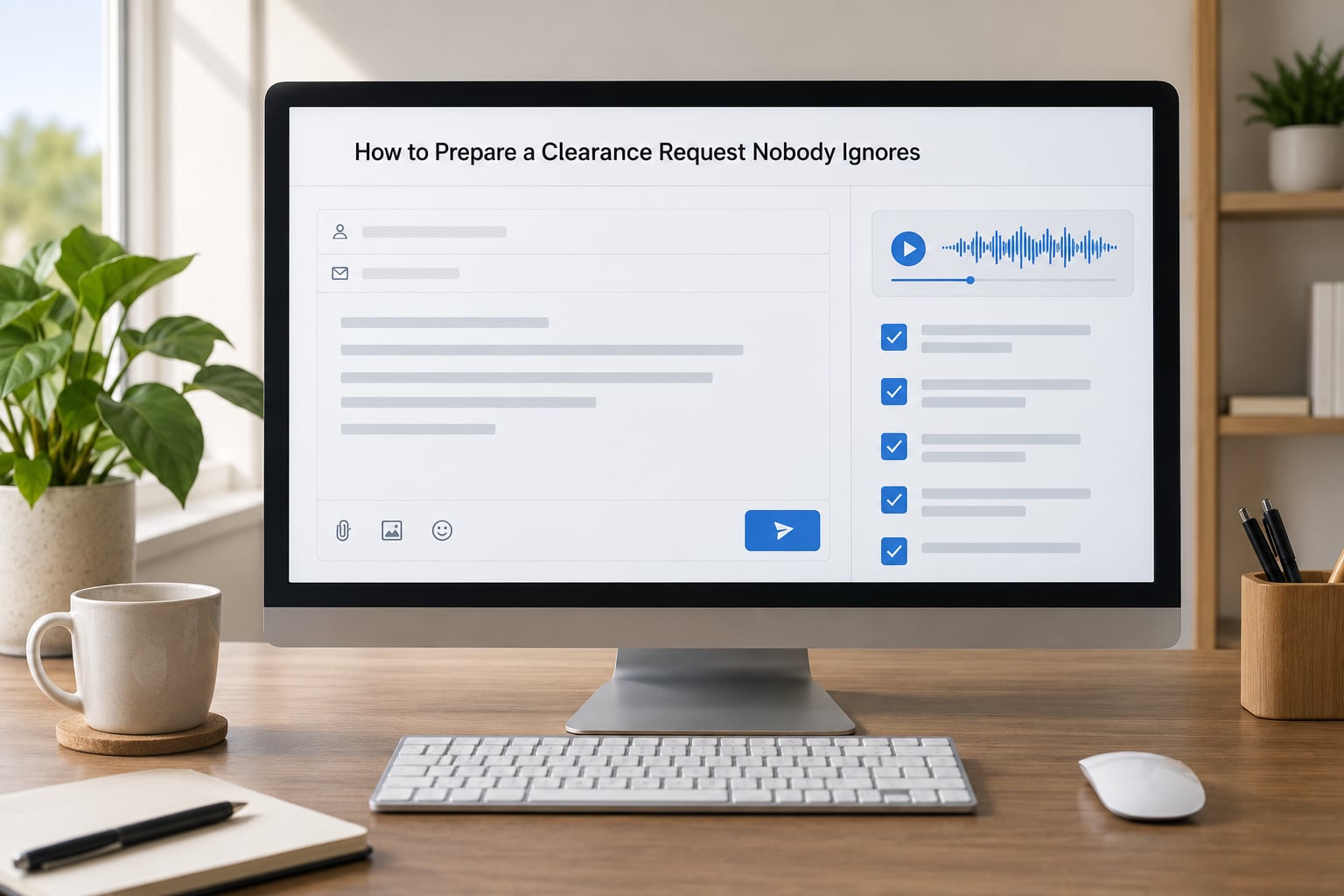
Rights holders judge a request on whether they can approve it without a follow-up email. Put these fields in writing, keep it under a page, and attach nothing you would not want forwarded.
- Who you are and what you are releasing.
- Source track, artist, release year and label or catalogue number.
- Exact timecodes and duration of the excerpt used.
- A private, watermarked demo link with a password if needed.
- Release formats: streaming, download, physical, social.
- Territories you need and the length of the licence you want.
- Whether sync, advertising, film, TV or game use is planned.
- Your budget range or willingness to discuss.
- Credit wording you would honour.
- A response deadline and your contact details.
A workable request reads like this, adjusted for whoever receives it: “I am producing a track that uses 1.4 seconds of the vocal from track X, starting at 0:47 through 0:48.4. The excerpt runs at half speed, reversed, in the bridge only, roughly 14 seconds of the finished track. Release is planned as a commercial digital single in the US, UK and EU within four months, with no advertising use planned at this stage. A private demo is at the link below, password provided separately. We can offer a publishing share, a master advance, or a combination, and we will credit in the usual places. If this is not workable, please tell me early so I can replace it.”
Send it to the licensing or sync department rather than a general inbox, and follow up once after ten business days. On the forums, producers describe the two workable routes as negotiating permission or accepting liability, which is a fair summary of the options in front of you.
Negotiate and Document the Permission
Expect to agree on money and on scope, and treat scope as the part you cannot get back later.
- Advance, royalty share, or both. Recognisable vocals attract higher rates than instrumental chops because the performance carries the identity of the original artist.
- Credit. Get the exact wording and placement agreed, in writing, before release.
- Territory and term. Worldwide and perpetual is normal for a commercial single, and it is what makes the sample usable in sync later.
- Permitted edits. Say whether you may pitch, time-stretch, chop, reverse or filter, and by how much. An unapproved edit can breach a licence you paid for.
- Exclusivity. Be careful if you grant it. Refusing other clearances to the same voice is a real concession and often negotiable for extra consideration.
- Approval of the final mix. Some agreements require the rights holder to sign off on the finished record. Build that review time into your release schedule.
- Declaration of ownership and indemnity. Standard clauses. Read them, and make sure any indemnity is matched to the money you are paying.
Get the agreement signed by both parties. A DM thread where someone says “go ahead” is a starting point, not a licence. It tells you what happened, but in a dispute it is much weaker than a document that names the rights, the parties and the terms.
Confirm the Release and Keep an Audit Trail
Before the track goes live, check that the vocal in the final master is the vocal you cleared. A last-minute re-chop can push the excerpt outside the agreed timecode or bring an unapproved performance into the mix, and that is the kind of detail that turns a signed licence into a dispute.
Then build the file. Keep the signed master licence, the signed composition licence, the request email, every reply, the payment record or royalty agreement, and the exact version of the track each one covers. Save a copy of the cleared excerpt next to the project file so nobody six months later guesses which two seconds it was.
Register the finished work, disclose the sample accurately to your distributor, and expect a question from Content ID or a rights monitoring service. Disclose it properly and these are administrative. Try to sneak an uncleared vocal past automated matching and you have created a takedown on your own release, which is harder to undo than a delay would have been.
On labels: a long-running GearSpace thread makes the point that most labels will not consider a submission with uncleared samples, and that sending a track with the problem attached and expecting the label to handle it is not a workable approach. Clear before the A&R listen, not after the signing.
Common Mistakes
Treating a short sample as free. There is no seconds rule, and a recognisable vocal is the hardest kind of sample to argue as transformative. Duration changes the negotiation, not the legality.
Clearing only the master. The most common failure by a distance. You need the composition licence too, and it lives in a different database under a different name.
Sending a vague request. “Can I use this vocal?” gets ignored. Every missing field is a reason for the rights manager to defer your email until next quarter.
Releasing while you wait. Silence is not permission, and the U.S. Copyright Office’s position is explicit about that. Releasing for free does not protect you either, since rights owners do sometimes sue to establish that a copyright has not been eroded.
Using an uncleared demo publicly. The demo you send for approval must stay private. Playlisting it while you wait turns a permission request into evidence.
Assuming re-recording fixes everything. Recording the same words yourself removes the master licence problem and leaves the composition and the text intact. For published music, a mechanical route may exist, at a statutory rate. For someone else’s speech, GearSpace users flag it as legally unclear and worth a lawyer’s call.
Fighting detection instead of clearing. Producers on r/makinghiphop describe pitching and reversing vocals to slip past matching algorithms. That is managing the appearance of a problem rather than removing it, and the paper trail you eventually hand a label will still be missing.
When clearance fails or never arrives, the alternatives are real: re-record the performance as an interpolation, rebuild the chop from a public domain or government recording, license a genuinely pre-cleared vocal from a library, or commission a session singer to perform something similar. Public domain sources, Creative Commons material with the right licence attached, and government recordings are the least explored of these, and they cost nothing to test.
Frequently Asked Questions
Do I always need permission to use a short vocal sample?
Nearly always, yes. There is no seconds rule that makes short samples free, and a recognisable vocal is difficult to argue as transformative because the performance itself carries the identity of the original artist. Permission comes from the master recording owner and the composition owner, and a recognisable voice may require a publicity release on top. The realistic exceptions are genuinely public domain recordings, properly licensed library material, and uses that a court would call transformative.
Who owns the rights to a vocal sample?
Usually more than one party. The sound recording is owned by the master owner, which is often a label but is sometimes an independent distributor. The words and melody are owned by the songwriter through a publisher or a self-publishing administrator, and you can find that name in the repertories of ASCAP, BMI, SESAC, SOCAN or PRS. The performer may also hold separate rights, and for an identifiable voice, right of publicity applies on top of copyright.
How much does it usually cost to clear a vocal sample?
It depends on recognisability, duration, the size of your project and how the rights are split. Recognisable vocals sit at the higher end because you are borrowing a performance, not just a texture. Terms usually combine a one-off advance with a percentage royalty share, and the publisher side is often cheaper to agree, particularly if you approach the songwriter directly. A clearance service will add its own fee on top, and keeps the deal if it does the work.
How do I clear an obscure vocal sample with no obvious owner?
Start with the recording. Search the performing rights repertories and the U.S. Copyright Office records, then work back through the distributor listed in the streaming credits. If the recording is speech rather than music, there may be no publisher at all, which means no repertory entry and no mechanical licence, so you approach the speaker or the entity that owns the tape directly. If ownership cannot be established at all, the sample cannot be cleared and you should replace it.
Can I use a vocal sample privately without permission?
Posting privately still counts as a reproduction and, in most cases, a public performance, so the copyright analysis does not change much. The practical enforcement risk is low for a private SoundCloud or Bandcamp link, but rights owners do sometimes act to establish that their copyright has not been eroded. Do not stream the file, do not send the link to anyone as a demo, and treat it as temporary until the permission is signed.
Conclusion
Start with one action today: pull the exact two seconds you want to use, note the timecode, and find out who owns the recording and who owns the composition. Everything after that is a written request, a negotiation and a signature.
Write the intended commercial use down before you email anyone, so the request lands complete on the first try. Clear before you publish, before you pitch the track to a label, and before it reaches a distributor, because the cost of replacing an uncleared vocal afterwards is always higher than the cost of clearing it now.