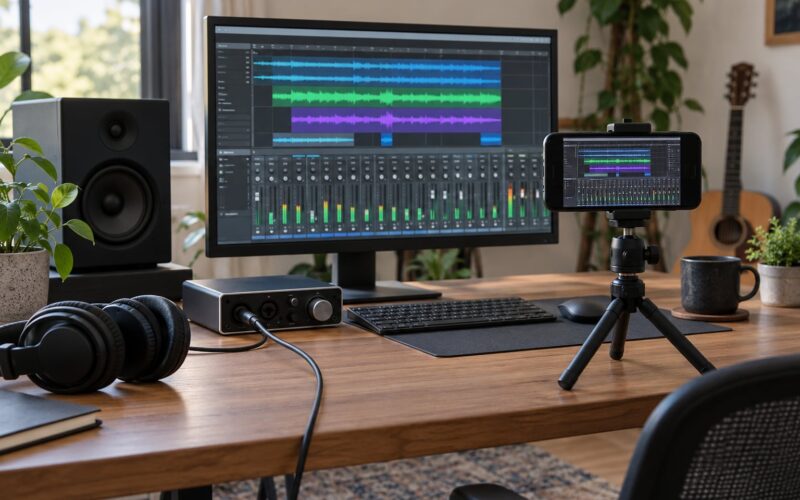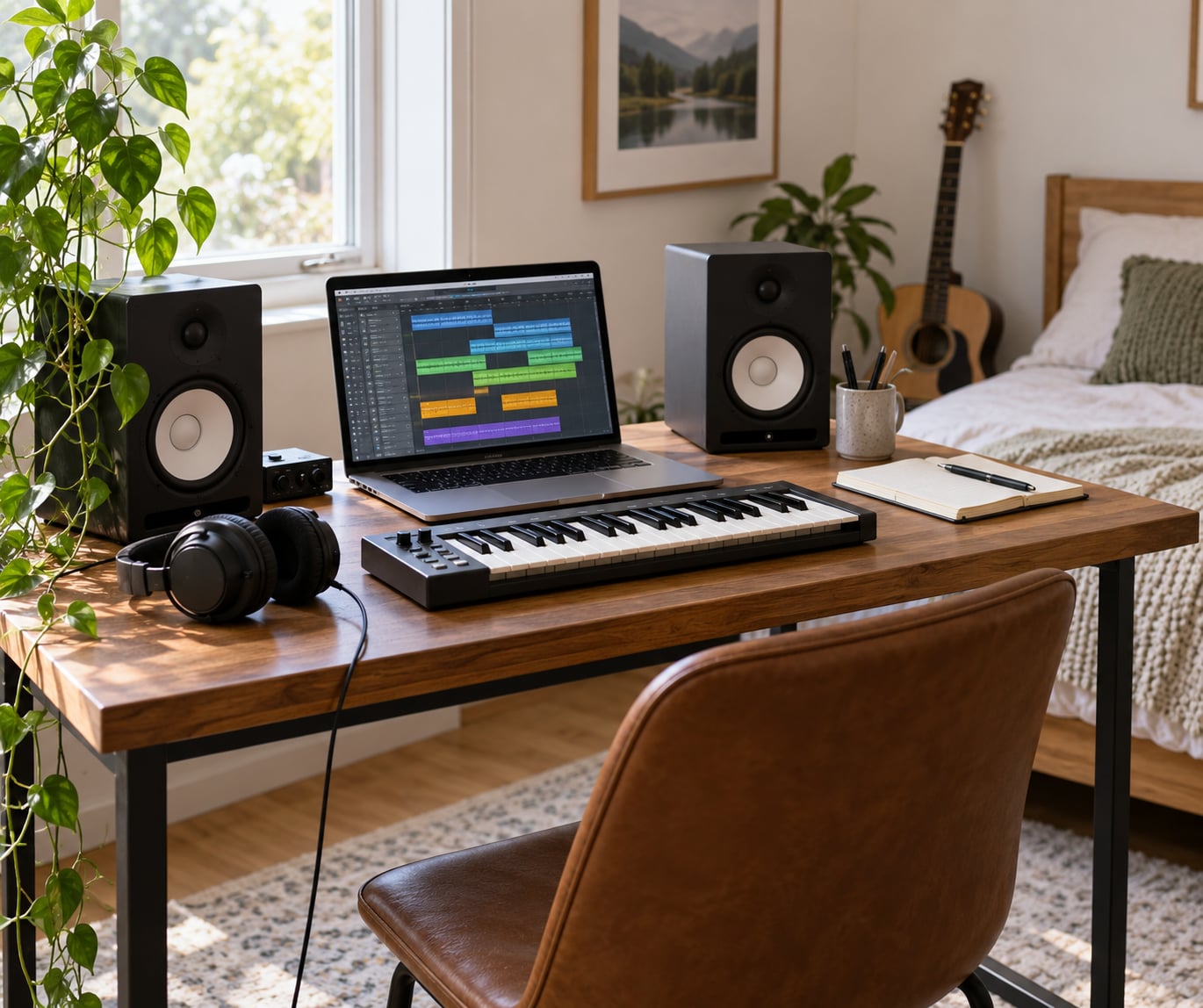
To grow an audience as a bedroom producer, pick one lane, choose one platform where your listeners already are, publish on a fixed rhythm, and make content that teaches something instead of advertising. It takes months, not weeks, and none of it needs a label or a bigger setup.
That is the honest version. There is no trick that makes a bedroom producer famous in a fortnight, and anyone selling you one is selling something else. What does work is a system you can keep running on a weeknight after work, when your DAW is already open and you have maybe three hours to spare.
Most guides on this topic are written for singers who can stand on a stage. If you make beats alone, do not sing, and would rather die than film yourself, most of that advice misses you entirely. This one is built for your version, and it starts with the same question any independent artist has to answer honestly: who exactly is listening, and why would they care?
Table of Contents
- What You Need
- How to Grow an Audience as a Bedroom Producer: Step-by-Step
- Define Your Position and Core Audience
- Choose One Primary Platform and Content Format
- Create a Sustainable Release and Content Rhythm
- Publish Useful Production Content
- Grow Your Audience as a Bedroom Producer With Relationships, Not Numbers
- Use Simple Analytics to Improve What Works
- Common Mistakes
- Frequently Asked Questions
- How long does it take to grow an audience as a bedroom producer?
- Which social platform is best for a bedroom music producer?
- Do I need to release full tracks to grow an audience?
- Should I use the same username across social platforms?
- How often should I post as a bedroom producer?
- Does audience growth require expensive studio equipment?
- Conclusion
What You Need
You need five things before you post anything publicly, and none of them cost money. Skip one and the others stop working, which is why most stalled accounts stall on the same missing piece.
- A clear artist identity. A name, a sound people recognise in three seconds, and a one-line description of what you make. Not a manifesto. A sentence.
- A reliable release workflow. The same path from finished track to live everywhere, so publishing takes an afternoon rather than a week.
- One main social platform. The one your intended listeners already scroll. One, not five.
- One channel you own. An email list or a community space. Platforms can vanish overnight; a list of addresses cannot.
- A basic analytics habit. Twenty minutes on a schedule, looking at a handful of numbers, not a dashboard binge.
A cover image that reads clearly at thumbnail size matters more than people expect, because your release is often judged as a small square next to nine others. Genre tags, a real photo or a consistent logo, and a bio in two lines finish the job. That is the entire foundation. Everything below is built on top of it.
What you do not need is expensive studio equipment, a manager, or a fanbase to start with. Gear affects quality, not discoverability, and no algorithm has ever promoted someone for owning a preamp.
How to Grow an Audience as a Bedroom Producer: Step-by-Step

The order below matters more than the effort level. Producers who jump straight to posting usually quit in month three because they never built anything for the attention to land on.
Define Your Position and Core Audience
A bedroom producer is an independent maker who creates, mixes and releases their own work from a home setup rather than a commercial studio, usually alone and without a label. That definition sounds obvious, but the useful part is what it excludes: you are not chasing a major career, you are building a small, durable audience around a specific kind of track.
To position yourself, combine four things in one written sentence: your style, your production level, the problem your listener has, and who that listener is. A beat seller might write: sample-flip-friendly beats for drill-adjacent rappers who cannot afford a producer’s session fee. A tutorial maker might write: plain-language mixing breakdowns for self-taught producers stuck above 100 Hz mud. Vague versions of these lines, like electronic music for everyone, produce vague results.
| Lane | Who the audience is | Weekly hours | Time to first real supporter | How income arrives |
|---|---|---|---|---|
| Release your own music | Listeners who follow artists, not producers | 6-10 | 6-18 months | Streaming, sync, performance royalties |
| Sell and license beats | Rappers and singers shopping for a track | 4-8 | 2-6 months | Lease and exclusive fees, publishing |
| Tutorial channel | Producers learning a specific skill | 5-9 | 3-9 months | Sponsorships, affiliates, paid products |
| Sample packs and presets | Producers browsing for sounds | 4-8 | 2-6 months | Direct sales and marketplace payouts |
Pick one lane for the first six months. Two lanes means two audiences, two voices and half the attention each, and the split usually leaves both confused. You can cross over later, and producers who release original music while also selling beats usually do better once the first identity is legible.
Useful test: write the sentence, then check whether you could describe it to a stranger in a lift without trailing off. If you cannot, the writing is not finished.
Choose One Primary Platform and Content Format
Choose the platform where your intended listeners already spend time, not where you think you ought to be. The video block on this topic’s search results is entirely short-form vertical video, which is a decent signal about where discovery happens now, but a TikTok account serving a niche sound-design audience beats a large account serving nobody.
Then choose one repeatable format and stay in it long enough to be recognised. Formats that work for producers specifically: short breakdowns of one production decision, screen recordings of a workflow trick, a flip clip showing a loop becoming a full track, or a straight answer to a question other producers ask constantly. The first two need only your DAW and a microphone.
Formats that need a performance do not work for most of you. If you cannot sing, play an instrument live, or want to stay off camera, skip every format that assumes those things. Screen recordings, DAW views, MIDI controllers and hand shots are enough visual material for months.
You can run a secondary channel later, and reposting the same clip there is fine. What kills accounts is starting five formats on five platforms and abandoning all of them in the same month.
Create a Sustainable Release and Content Rhythm
Pick a rhythm you could keep through a bad week, a bad month and a bad quarter. For releases, one single every four to six weeks is a well-worn benchmark, and consistency beats volume every time. Three rushed releases in a fortnight do less than one track you actually finish and promote.
For content, aim for two to four posts a week. That number assumes roughly twenty minutes each, most of which is process footage you captured while making music anyway. Your production sessions generate more raw material than most people ever edit together.
Batch it. Choose a Saturday, make six pieces of content in one session from footage already on your drive, and schedule them across the following two weeks. Scheduling also removes the daily decision of what to post, which is the decision that kills most side projects.
| Week | Release | Content | Relationship work |
|---|---|---|---|
| 1 | Finish and master track one | Two breakdowns from the session | Reply to every comment and mention |
| 2 | Artwork, metadata, scheduling | One flip clip, one workflow tip | Message three artists you respect |
| 3 | Release the single | Two posts about a decision on the track | Post in two relevant communities |
| 4 | Start track two, no pressure to finish | Repurpose the best-performing post format | Follow up on last week’s messages |
Alternate release types to survive slow months. A single every six weeks, with an instrumental or a remix of someone else’s record in between, keeps the profile active without doubling your workload. Reuse process footage from older sessions when a week goes sideways; nobody can tell, and the alternative is a gap on your profile.
Never build a schedule that depends on constant inspiration or a production budget you do not have. Both fail, and they fail quietly, which is why the account goes quiet and the whole thing feels finished.
Publish Useful Production Content
The posts that grow an account are the ones that teach something. A producer asking for followers gets nothing, because there is no reason to follow. A producer explaining why a low end sounds muddy on cheap monitors gives people a reason to come back next week.
Every session contains material for this. A sound-design choice you tested twice. A mixing decision you reversed. An arrangement trick that saved an hour. A workflow shortcut that stops your project file becoming a mess. These are the posts that earn saves and shares, and saves and shares are what recommendation systems read.
Be specific. “Here’s my mixing process” gets skipped. “This is what happened when I high-passed the kick at 60 Hz on a track with a piano” gets watched by people with the same problem. Narrow beats broad. Every post should leave the viewer with one thing they can try tonight.
Show the wrong turns too. The version that failed, the plugin that sounded worse, the arrangement you rebuilt twice. Producers trust producers who admit a mix took three passes, and honesty is easier here than in any other creative field because so much of it is just decisions and results.
Finish with a small request tied to the content. Ask which sample they would have used, or what they would have done differently with the low end. Specific questions get replies, replies create conversation, and conversation is the signal that turns a viewer into a listener.
Grow Your Audience as a Bedroom Producer With Relationships, Not Numbers
Audience growth as a bedroom producer comes from relationships, not numbers. A thousand followers who never press play are worth less than forty people who comment by name, share your work unprompted and open a link you send.
Reply properly. Read what someone wrote before answering, answer the actual point, and skip the string of emoji. Forum and comment threads about bedroom production are full of people asking real questions, and answering two of them a week, well, is more valuable than a month of broadcasting.
Give feedback that costs you something. Tell a lesser producer specifically what works in their mix and why, and what to try next. This is not strategy, it is how friendships in this scene actually start, and it is the cheapest distribution network available to anyone working alone in a small room.
Collaborate across the level gap, not just up. A producer one stage ahead of you is far more useful than someone ten stages ahead, and they are far more likely to say yes. Split EP, mutual remix, track swap, a beat on someone else’s release, a breakdown of each other’s workflow. Each one puts your work in front of an audience that already trusts the other person.
Then follow up. Most promotion dies because the last message was sent and never chased. A short, polite check-in a fortnight later is normal and it works. Sharing someone else’s work, with a sentence saying why it is good, costs nothing and is the most underused tactic in independent music.
Use Simple Analytics to Improve What Works
Review a small set of numbers on a schedule, twenty minutes a week, and stop. The numbers worth watching are saves per post, completion rate on video, where your listeners come from, and monthly listener trend. Follower count is not on the list because it moves for reasons that have nothing to do with your music.
Saves tell you whether something was useful. Completion rate tells you whether your hook worked. Source of streams tells you which platform deserves the extra hour, and the monthly listener trend is the only number that reflects whether people are actually staying. Write down what you changed and what happened, because memory is bad at attribution.
Compare posts against posts, not against other people’s posts. Your tenth video is not supposed to beat your first. Look for the formats that outperform your own average and make more of those, and stop posting the ones that consistently underperform even though you enjoy making them.
| Stage | What it looks like | Rough time in stage | The one thing to do next |
|---|---|---|---|
| Building | A few dozen real followers, occasional comments, no consistent stream source | Months 1-6 | Fix the profile and keep the rhythm |
| Getting noticed | Steady comments, first saves and shares, a handful of regulars | Months 6-18 | Collaborate with people at your level |
| Compounding | People arriving from your content without you asking, repeat listeners | Months 18-36 | Release more often, own the contact channel |
| Established | Incoming requests, a small reliable income, others citing your work | Beyond 36 months | Decide what you actually want from it |
Treat those stages as a rough guide, not a promise. Some producers move faster because their sound lands in a crowded pocket, and some move slower because they work full time and post once a week. Where you are on the table matters far less than whether you are doing the one thing in the final column.
Common Mistakes
Almost every stalled bedroom producer account fails for one of a handful of reasons, and none of them are about talent or gear.
- Changing your sound every few months. The fix is a two-year commitment to one direction. You can refine inside a style for years, and an audience only forms when it knows what to expect.
- Copying whatever is trending. Trends bring a temporary spike and an audience that leaves when the trend does. Use them occasionally as a container for your own content, never as the content itself.
- Releasing with no plan. A track released with no artwork, no post prepared and no pitch written is a track that gets one day of attention. Decide the date, then work backwards through the assets it needs.
- Watching follower counts. The fix is to track saves, watch time and where your streams come from. Followers are a side effect of good work; a target of a thousand per month makes you post things you do not believe in.
- Buying followers or plays. Fake numbers attract advertisers, not listeners, and they pollute the very analytics you are trying to learn from. Any service promising a fixed number of streams for a fee is selling you a number, not a listener.
- Replying with a string of emoji. A reply that takes fifteen seconds and says something specific about what someone made is the difference between a fan and a scroll-past. Read, then answer the point.
- Judging results too early. A post that does nothing on day one can pick up traffic weeks later. Review in batches over a month, not in the hour after posting.
- Doing all of it alone, forever. Share admin, artwork and release logistics with someone who enjoys that side of it. Doing the parts you hate is what ends projects, and the skills involved are cheap to trade.
One more worth naming: treating your account as a shop window rather than a place. Nobody follows a shop window. Post the messy middle of your process, the failed take, the argument you had with a mix, and people will stay for the person as much as the records.
Frequently Asked Questions
How long does it take to grow an audience as a bedroom producer?
Honestly, months to years, and it depends far more on how often you publish than on how good your sound is. Most producers posting two to four times a week see a small but real shift between months three and six, and a handful of regular listeners rather than a crowd. Anyone promising faster results is either selling something or counting something other than listeners.
Which social platform is best for a bedroom music producer?
The one where the people who would enjoy your music already spend time. For most producers that means short-form video, because production process content travels well without a performance. If your listeners are other producers rather than listeners, a long-form platform suits breakdowns better. Pick one, post consistently for three months, then judge it on saves and comments rather than follower count.
Do I need to release full tracks to grow an audience?
No. Most of the audience you build comes from process content, breakdowns and short clips, not from finished releases. A finished track every four to six weeks gives people something to come back for, and that matters, but posting two useful production breakdowns a week will do more for discovery than six unreleased tracks sitting in a folder.
Should I use the same username across social platforms?
Yes, and claim it everywhere before someone else does. One name, one photo, one colour across every platform makes it far easier for someone who discovers you on one to find you on another. Keep your handles identical so the search works, and make sure the bio says in one line what you make so a new visitor knows within seconds.
How often should I post as a bedroom producer?
Two to four times a week is a workable target for someone with a day job, and consistency matters more than the exact number. Batch the filming once a month from footage you already capture while working, then schedule it. If you can only manage once a week, keep that one post rather than committing to daily and disappearing in week three.
Does audience growth require expensive studio equipment?
Not at all. Equipment affects how good a track sounds, not whether anyone finds it, and no recommendation system has ever promoted a producer for owning a nicer preamp. Clear audio and a legible idea carry a long way. Spend on things that remove friction, like a decent interface for clean recordings, and skip anything you would need to justify to somebody else.
Conclusion
Audience growth for a bedroom producer is not a trick. It is one lane chosen clearly, one platform posted to reliably, content that teaches something, releases on a schedule you could keep, and relationships built reply by reply over months.
Start with four things today. Write the one-sentence description of who you make music for and what problem they have. Choose the single platform where those people already are. Publish one useful production post this week, something you learned in the last month. Then review saves, comments and where your streams came from before adding anything.
Keep doing that for ninety days before you judge it. Almost every producer who gives up does it at week seven, right before the compounding starts.