An extended play (EP) is a short release of three to six tracks running roughly 15 to 30 minutes, packaged as one piece with its own artwork and release date. Planning one means writing the concept first, scoring what you already have, fixing the running order, and working backwards from release day. Most independent producers can do the whole thing in four to eight weeks once the songs exist.
The reason to plan instead of dropping singles is simple. A single is one ask for attention and then nothing follows it. An EP gives a listener a reason to press play a second, third and fourth time, and it lets the songs you already proved carry the weight.
If you are reading this with a folder of twelve half-finished sketches, the workflow below will get you to a finished release without scrapping anything.
Table of Contents
- What You Need
- Step-by-Step: How to Plan an EP Instead of Singles
- 1. Define the EP’s central idea
- 2. Set the scope, track count, and completion rules
- 3. Inventory and evaluate every track idea
- 4. Build the emotional and sonic arc
- 5. Design the track order and pacing
- 6. Create a release map and production schedule
- 7. Test the EP as one complete release
- Common Mistakes
- Frequently Asked Questions
- How long should an electronic music EP be?
- Is an EP different from releasing several singles?
- What should the last track on an EP be?
- What if one song does not fit the EP concept?
- Should all tracks on an EP sound the same?
- How do you promote an EP while still releasing individual singles?
- Conclusion
What You Need
You do not need a budget or a team. You need six things, and most of them take an afternoon to assemble.
An EP concept in one sentence. If you cannot write it, you cannot test a track against it later. Something like “four tracks recorded to tape in one room, all under six minutes” is more useful than “dark electronic music”.
Three to five reference tracks. These set the sonic palette: mix character, arrangement density, how loud the low end sits, how long tracks run before they end.
A track inventory. Every idea you have, including loops, stems and abandoned folders. One spreadsheet, one row per idea, four columns: title, date last touched, current state, vibe in three words.
A DAW project template. Producers on r/musicproduction keep asking the same question, and the answer is that consistency comes from the session, not the mastering. Same sample rate, same bus layout, same limiter settings, same limiter plugin, one track per song.
A rough-mix checklist. Five lines you check on every track before it counts as finished: kick and bass relationship, vocal or lead presence, low-end headroom, a reference match, and a note on what the track is supposed to feel like.
A release timeline built backwards. Pick the Friday, count back four weeks for distributor delivery and pitch windows, and work outward from there. Every date in the plan comes from that one choice.
Step-by-Step: How to Plan an EP Instead of Singles
1. Define the EP’s central idea
Start with a musical thesis, not a genre label. The thesis tells you what every track has in common, and it makes the hard decisions later in the process fast.
For trance, a thesis might be one vocal hook repeated across four different emotional registers. For progressive house, a single synth motif that appears raw in track one and fully voiced by track four. For techno, four variations on one drum sound recorded at a fixed tempo range.
Here is the test: finish the sentence and check whether you can name something a listener could point at. “All the tracks here are about leaving” passes. “A collection of my best work” fails, because it rules nothing in and nothing out.
Add two more lines while you are there: who this is for, and the one sonic promise you are making them. Those two sentences become your artwork brief and your lead track decision later.
2. Set the scope, track count, and completion rules
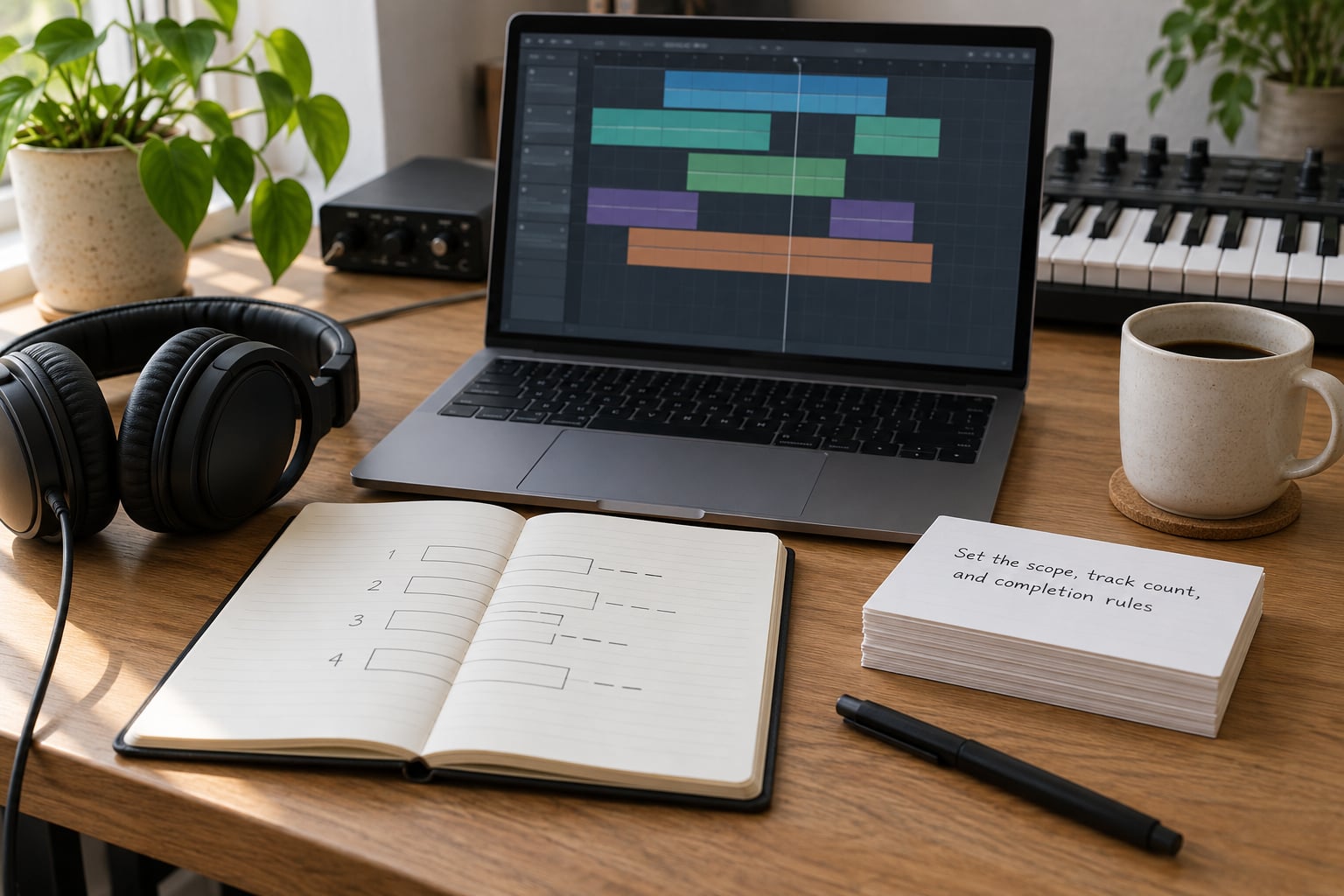
Four to six tracks is the working range. Four is tight and takes roughly two months of finishing; six is comfortable if most songs are already close. Going beyond six is the single most common way an EP turns into an unfinished album.
Write the completion rules down before you start. Mine are: mix bus routed and printed, loudness matching the reference track within a dB or so, arrangement finished or deliberately left sparse, no new sound design after the deadline. A rule you did not write is a rule you will talk yourself out of in week five.
Decide what happens when a song does not finish. My rule is that anything that misses the deadline by two weeks gets shelved for the next release rather than dragging the whole project down. Protecting the release date is worth more than forcing a weak track onto the tracklist.
3. Inventory and evaluate every track idea
Go through the inventory row by row and score each idea from one to five on five criteria: core idea, fit with the EP concept, emotional contrast against the other tracks, production potential, and readiness right now.
Readiness carries the most weight in the early rounds. A five on core idea and a two on readiness is a development project, not a release track, and mixing the two up is how EPs stall.
Four outcomes are possible from a scored list. Keep anything that scores well and is nearly done. Develop anything with a strong concept score and an obvious gap. Combine two ideas that share a hook or a drum sound, which is often where the best fourth track comes from. Cut anything that only sounded good next to the song you wrote it after.
When you are done, your list should have exactly as many rows as your track count, plus a short list of reserves.
4. Build the emotional and sonic arc
Before you decide the order, map the movement. Score every track on energy, tempo, texture and arrangement density, then look at the shape of the set as a whole.
Most EPs that fall flat are not inconsistent. They are flat, four tracks at the same level with no low point and no peak. Contrast is what makes a listener press play on track three.
A workable arc for a four-track release: an introverted opener with few elements, a track with the EP’s core motif, a peak track that uses the full arrangement, and a closer that strips back to something unresolved. Tempo and key can move between tracks as long as the texture changes with them, and an eight to twelve BPM gap between adjacent tracks usually needs a longer or shorter transition to absorb it.
5. Design the track order and pacing
Sequencing is a design job, not a ranking job. Sorting by energy alone gives you a set that starts and stops without shape, and sorting by popularity puts your strongest idea second where nobody hears it.
Five rules I work with. The opener has to establish the world, so it carries atmosphere rather than the biggest hook. The most intense track goes fourth or fifth, never first. Something low-energy sits between the two loudest tracks so the loud ones still register as loud. The closer ends cleanly and can be a little unresolved; a track that feels like it wants a sequel works well here. Transitions matter more than you think, so listen to the last eight bars of one track against the first eight of the next.
The order changes with the goal. A streaming-first release front-loads the track with the clearest 15 seconds. A DJ-friendly set pushes the mixed, beat-friendly track up. A home listen rewards the full arc even when the opener is not the strongest song.
6. Create a release map and production schedule
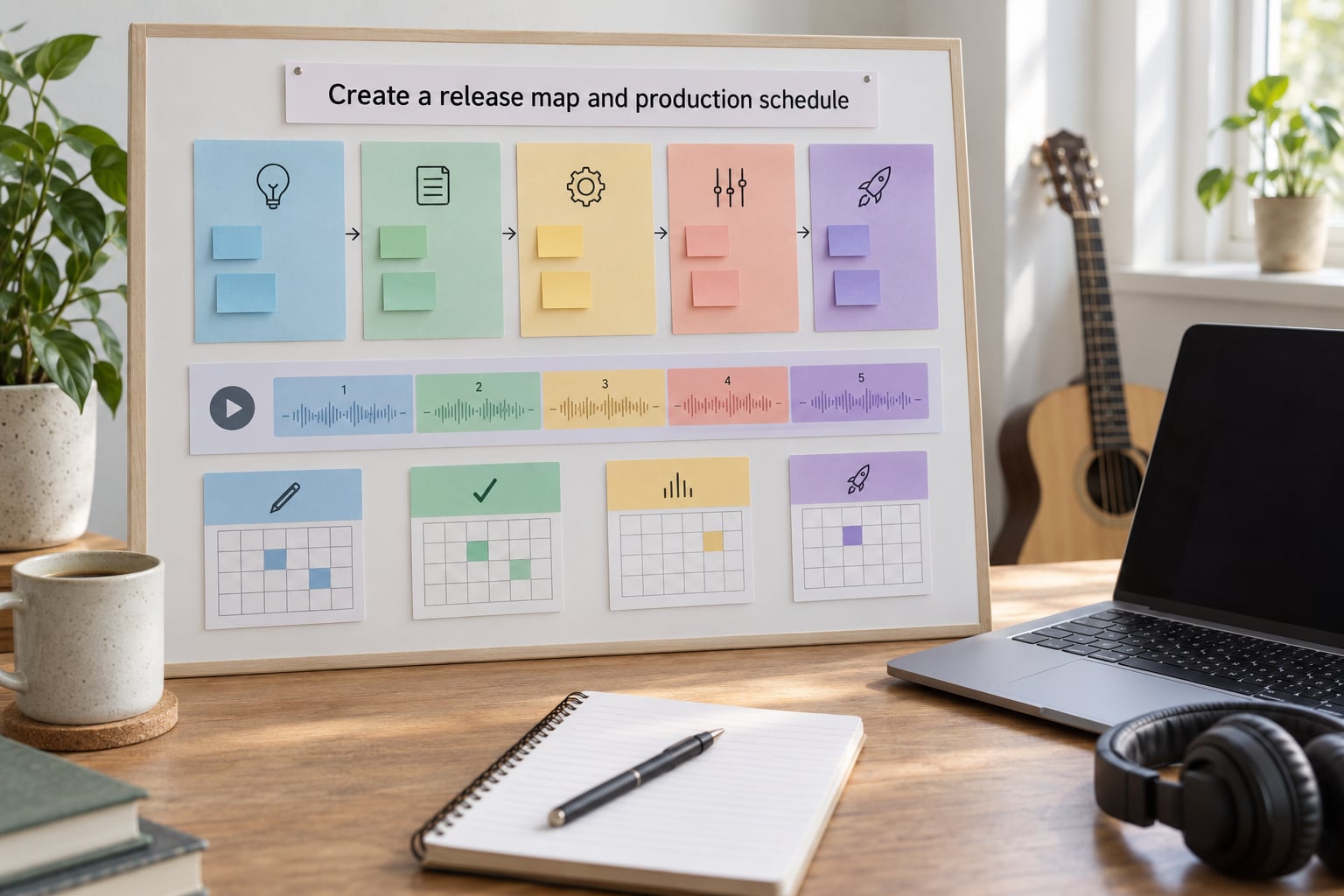
The release map is the document that stops this from turning into a series of singles. One page, one row per track, columns for the owner, the deadline and the current state.
Work backwards from release Friday. Final masters to your distributor four weeks ahead so the editorial pitch window is not missed. Artwork and metadata done two weeks ahead. Mix and master work finished with a revision limit of two rounds per track, because unlimited revisions on four tracks is how an EP never ships.
Add the promotion milestones to the same map: which track is the lead single, which is the focus track, when the announcement goes up, and when the content pieces get made. If the artwork brief from step one has not been written down, write it now.
7. Test the EP as one complete release
Play the whole sequence without touching anything, at low volume in a small room and at normal volume on a decent system. Both listening tests catch different problems.
Write down what you notice. One track suddenly feels a beat slower than the rest. The second transition is jarring. The opener makes you check the title. Those are cheap to fix now and expensive after the artwork is printed.
Get two or three people outside the project to listen without any context. Give them one question: does this sound like one release or a list of songs? If they say list of songs, the concept did not survive the mix stage and no amount of promotion will fix it.
Finish with the checklist: does the sequence state the concept, is there contrast, does the lead track earn the first thirty seconds, does the closer land, and do all the tracks sit at a matched loudness. Only then do the masters go out.
Common Mistakes
Choosing the track count last. Fix: set the number in step two and score your inventory against it. A target makes every keep-or-cut decision trivial.
Including tracks that dilute the concept. Fix: read your one-sentence concept aloud, then check each track against it. Anything that needs a paragraph of justification does not belong.
Using the same arrangement formula on every track. Fix: assign each track a role, such as opener, motif, peak, closer, and write the role above the name before you arrange.
Ordering only by energy. Fix: place your strongest track last, not first, unless the release is being judged in a feed.
Polishing one song forever. Fix: two revision rounds, then move on. Reserve your best judgement for the closing track, not track one.
Promoting individual tracks with no thread. Fix: every post about one track points back to the full release. Fans of one song should find themselves curious about the other three.
On collaboration, decide splits, credits and artwork ownership in writing before release day, not after a disagreement. If the EP is a collab, list both artist names on every track so it appears in both catalogues.
One more note on the singles you already released. Keeping them and stacking them into an EP is a perfectly good strategy, and it is what most successful independent artists do. The difference is that they decide the track count and concept before the singles start, so the singles read as chapters rather than as an accidental collection.
Frequently Asked Questions
How long should an electronic music EP be?
Three to six tracks, running about 15 to 30 minutes total, is the standard range for an electronic music EP. Four tracks is the sweet spot for a first release because it is achievable solo in about two months of finishing work. Six works well when most songs are already close to done. Beyond six, the project usually turns into an album that never ships.
Is an EP different from releasing several singles?
Yes, and the difference is planning rather than track length. Singles released one at a time need no shared concept, order or completion date, so each one is judged on its own. An EP is designed as a single listening experience: one concept, one sound, a fixed tracklist and a release date. Singles can still feed into an EP, provided the concept and track count were decided before the first one went out.
What should the last track on an EP be?
Choose a track that ends cleanly and leaves a little unresolved, so the listener feels the story finished rather than the project abandoned. A closing track that reuses the EP’s core motif, stripped back to fewer elements, works well in electronic music. Avoid closing with the loudest, busiest track on the release, and avoid closing with a track so unresolved that listeners assume a part two is coming.
What if one song does not fit the EP concept?
Move it to your reserve list and keep working the release without it. A track that does not fit usually signals a concept problem, not a song problem, so it is worth checking whether your one-sentence concept was written loosely. If the song is genuinely strong, it becomes the first single of the next release. Shelve it rather than reshaping the whole EP around one track.
Should all tracks on an EP sound the same?
No, they should sound related. Matching loudness, mix bus treatment and sound design quality matters more than matching tempo or key. Electronic releases often vary by eight to twelve BPM between adjacent tracks, and that is fine when the texture changes alongside it. What listeners notice as inconsistent is a mismatch in level and production quality, which is why the DAW template and mastering brief matter more than a fixed BPM.
How do you promote an EP while still releasing individual singles?
Pick one lead single and one focus track from the finished release, and promote those two rather than all four equally. Release the lead single a few weeks ahead of the EP, then reuse every post about that track as a reason to hear the full sequence. Every piece of content should point back to the release so the audience arrives with context rather than a single song and nothing else.
Conclusion
Four things you can do today. Write your concept in one sentence. Choose the track count, probably four. Score every idea in your folder against that count. Draft the emotional order before you arrange a single track.
That is the whole difference between a stack of singles and an EP. Singles ask for attention once; a planned release is built so the listener stays for the whole sequence. Treat it as one listening experience and the four tracks stop being four separate problems.