Joining a producer feedback community takes about an hour. Pick the kind of note you need, choose a subreddit or Discord server whose rules match that request, join, read the pinned posts, reply to two other members’ tracks, then post your own with two specific questions. Here, producer means music producer — mixes, DAWs and arrangement feedback, nothing about film or manufacturing.
The reason it works is simple. After three hours in a session your ears stop being reliable judges, and a stranger with fresh ears catches the low-end pileup or the vocal sitting nowhere in thirty seconds. You want critique, not compliments, and communities are the cheapest place to find it.
Table of Contents
- What You Need
- Step-by-Step: How to Join a Producer Feedback Community
- 1. Define the feedback you need
- 2. Find communities with relevant rules and members
- 3. Join a producer feedback community, read the rules, and observe first
- 4. Prepare a track and a useful feedback request
- 5. Share the work and interpret the responses
- 6. Keep improving and build ongoing relationships
- Common Mistakes
- Frequently Asked Questions
- Can beginners really get useful feedback from a producer feedback community?
- Is free peer feedback good enough, or should I pay for mix feedback?
- Should I join a feedback community for my genre only?
- Is it safe to share unreleased music in these communities?
- What do I do when the feedback I get contradicts itself?
- Start With One Focused Review
What You Need
Four things, and skipping any of them is the reason most first posts get ignored.
A track that is finished or nearly finished. Communities are not a place for open-ended concept stages. If your arrangement is still changing week to week, ask about one element instead of the whole song.
A clear feedback goal. One track, one question. “Is this mix too bright?” is answerable. “Does this work?” gets polite vagueness back.
Basic project details. Genre, DAW, rough length, whether it is a demo or near release, and what you already tried. Reviewers cannot help with what you hide.
A willingness to receive notes. And a willingness to give them. A long-time poster on the KVR Audio forum put it plainly: people have to actually want constructive criticism, not a pat on the back.
Step-by-Step: How to Join a Producer Feedback Community
1. Define the feedback you need
Different communities have different scopes, and you will waste a week posting in the wrong one. Sort your request into one of four buckets first: arrangement and song structure, sound design and mix, vocal and low-end balance, or a pre-master sanity check on loudness and dynamics.
Mix-specific communities deliberately narrow themselves. r/mixingmastering states in its own description that feedback there is on the mix, and that other subreddits are more appropriate for composition, performance and production feedback. r/Songwriting and r/WeAreTheMusicMakers lean the other way, toward writing and the finished song.
How to tell you picked right: the community’s pinned rules name your exact question. If you cannot find a rule that either allows or bans what you want to ask, assume it is off-topic and find another home.
2. Find communities with relevant rules and members
Most people land in one of three tiers, and the tier matters more than the specific group.
Free peer communities. On Reddit, r/mixingmastering and r/musicproduction are the busiest mix-adjacent subs, r/WeAreTheMusicMakers covers the whole craft for artists, r/recordingmusic and r/ableton are DAW-and-room oriented, and r/Beatmatch runs a weekly mix feedback thread with an explicit reciprocity rule. On Discord, producer servers are where live feedback streams and sample-pack level bots live. There is no single best Discord for producers — what matters is whether its feedback channel has recent, specific replies in it.
Long-form forums. KVR Audio and Gearslutz skew toward gear discussion, but both have production-technique sections where the posters have decades of release history. Longer posts get longer, more technical answers, and you can see a person’s track history before you weigh their opinion.
Paid one-on-one critique. Worth it when you need a release decision rather than opinions. Set expectations honestly: peer communities give you surface-level comments from people at roughly your skill level, which is useful for catching gross problems and useless for judging whether a track is finished.
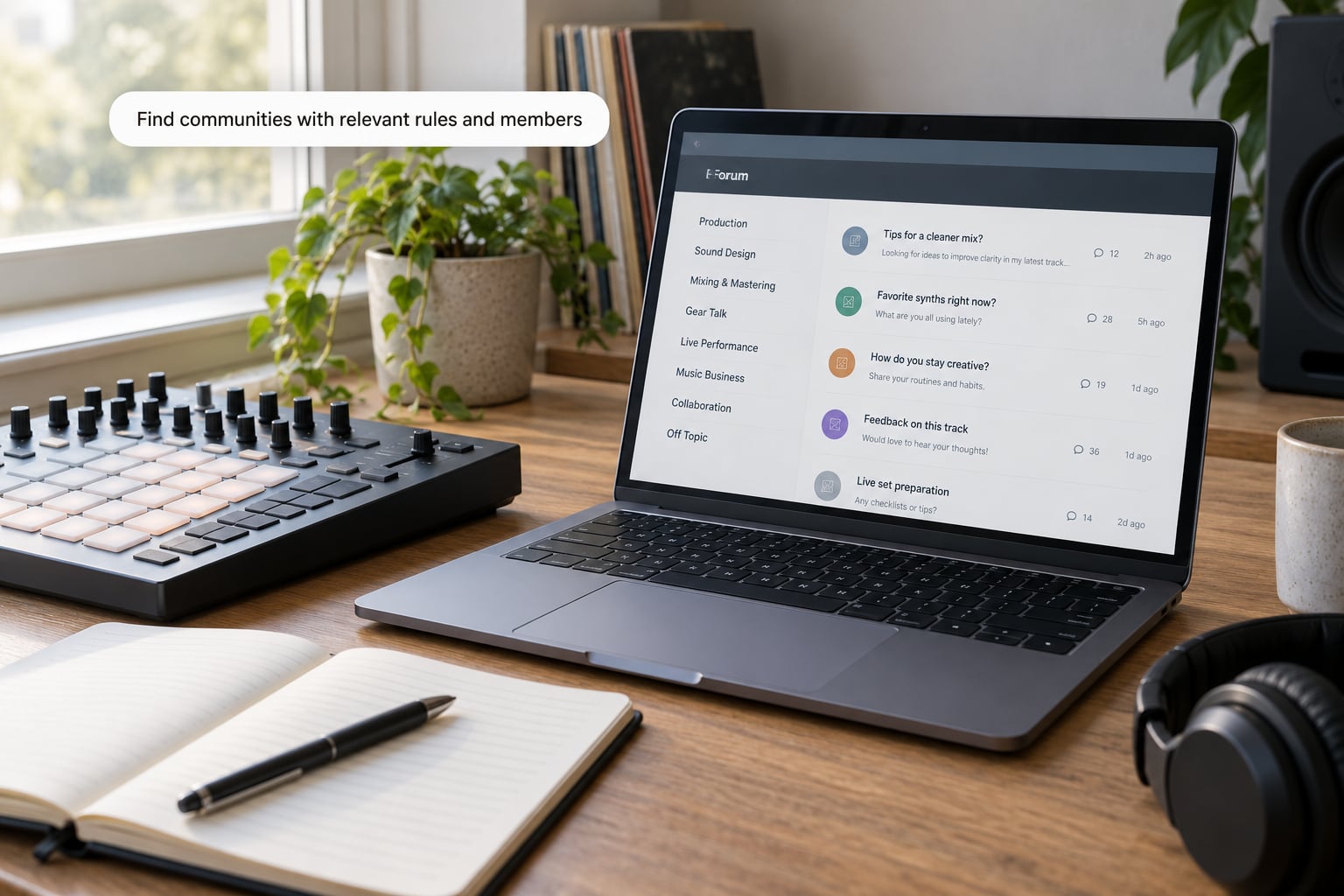
Community activity is the filter. Open a subreddit, scroll the last month, and count how many feedback posts got real replies. If the newest one is three weeks old, joining there is pointless.
3. Join a producer feedback community, read the rules, and observe first
Create the account, then set a flair. Flair is how moderators route posts to the right readers and how other members know your genre and level. A post tagged as a hip-hop beat from someone with 200 tracks in their history gets a completely different response than an untagged one.
Then read before you write. Check the subreddit’s About and rules sidebar, and open the pinned weekly feedback thread. This is where the format rules live, and breaking them is the fastest way to get a post removed without a warning.
r/mixingmastering, for example, requires that the person posting is the mixing or mastering engineer of the submitted work. r/Beatmatch’s weekly thread asks submitters to spend time listening to others and leaving feedback in return. Both rules exist for the same reason: reciprocity is what keeps a feedback thread alive.
Spend a week reading before posting. Then reply to two people properly — a timestamp and a specific observation each. That is how you learn the house style, and it builds the standing you will need on day one.
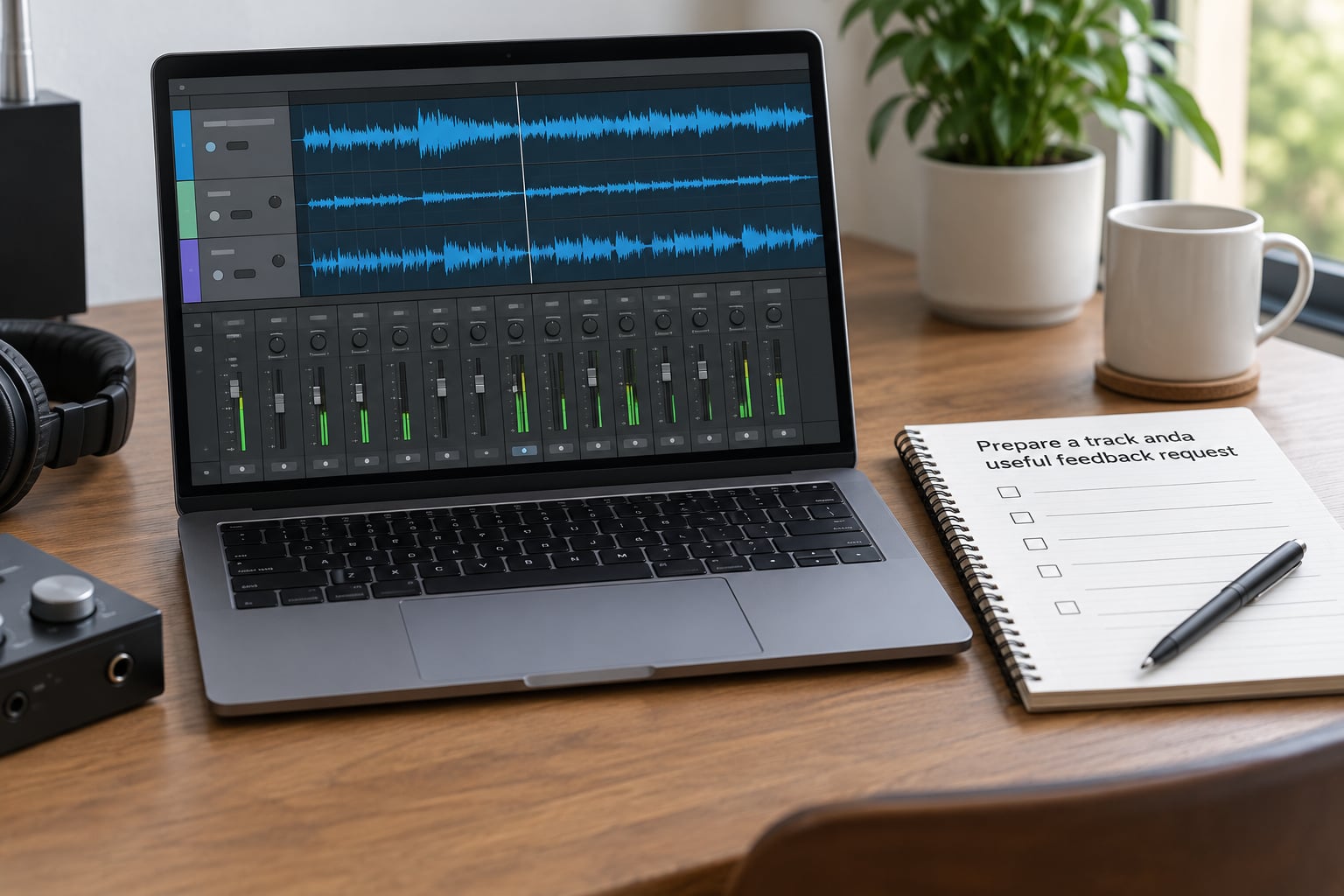
4. Prepare a track and a useful feedback request
Pick the version you actually want judged. Not the rough bounce from three weeks ago, not an unfinished idea. If the vocal comp is still in dispute, fix it first, because notes on it will be wasted.
Write the context in two or three sentences: genre, DAW, what the track is trying to do, what you have already tried. Then ask two or three pointed questions instead of asking whether the track is good. Pointed questions get pointed answers.
A format that works well:
Genre: melodic techno, 124 bpm. DAW: Ableton Live. Mix is done, arrangement is final.
Question 1 — 1:12 the vocal sits behind the kick in the chorus. Is that masking or just arrangement?
Question 2 — 2:40 the sub disappears on small speakers. Would you fix this at mix or leave it for mastering?
Question 3 — Does the low end feel right on headphones? I have limited speaker monitoring.
Also add the reference track you are matching against, the format of the link, and whether self-critique or revision is welcome. Reviewers who know what you are aiming for will chase the same target you are.
5. Share the work and interpret the responses
Post during the community’s active hours, in the thread type that exists for exactly this — the sticky weekly thread where there is one, a dedicated feedback channel otherwise. A standalone post asking for feedback is more likely to be redirected or removed.
Expect a spread. One person hears mud in the low end, another hears it as warmth, a third gives you a genuine problem. The useful move is to look for the note that appears three times in different words, not the loudest single opinion.
Reply to every commenter, even briefly. Thanking someone who spent five minutes on your track is the cheapest reputation you will ever buy, and it is what gets you replies next time. If you disagree, say so with a reason rather than a silence — plenty of good arguments in these threads come down to taste, and taste is worth nothing unless you can name it.
Watch for a second pattern too: reviewers who reach for preset advice. Sidechaining pads to hats and boosting highs gets repeated often enough to become a reflex. A veteran poster on KVR Audio dismissed that kind of comment as recycled DAW clichés that help nobody. Feedback that cannot point at a frequency, a timestamp or a balance decision is a guess.
6. Keep improving and build ongoing relationships
Keep a revision log. Every time feedback comes in, note the timestamp, the note, and whether you acted on it. Three tracks later the pattern is obvious: your recurring blind spot is usually in one narrow frequency band or one type of arrangement decision.
Then give back. The same thread that gave you notes on your mix is how you build the standing to post again with something more ambitious. Listening to other people’s tracks is not politeness overhead — one poster put it as the condition for receiving anything at all: you only get feedback if you listen to and evaluate music from outside your own genre.
That cross-genre habit is worth more than it sounds. Producers stuck inside one style tend to hear confirmation instead of critique. Someone who works in ambient or in jazz will hear things about your arrangement that a dozen techno peers will not.
Repost only when you actually changed something, and say what changed. A version log turns a stream of posts into a thread people follow.
Common Mistakes
Posting into an empty thread. Check the last activity date before you write. A quiet community is a dead community, no matter how many members it shows.
Asking “is this good?” with no question attached. You will get “sounds great, nice work” and learn nothing. Specific questions produce specific notes.
Posting an unfinished track with no context. Reviewers cannot tell whether a rough section was intentional. Say what is finished and what is not.
Asking before you have contributed. New accounts that post a track on day one get silence. Give feedback on two tracks first.
Ignoring the rules. Link format, self-promotion limits and engineer-of-record requirements are enforced. Read the sidebar, not the comments about the sidebar.
Reacting defensively. If three people hear the same problem, it is in the track, not in their taste. One poster on r/musicproduction described the trap well: chasing positive feedback until it matters more than the music.
Treating one opinion as a verdict. Communities are peers, not a focus group. Collect notes, look for repeats, and keep the decisions that match your intent.
Three habits cover most of it: read the thread twice, answer at least three other people per post of your own, and keep every note you receive in one document. The document is what turns a community into a feedback loop.
Frequently Asked Questions
Can beginners really get useful feedback from a producer feedback community?
Yes, as long as you ask a specific question instead of asking whether the track is good. Beginners get the most value from balance, arrangement and vocal placement notes, where a second pair of ears catches problems you stopped hearing hours ago. What beginners rarely get is release-readiness judgement from peers at the same level, so treat community feedback as one input rather than a final call.
Is free peer feedback good enough, or should I pay for mix feedback?
Free community feedback is enough for most stages: catching gross balance problems, arrangement choices and translation issues. It is not enough when you need someone to tell you whether a track is finished and ready to release. That is the point to pay for a written critique or a full mix, because peers cannot assess commercial viability in your genre as reliably as someone who ships records.
Should I join a feedback community for my genre only?
No, not only. Genre-specific communities are the right place for release standards and arrangement conventions, but cross-genre listeners tend to notice structural problems that same-genre peers approve. Producers on the KVR Audio forum recommend listening to and evaluating music outside your own genre as a condition for getting useful notes in return. Keep one genre community and one unrelated one.
Is it safe to share unreleased music in these communities?
It is reasonably safe but not risk-free. Anything you post can be screenshotted and shared, and some servers and forums are publicly indexed. If the track matters commercially, post the mix without a public title and reference check, or upload through the community’s private submission channel if it has one. Never share stems or project files, and strip metadata from the file if the release is sensitive.
What do I do when the feedback I get contradicts itself?
Sort the notes by whether they name something specific. A note pointing at 2:40 and a frequency range is a measurement; a note saying it sounds muddy is a preference. Implement the measurements first, since they are testable, then judge the preferences against your intent. When notes genuinely conflict, make the decision yourself and log it, otherwise you will oscillate between versions forever.
Start With One Focused Review
Pick one community today, read its rules and its most recent feedback thread, and reply to two tracks before you post anything of your own. Then request feedback on a single defined aspect of your next track rather than the whole song — one community, one question, one finished week of listening. That is how to join a producer feedback community that keeps giving you notes after the novelty wears off.