To practice production deliberately, you run short sessions on one measurable skill instead of one long session on whatever comes to mind. Pick a single outcome, remove the variable that lets you hide, work in one focused block, bounce the result, and write down the next experiment. Do that five sessions in a row and you will move faster than a year of open-ended beat-making.
The reason is simple. Hours in a DAW only rehearse the habits you already have. Deliberate practice is structured, goal-directed time spent on the one weakness holding your tracks back, broken into small repeatable drills, done slowly, with immediate feedback on whether it actually improved.
This matters most for the producer who has been at it for six months or more and feels stuck. If you finish the same style of beat every month, cannot name what changed in the last six months, or spend more time in YouTube than in your DAW, the problem is not talent or gear. It is that nobody ever told you to practise on purpose.
Table of Contents
- What You Need
- Step-by-Step: The Deliberate Practice Cycle
- Set One Measurable Production Goal
- Choose a Deliberate Constraint
- Work in Focused Practice Blocks
- Record and Review the Result
- Write the Next Action
- Build a Practice Queue
- Review Progress Every Two Weeks
- Common Mistakes
- Frequently Asked Questions
- How long should a production practice session be?
- What should I practise first as a beginner?
- Do beginners need a formal curriculum?
- How do I choose an exercise when I have no idea what to work on?
- How do I know when to stop a session?
- Conclusion
What You Need
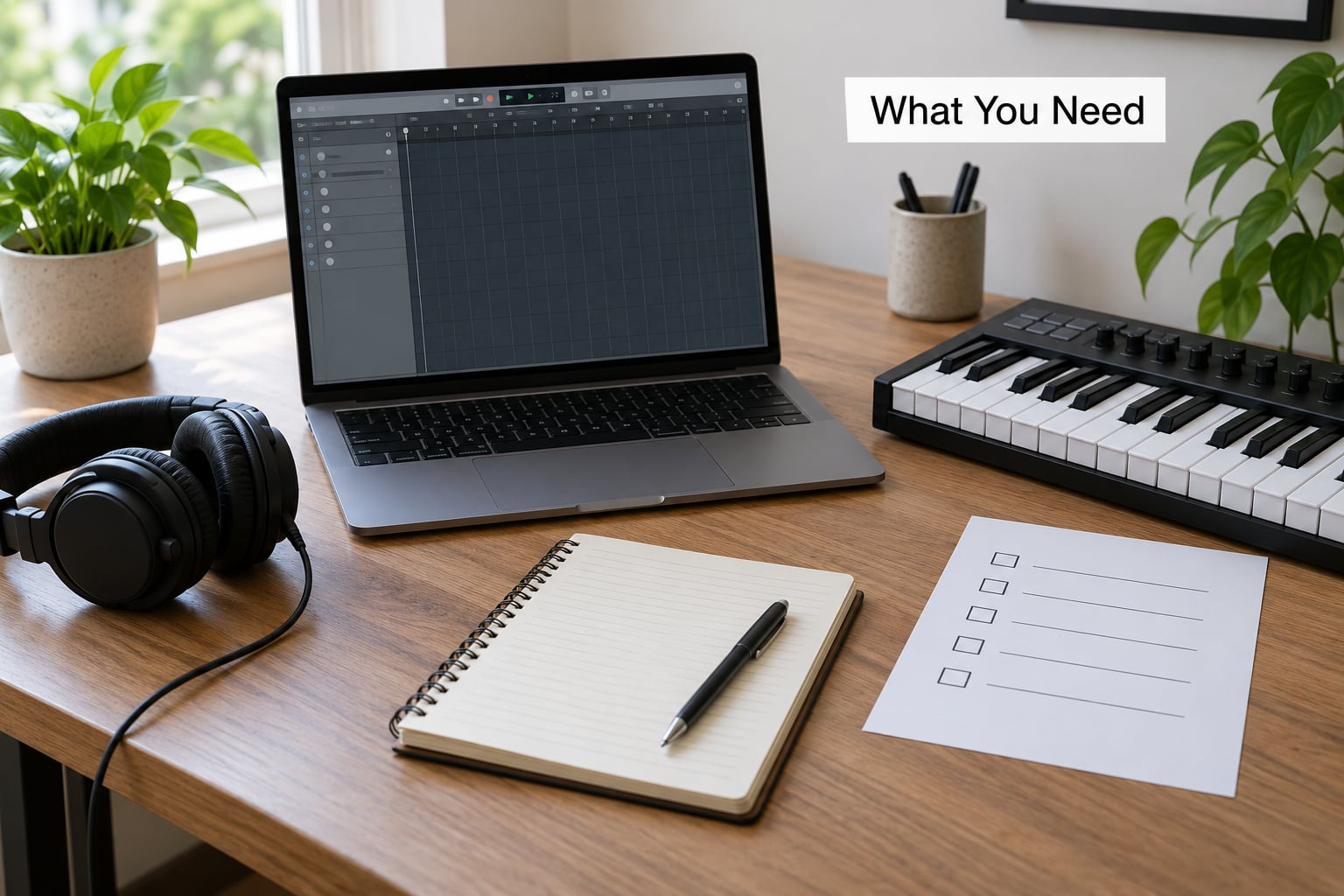
You need almost nothing. The whole system runs on a DAW you already own, one reference track and a way to write down what happened.
- A practice template project. Open a blank session with your buses, sends and limiter already patched so no routing is part of the exercise. The same template works in Ableton Live, FL Studio, Logic Pro, Cubase, Studio One, Bitwig or Reason.
- One reference track in the genre and energy level you actually want to make. Pull up something well mastered and reasonably busy, because sparse mixes have fewer decisions to study.
- An export path. Know where your bounce lands before you start. In Ableton, Logic and Cubase it is the export or bounce dialog; in FL Studio, Studio One and Bitwig it is Export Audio; in Reason it is Export Song.
- A loudness-match utility where your DAW ships one. Ableton has Utility, Logic has Adaptive Volume, Studio One has Match Loudness. Without it your ears will lie to you about which version is louder.
- A practice log. A plain text file, a spreadsheet, a notebook. One line per session is enough: goal, constraint, result, next action.
Prepare the session in the five minutes before you start, not during it. Open the template, load the reference, drag the decay knob, and note the three things you are testing. Starting cold costs you the first twenty minutes of a ninety-minute block.
Step-by-Step: The Deliberate Practice Cycle
The cycle is seven steps and it repeats. Once you can run it without thinking, you can run it on any skill in any genre.
Set One Measurable Production Goal
Write one sentence that names an observable outcome and a time box. Not “work on my mixing”, but “get a clear kick and bass balance in a 120 BPM trance loop inside 45 minutes”.
Test the goal against three checks. Can a stranger look at the exported file and tell whether you hit it? Would you know within seconds of listening whether it worked? Does it name a skill rather than a genre or a vibe?
One goal per session. Two goals means you will spend the whole block on whichever one is more fun, which is the reason you are reading this.
Choose a Deliberate Constraint
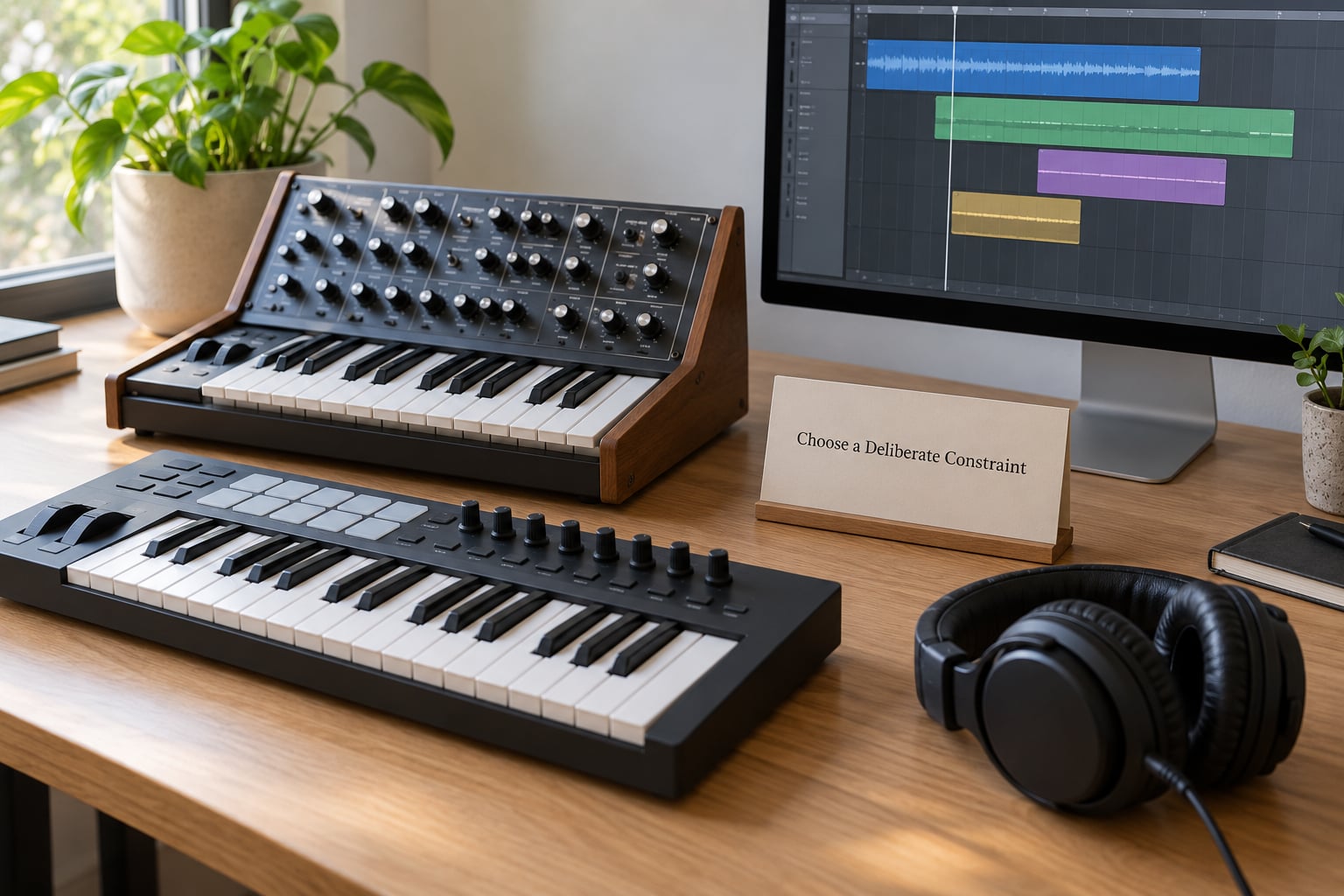
A constraint removes the option you usually hide behind. If you limit the variables, you have to make decisions instead of browsing presets.
Constraints that work well: only stock plugins, only one synth, a fixed 8-bar arrangement length, a locked tempo, no EQ after the first pass, gain staging frozen at the fader positions you set on day one.
Constraints are uncomfortable on purpose. A producer stuck on a plateau usually already knows how to solve a problem the easy way, so take the easy way off the table for one session.
Work in Focused Practice Blocks
A deliberate block runs 60 to 90 minutes with four parts: warm-up, one drill, application on your own material, then review and notes. Longer sessions are not better here, because attention drops long before the clock runs out.
Scale the same shape to whatever time you actually have.
- 10 minutes: skip the warm-up, 6 minutes on the drill, 4 minutes to review and log.
- 30 minutes: 3 minutes warm-up, 15 on the drill, 7 applying it to your own material, 5 to review and log.
- 60 minutes: 5 minutes warm-up, 25 on the drill, 20 applying it, 10 to review and log.
- 90 minutes: 5 minutes warm-up, 40 on the drill, 30 applying it, 15 to review and log.
Stop at the end of the block even mid-thought. A stopped session gets resumed; a smeared four-hour session rarely does.
Record and Review the Result
Feedback is what turns repetition into practice. Bounce the attempt, then loudness-match your version against the reference so the switch is honest. Play both twice, then write down every difference you hear.
Then force yourself to name one strength and one specific adjustment. “It sounds better” is not usable. “Bass sits 3 dB too loud at 120 Hz, and the kick loses its click above 4 kHz” is a target for next time.
If a drill produced no difference in your own track after three tries, the drill was too easy or too broad. Shrink it until you can hear the change.
Write the Next Action
End every session with a brief, not with a blank project. Four lines is plenty: what worked, what failed, the next experiment, and the exact file or setting to reopen next time.
This is the single highest-return habit in the whole system. Opening the previous session’s note means you spend the first two minutes of the next block fixing a known problem instead of rediscovering it, which is why composers who keep written briefs tend to move faster than those who start from a blank session every time.
Build a Practice Queue
Keep a backlog of short exercises so practice rotates instead of collapsing into your favourite task. Four buckets work: arrangement, sound design, mixing, workflow.
Keep ten entries in the queue and take the first one. Your body does not get to pick, which is the point. Producers who practise only what they are already good at stay at that level, usually without noticing.
Good queue entries are concrete. “Recreate the drum bus of a reference with stock EQ” beats “work on drums”. “Rebuild this 8-bar arrangement using only three sounds” beats “get better at arrangement”.
Review Progress Every Two Weeks
Once a fortnight, pull up the oldest bounce in your log and the newest one and A/B them. Then list the problems you have now written down more than twice.
Those repeats are your real curriculum. If muddy low end shows up in five consecutive entries, low end is your practice focus for the next month, whatever you were planning to work on.
When a focus stops producing change, change the variable rather than adding hours. New reference track, new genre, new tempo range, new constraint. Volume was never the problem.
Common Mistakes
Nine habits account for most failed practice systems. Each one has a fix you can apply tonight.
Vague goals. “Practice mixing” gives you nothing to check at the end. Replace it with one observable result and a time box.
Constant plugin browsing. Browsing feels like work and produces nothing. Decide your constraint before you open the plugin menu, and if the constraint excludes new plugins, exclude them.
Finishing whole tracks every session. A finished track is a reward, not a drill. Most sessions should end mid-arrangement with a note attached.
Changing every variable at once. If you swap the kick, the tempo and the reverb in one pass you learn nothing. One change per session, or the next bounce tells you nothing.
Skipping the bounce. Working entirely in the session means reviewing from memory, and memory flatters you. Export it and listen away from the screen.
Reviewing without writing. A thought that is not written down is gone by the next session. Four lines, every time.
Treating a hard session as failure. A session where you struggled and wrote down three specific errors advanced you more than an easy one, because you know exactly what to work on next time.
Long marathon sessions. Forum reports of five to seven hours a day with no measurable change are common. Attention is the limit, not stamina, and a shorter focused block beats a long unfocused one most weeks.
Passive tutorial-watching. Watching someone else set a compressor can feel productive and changes almost nothing. Watch first if you must, then immediately reproduce the exact setting on your own material with the video closed.
Frequently Asked Questions
How long should a production practice session be?
For most producers, 60 to 90 minutes is the sweet spot: long enough for a real drill and a bounce, short enough that attention holds. If you only have 30 minutes, use the 3/15/7/5 split above. Below 10 minutes, set yourself a single measurable goal and stop there.
What should I practise first as a beginner?
Practise the skill that blocks your other work, not the one you enjoy most. For most beginners that is gain staging and frequency balance, because almost every later problem is easier to fix when levels and headroom are right. Start with one kick, one bass and one melody, and finish them.
Do beginners need a formal curriculum?
Not really. A curriculum is useful as a source of drills, not as a curriculum to complete. Pick one course or book, extract two or three specific exercises, and run them through the goal, constraint, drill, bounce cycle. A loose plan you actually follow beats a structured one you abandon in week three.
How do I choose an exercise when I have no idea what to work on?
A two-week run on your last bounced track. Play it three times and write down every moment that annoys you, then pick the one that appears most often. That single item becomes your practice focus until it stops showing up in your notes.
How do I know when to stop a session?
Stop when the block ends, or earlier if you catch yourself making the same adjustment repeatedly with no result. Deliberate practice runs on focused attention, and attention is gone by then. Export or note what you have, and pick the session back up tomorrow with your brief in front of you.
Conclusion
Do one thing this week: schedule a single 45-minute block, pick one measurable skill, impose one constraint, bounce the result, and write the next experiment before you close the DAW. That full cycle, repeated a few times, is what turns studio hours into progress instead of familiar motion.