The circle of fifths is a diagram that arranges the twelve notes of the chromatic scale in intervals of perfect fifths, so neighbouring keys share most of their notes. That makes it a map of how related any two keys are. For EDM it turns chord choice from guesswork into a decision you can hear, write down and transpose later.
Most producers who learn it end up in the same place: they can name the twelve keys but they have no idea what to do with the chart in a session. That is the gap this guide closes. Everything below runs in a DAW, uses note names instead of Roman numerals, and assumes you are writing trance, house, techno or anything else with four-on-the-floor drums.
It takes about fifteen minutes to work through end to end. If you already know the note order, jump straight to step 3 and start building.
Table of Contents
- What You Need
- Step-by-Step
- 1. Learn the note order around the circle
- 2. Choose an EDM-friendly key and progression goal
- 3. Move through chords by fifths
- 4. Convert the progression into a chord loop
- 5. Add tension, release and movement with circle relationships
- 6. Transpose the idea into other keys
- Common Mistakes
- Tips for Using the Circle of Fifths in EDM
- Frequently Asked Questions
- What is the trick for the circle of fifths?
- How to practice using the circle of fifths?
- What is a good minor chord progression for EDM?
- What is the forbidden chord in music?
- How do I build off of a chord progression?
- How do I use the circle of fifths for melody writing?
- Conclusion
What You Need
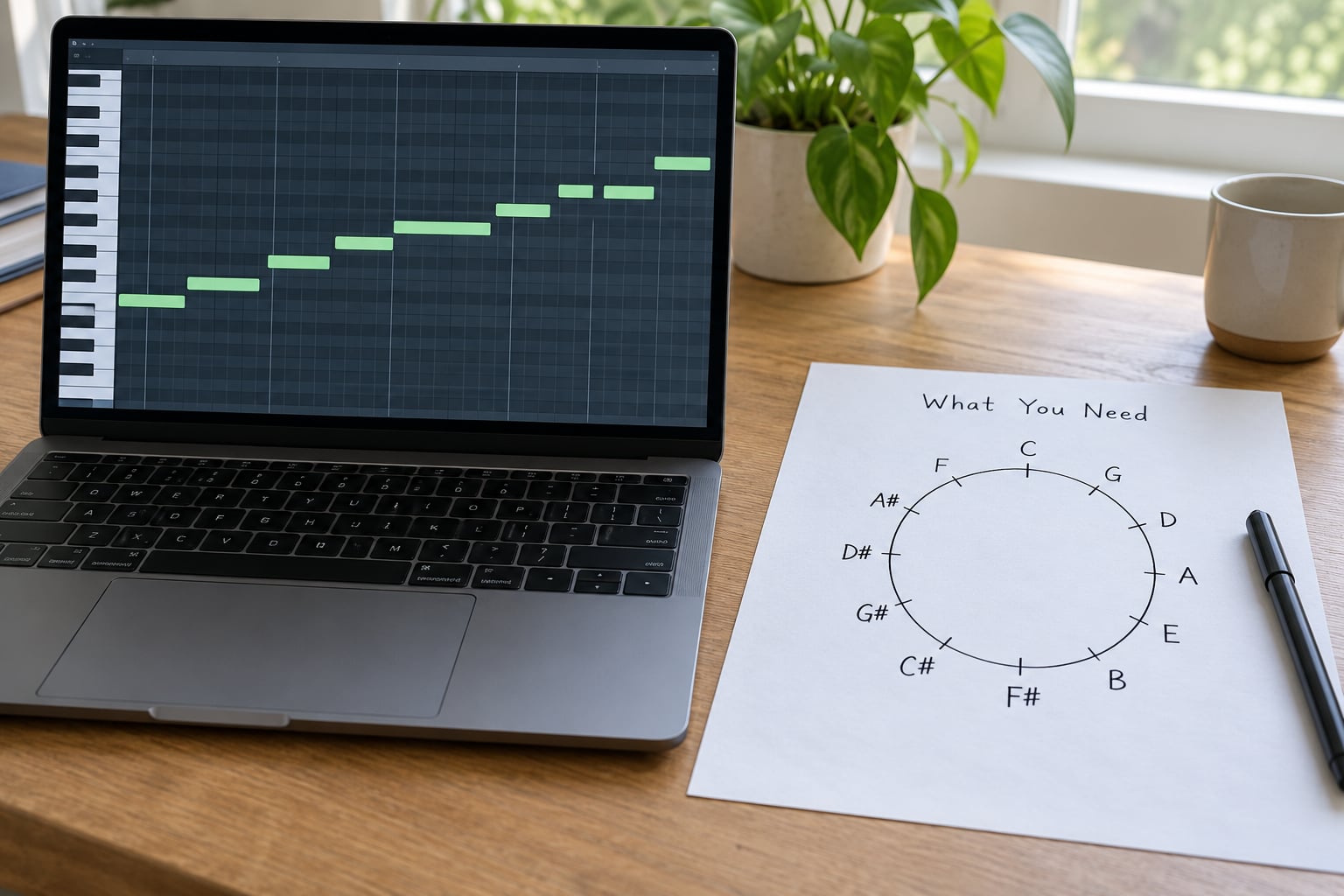
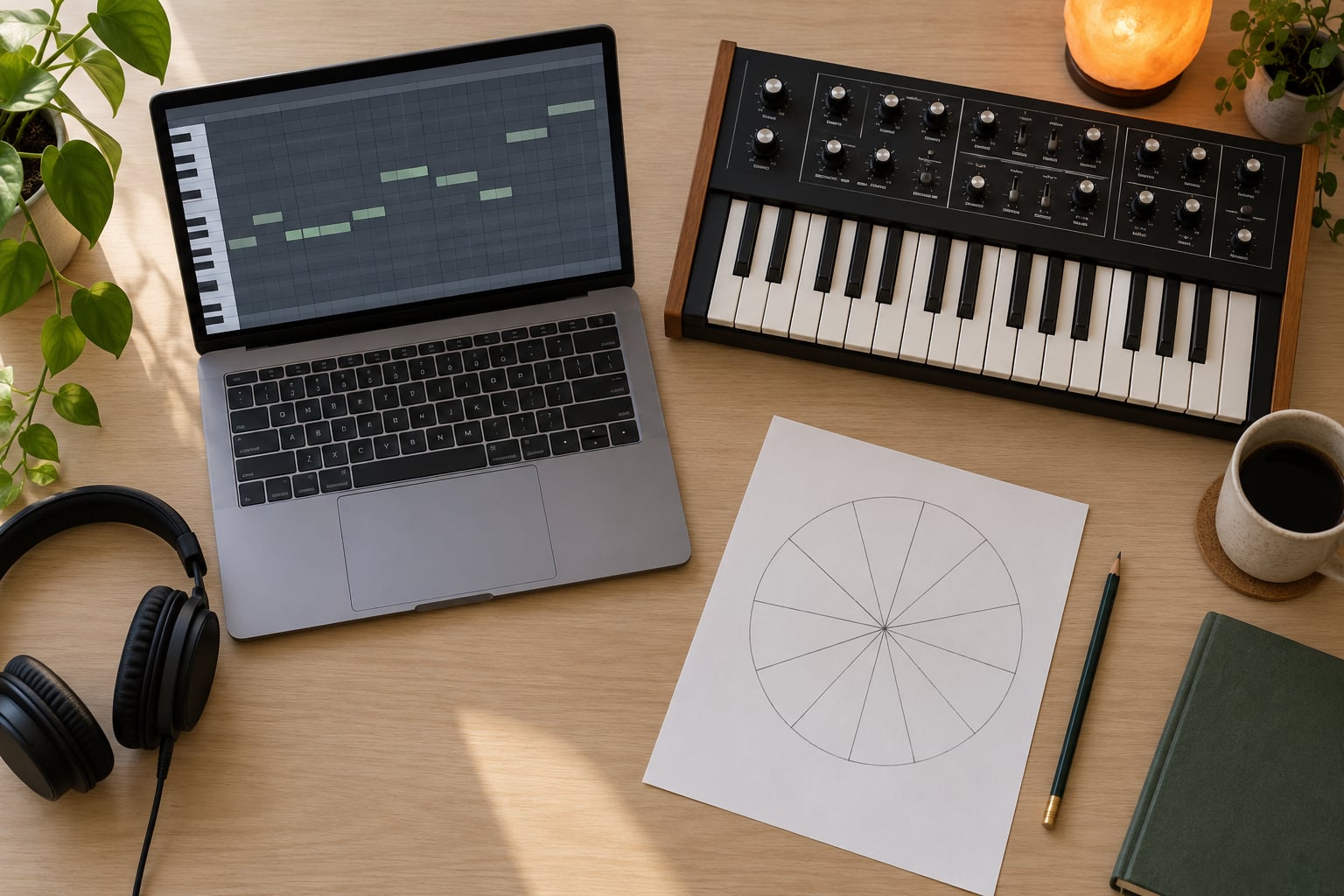
The circle itself is free to draw by hand in about two minutes, and that hand version teaches you more than any plugin.
- A DAW. Anything that accepts MIDI. The steps work identically in Ableton Live, FL Studio, Logic Pro and Cubase.
- One MIDI instrument. A piano or electric piano patch handles chords, a saw or pluck patch handles stabs, and a sub or reese handles roots. You only need those three to build a full idea.
- A printable or hand-drawn circle. Keep it next to the screen for the first few sessions.
- A starting key. A minor is the natural home for most dance music, and A minor, E minor, D minor and B minor cover the vast majority of what you will write.
Here is the reference chart you will keep coming back to. Read the outer ring clockwise for major keys, the inner ring for their relative minors, three semitones below.
| Clockwise position | Major key | Relative minor | Key signature |
|---|---|---|---|
| 12 o’clock | C major | A minor | None |
| 1 o’clock | G major | E minor | 1 sharp |
| 2 o’clock | D major | B minor | 2 sharps |
| 3 o’clock | A major | F sharp minor | 3 sharps |
| 4 o’clock | E major | C sharp minor | 4 sharps |
| 5 o’clock | B major | G sharp minor | 5 sharps |
| 6 o’clock | F sharp major | D sharp minor | 6 sharps |
| 7 o’clock | D flat major | B flat minor | 5 flats |
| 8 o’clock | A flat major | F minor | 4 flats |
| 9 o’clock | E flat major | C minor | 3 flats |
| 10 o’clock | B flat major | G minor | 2 flats |
| 11 o’clock | F major | D minor | 1 flat |
Two things fall out of that chart immediately. Clockwise from any key adds one sharp, and counterclockwise adds one flat, so keys on the sharp side tend to sound brighter while the flat side leans darker. The twelve keys eventually close the loop and land back on C, which is exactly why it is a circle.
Step-by-Step
1. Learn the note order around the circle
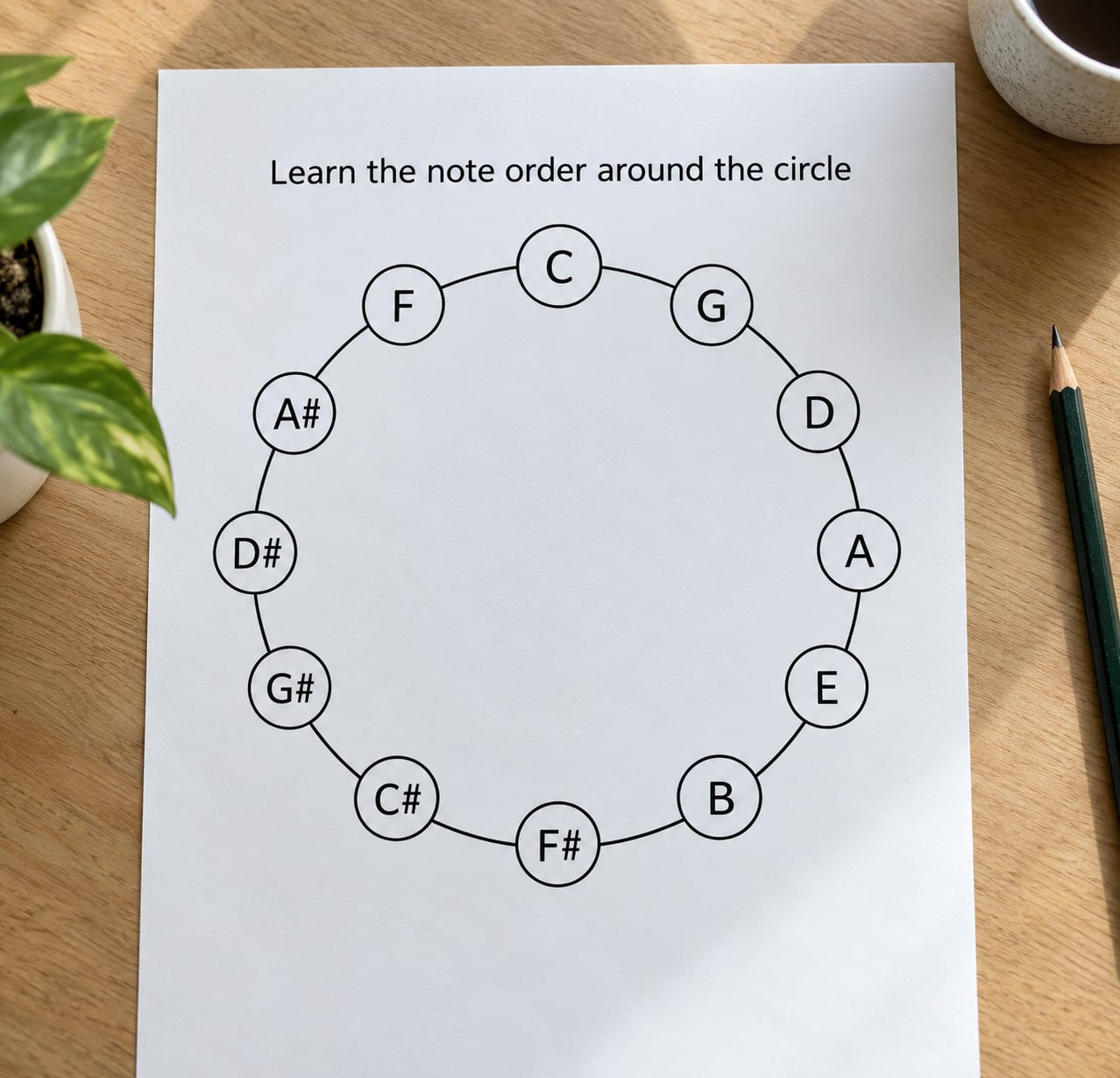
Start at C and walk clockwise by perfect fifths: C, G, D, A, E, B, F sharp, then D flat, A flat, E flat, B flat, F, and back to C. Every pitch class appears exactly once, and every position sits next to the two keys it shares the most notes with.
Work in fifths, not fourths. Moving clockwise from C to G is up a fifth, but if you go counterclockwise from C to F that is up a fourth, and confusing the two is the single most common beginner error.
Ten minutes of practice: play the seven white keys in a circle shape on your MIDI keyboard, going C, G, D, A, E, B, F sharp. Then do the same descending. Your fingers will learn the layout faster than your eyes will.
2. Choose an EDM-friendly key and progression goal
Decide the mood before you decide the notes. Emotional and wide-open points to A minor, C major or F major. Dark and driving points to D minor, E minor or a flat-side leaning key. Aggressive techno usually sits in A minor or D minor with a borrowed flat seven.
Relative minor is the default EDM starting point because the sub bass and the minor chord share a root, so one bass note serves both. Pick your tonic chord first: A minor, E minor, D minor or B minor. Everything else follows from that choice.
The seven diatonic chords above that tonic are your raw material. In A minor they are A minor, B diminished, C major, D minor, E minor, F major and G major. Anything built from those seven is safe and will sit well under a four-on-the-floor kick.
3. Move through chords by fifths
Two chords that sit next to each other on the circle share four of seven notes, so the change sounds smooth. Two chords three steps apart share almost nothing, so the change sounds like an event. That distance is the whole trick, and it is what you can use to plan a build or a drop.
For an uplifting trance lift in A minor, walk down the circle in fifths, the same path you would get by stepping up in fourths: A minor, D minor, G major, C major. Every root moves the same distance in the same direction, so the progression keeps drifting forward without ever resolving.
For darker house or techno, take the other path in E minor: E minor, A minor, D major, G major, C major. All five chords are diatonic to E minor, and the movement has that slow-turning quality that works under a long offbeat bass pattern.
In a major key, walking down the circle by fifths from C gives C major, G major, D minor, A minor. That four-chord shape is the I-V-vi-IV that most beginners learn first, and it works just as well in a melodic house chorus as it does in a pop song.
For something less predictable, take three steps instead of one. From A minor jump to D minor, then to E minor, then to C major. Three-step jumps are the cheapest way to make a loop sound intentional.
4. Convert the progression into a chord loop
Open a MIDI clip, draw one chord per bar or two bars, and put the root notes in a piano patch first so you can hear the harmony on its own. Keep every chord inside one octave and under four notes. Voicings that spread past an octave and a half turn muddy as soon as you add a sub and a reverb send.
Then copy the exact same root path into a bass patch. If your bass roots and your chord roots disagree, the low end argues with the harmony and the whole mix feels unsettled. Matching them is free polish.
Now write the melody in one key only, with a scale or chord highlight switched on. Constrain it first, transpose it later. Producers who write melodies note by note usually end up with hooks that cannot move anywhere.
You can hear it worked when you can hum the loop after one pass. If you cannot, the chord movement is probably doing nothing yet.
5. Add tension, release and movement with circle relationships
Neighbouring keys give you smooth movement for verses and breakdowns. A whole-step jump between relative minor and relative major, A minor to C major, is the lift that makes a chorus feel brighter without changing the bass note.
Distance is your tension dial. Build a riser toward a key three or more steps away and then resolve into the home key on the downbeat, and the drop lands because you earned it rather than dropped it in.
Relative major and relative minor are also the cheapest source of colour. The three semitones between A minor and its relative major C is a constant lift in trance, and pairing it with the six semitone move up to F is a moodier version of the same trick.
Borrowed chords give you the darker shades. The major sixth and major seventh in A minor, F major and G major, are diatonic to the scale but sound borrowed because they carry the colour of the parallel major instead. One per section is plenty, not four in a row.
The diminished chord is the odd one on the wheel. A fully diminished seventh built on B, containing B, D, F and A flat, is shared between two keys a tritone apart, so it can pivot between them without warning. It works as a tension chord into a drop in progressive house and trance.
6. Transpose the idea into other keys
Once the loop works in one key, duplicate the clip and transpose the copy. Harmonic function stays identical, so a progression that works in A minor still works in F minor or D minor. That is the payoff of learning the circle rather than memorising four progressions.
Transpose for real reasons, not novelty. Your vocalist sings comfortable notes around C to A and struggles above D, so the chorus moves down a whole step. Your sample sits in a fixed key, so the pad around it moves to meet it. Your kick and bass have a room resonance somewhere near F sharp, so the whole loop drops a fifth.
Keep the melody and the chords on the same transposition. Moving one without the other is the usual reason a transposed loop sounds wrong rather than different.
Common Mistakes
Confusing fifths with fourths. Clockwise is up a fifth, counterclockwise is up a fourth. The fix is to say it out loud while you walk the ring, once per session, until it stops being a decision.
Ignoring chord quality. The circle tells you which key, never which chord. B minor in a loop built on A minor needs to be B minor, not B major, and the B diminished chord in between is not a mistake to fix.
Choosing awkward voicings. Wide, overlapping voicings from distant keys clash. Keep chords in one register, leave a gap above roughly E4 for the lead, and let the sub handle everything below middle C.
Copying a progression without shaping its rhythm. The same four chords over four bars of identical rhythm sound like a demo. Push the fourth chord a bar late, or drop it entirely, and the same notes start working.
Reusing the same movement everywhere. If every section travels one step in the same direction, the track has no contrast. Give the breakdown a neighbour key and the drop a distant one.
Adding distant chords at the same time as a lead line. Two keys three steps apart already want attention. Add a melody in a fourth key on top and the result is noise, not tension.
Tips for Using the Circle of Fifths in EDM
Turn on the circle for the loop, then turn it off. In Ableton, load chords from the Library of Chords and set the scale highlight to the relative minor. In FL Studio, the piano roll scale selector does the same job, and the channel settings keep every future note in scale. In Logic, the chord track in FLogic mode gives you inversion and voicing controls as you draw.
Let the bass carry the circle. An offbeat bass that plays nothing but roots still feels like it is moving forward if those roots follow fifths. Rolling sixteenth bass lines can even sit on a two-step path, one chord per two steps, and still read clearly.
Keep the melodic space open. A four-note chord under a lead is a wall. Drop the chord to three notes, put the fourth note in the bass, and the lead has somewhere to sit.
Match distance to arrangement energy. Verse and breakdown want one-step movement. Pre-drop wants one long step. The drop itself can hold a single chord for four bars and still feel huge, because the arrival is the event.
Sidechain the stabs, not the timing. Pumping open chords on the offbeat survive a heavy sidechain; a sustained pad does not, so leave pads unsidechained and let them fill the tail of each phrase.
And be honest about what the circle cannot tell you. It does not choose voicings, it does not know genre conventions, and it will not make a progression memorable. The consensus on r/edmproduction is that the circle narrows the options and your ear makes the final call. Treat it as a reference you consult, not a rulebook you obey.
Frequently Asked Questions
What is the trick for the circle of fifths?
The trick is distance. Two keys next to each other on the circle share four of their seven notes, so a chord change between them sounds smooth. Keys three steps apart share almost nothing, so that change sounds like an event. Decide whether you want a section to glide or to jump, count the steps, and pick your chords from the keys at that distance. Everything else on the wheel follows from that one idea.
How to practice using the circle of fifths?
Practise it in a short daily loop rather than with theory exercises. Play the twelve notes clockwise by fifths on your MIDI keyboard, build one four-chord progression in A minor, then transpose the loop to a different key and build it again. Fifteen minutes a day for two weeks is enough to make the layout automatic. The moment you can name the key after hearing a loop is when it has stuck.
What is a good minor chord progression for EDM?
A minor to F major to C major to G major is the workhorse in A minor, with the six and three semitone moves giving it the lift-and-release feel most dance music wants. For a darker option, A minor, D minor, E minor, C major moves in fifths and circles without resolving. Both sit well over four-on-the-floor drums because every root is a plain note a sub can double.
What is the forbidden chord in music?
The so-called forbidden chord is the tritone between the third and seventh of a dominant seventh chord, for example F and B in G7. In common practice harmony that interval wanted to resolve inward, so it was treated as a dissonance to avoid. In electronic production it is a tool rather than a taboo, and the diminished seventh chord built on it is a common way to pivot between distant keys.
How do I build off of a chord progression?
Treat the last chord as a new starting point on the wheel. If your loop ends on G major, look at the keys next to G, which are C and D, and build the next section from those. Moving to a neighbour key continues the mood, moving three steps away restarts the tension. Add one borrowed chord from the parallel major, such as a major sixth in a minor loop, and the extension stops sounding like a copy.
How do I use the circle of fifths for melody writing?
Write the hook first in one key with a scale highlight on, then decide where you want it to travel. Rotating the same melody through keys a step apart changes its colour without rewriting it, and moving it three steps for the drop creates a lift. Keep the melody inside the scale of the chord it sits on, and remember that the notes you leave out matter as much as the ones you add.
Conclusion
Start with the smallest possible job: draw the circle, put A minor at twelve o’clock, and build one four-bar loop using A minor, D minor, G major and C major. Copy the same root path into a bass patch underneath it and listen for five minutes. That is the whole method in one sitting.
Once that loop hums back to you, the circle stops being a diagram and becomes a set of decisions about distance. One step for flow, three steps for impact, borrowed chords for colour, and transposition for range. Every better chord progression in your catalogue came from knowing which key you were standing in and where on the wheel you wanted the next one to be.
Print the twelve-key table, keep it beside your monitor for a fortnight, and your ear will take over from there.