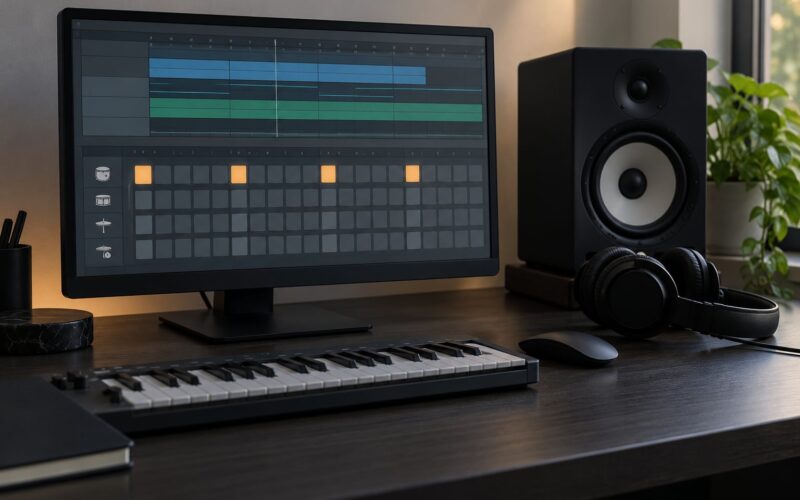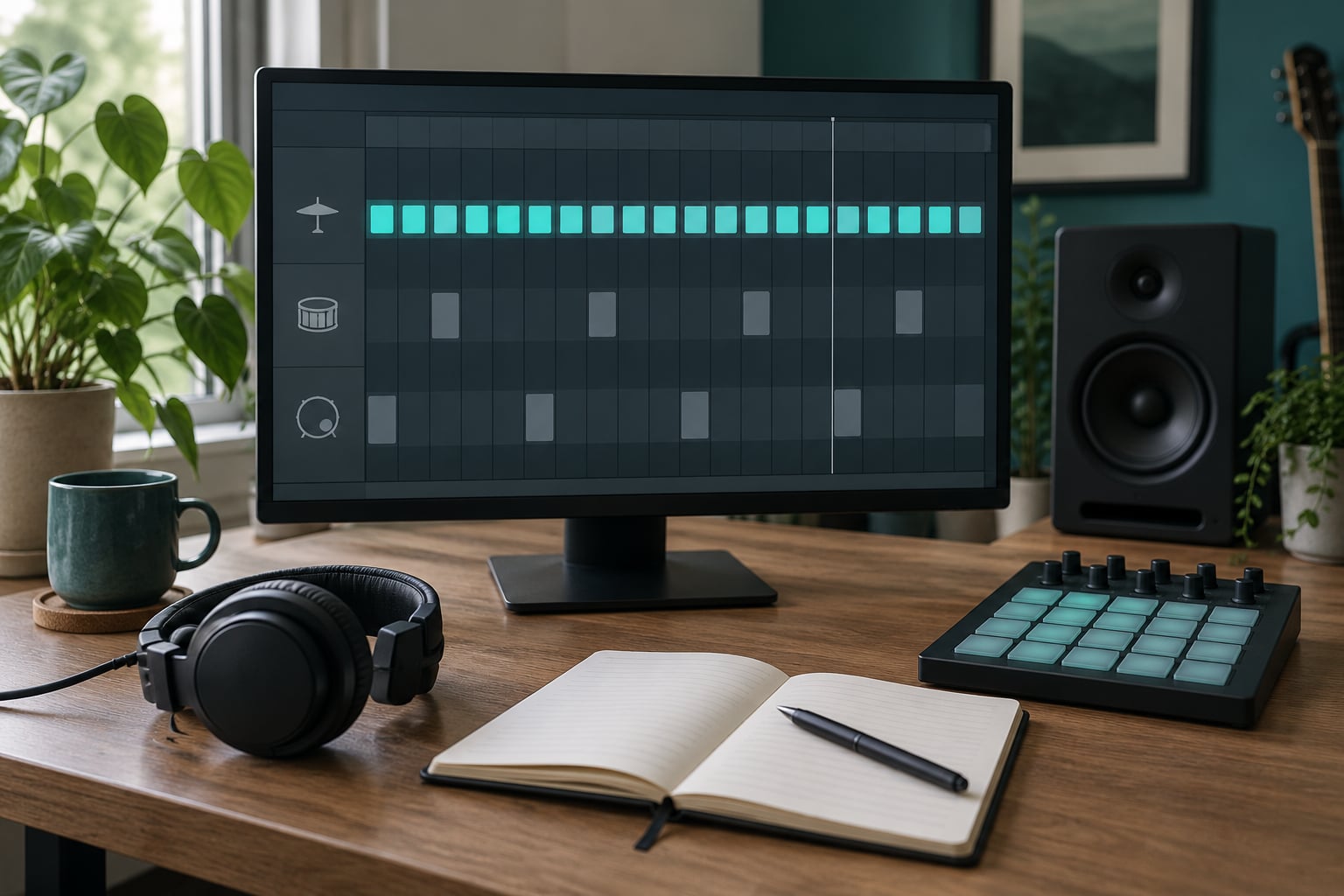
How to program offbeat open hats without wrecking your mix: put an open hi-hat on the “and” of each beat rather than on the beat itself, which in a 16-step bar means steps 2, 6, 10 and 14. You do it by laying closed hats on every eighth note, swapping those offbeat steps for an open hat at a lower velocity, then shortening the open hat so it decays before the next downbeat. Ten minutes, any DAW, no hardware required.
The open hat on the offbeat is the sound that makes house, UK garage and dance-pop grooves bounce. A four-on-the-floor kick covers every downbeat and leaves the “ands” empty, so an open hat ringing across them fills that hole and pushes the track forward.
What trips people up is that the note placement is the easy half. Timing, velocity, choke behaviour and level are what separate a groove that locks in from one that just sounds like a machine hitting hats. The steps below handle all four in order, with values you can type straight in.
Table of Contents
- What You Need
- Step-by-Step: How to Program Offbeat Open Hats
- Step 1: Choose the Hat Sound and Set the Groove Foundation
- Step 2: Build the Offbeat Open-Hat Pattern
- Step 3: Add Velocity, Swing and Human Variation
- Step 4: Process the Hats for Width and Control
- Common Mistakes
- Frequently Asked Questions
- What is the difference between a closed hihat and an open hihat?
- How do I notate an open hi-hat in standard notation?
- What software can I use to program offbeat open hats?
- How do I swing only the hi-hats without moving the kick and bass?
- Why do my open hi-hats sound muddy?
- What BPM should I program offbeat hats at?
- Conclusion
What You Need
You need a DAW, one hi-hat sound, and about ten minutes. Everything else is a refinement pass you can do later.
- A DAW. FL Studio, Ableton Live and Logic Pro all cover this method with their own menus, and any of them will do. Ableton users work in Session View with a Drum Rack, FL users in the step sequencer and piano roll, Logic users in the Step Sequencer.
- A hi-hat sample or a drum kit. A single bright closed hat plus a single open hat is enough. If you are starting from a kit, a Roland TR-909 style hat covers the whole genre range this groove lives in.
- A tempo. Pick the target genre tempo before you draw anything, because swing percentages feel completely different at 92 BPM and at 150 BPM.
- A drum pattern to sit against. Four-on-the-floor kick plus a clap on 2 and 4 gives you the standard canvas the hats have to fight for space with.
- Optional processing. A short reverb, a saturator and a bus compressor are all useful later, but build the unprocessed groove first so you know what you are fixing.
- A reference track. One record you like the hat line on. Comparing against it beats guessing.
One decision matters more than the others: whether your groove runs on straight eighths, swung eighths or sixteenths. Decide that first, because everything after it is decoration.
Step-by-Step: How to Program Offbeat Open Hats
Step 1: Choose the Hat Sound and Set the Groove Foundation
Choose a hat with a short, bright attack and a clean ring-out, then set your tempo to the genre target before placing a single note. House usually sits at 124-128 BPM, UK garage at 130-136 BPM, dance-pop at 118-128 BPM, drill around 140-142 BPM and hyperpop at 150-160 BPM.
Then decide your subdivision. Straight eighths give you the clean club pulse, swung eighths give you shuffle, and sixteenths give you the busy energy most current producers reach for first.
How you can tell step one worked: play two bars of kick and clap alone and the pulse already feels settled. If it feels wobbly, change tempo or groove type now rather than after thirty hat notes exist.
Step 2: Build the Offbeat Open-Hat Pattern
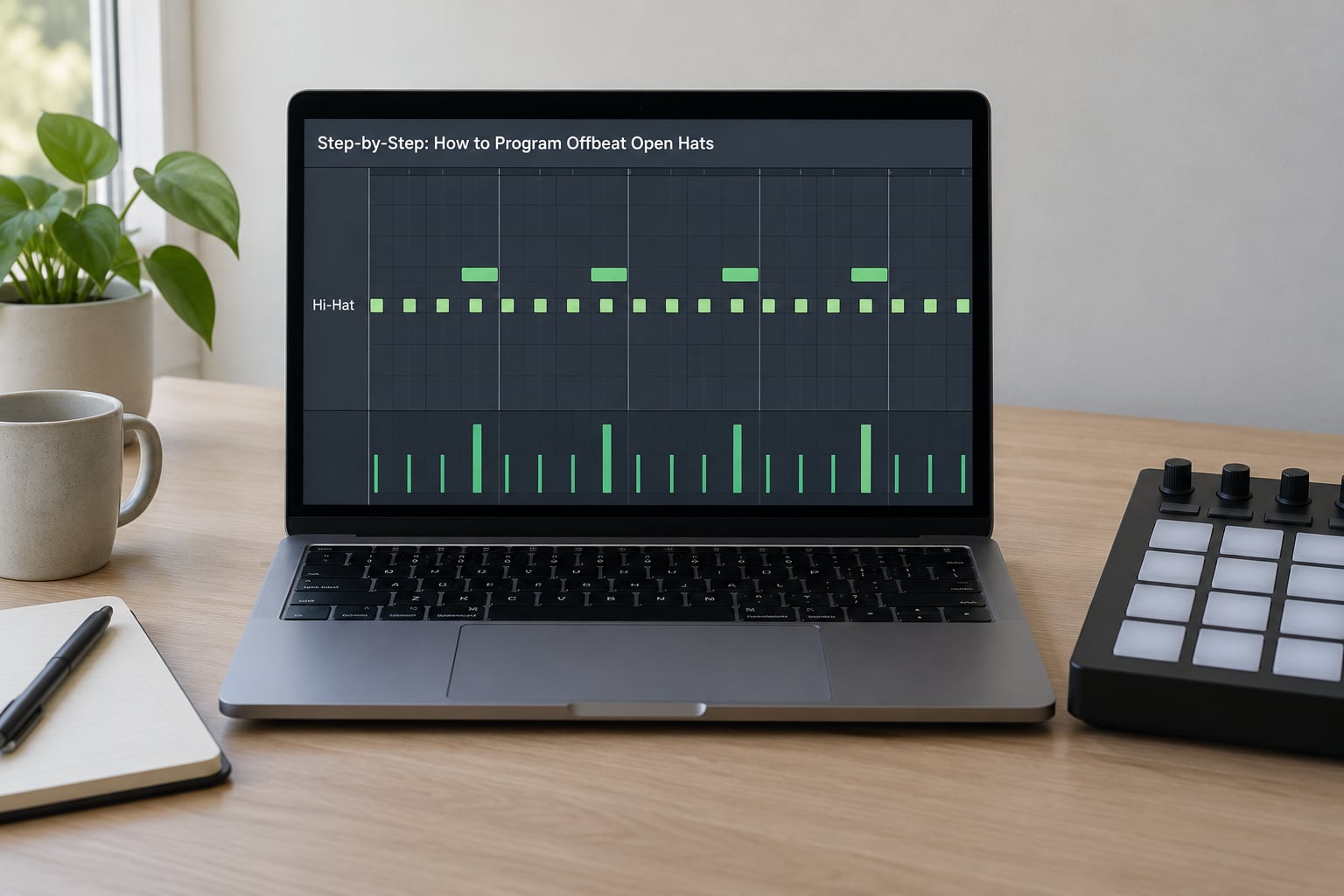
Put closed hats on all eight eighth-note positions first, so the hat has a steady pulse the ear can measure against. Then replace the offbeat steps (2, 6, 10 and 14) with the open hat, keeping the closed hats on 1, 3, 7, 9, 11 and 15.
That gives you the baseline grid most house and dance-pop grooves run on:
| Step | 1 | 2 | 3 | 4 | 5 | 6 | 7 | 8 | 9 | 10 | 11 | 12 | 13 | 14 | 15 | 16 |
|---|---|---|---|---|---|---|---|---|---|---|---|---|---|---|---|---|
| Note | Closed | Open | Closed | Closed | Closed | Open | Closed | Closed | Closed | Open | Closed | Closed | Closed | Open | Closed | Closed |
| Velocity | 110 | 85 | 95 | 95 | 100 | 82 | 95 | 95 | 110 | 88 | 95 | 95 | 100 | 80 | 95 | 70 |
Leave room around the strong beats. If you stack an open hat directly on beat 1 against a kick and a clap, the three transients collide and the downbeat loses its weight.
Before you add variation, mute everything except hats and listen to one bar on repeat. You should hear a clear tick-tock shape, not a wall of noise.
Step 3: Add Velocity, Swing and Human Variation
Set the downbeat hats around 100-115 and the open hats between 75-90, which is what stops the pattern sounding flat. Push your swing to between 54% and 62% if the groove calls for shuffle, but apply it to the hat pattern only, never to the whole loop.
Global swing drags the kick and bass with it and the whole track turns to sludge. In Ableton, set swing per clip or per note in the Drum Rack; in FL Studio, move the hat to the piano roll and use the swing handle on the hat notes only; in Logic, use the swing on the hat MIDI region or nudge individual notes.
Then make small changes. Every fourth or eighth bar, drop one offbeat hat’s velocity by 15 points or remove one entirely. Accent placement is what creates the groove, and producers regularly flip the emphasis so the offbeats hit harder than the downbeats when they want a bouncier feel.
You will know step three worked if you can play along with a finger tap on the offbeats without looking at the screen.
Step 4: Process the Hats for Width and Control
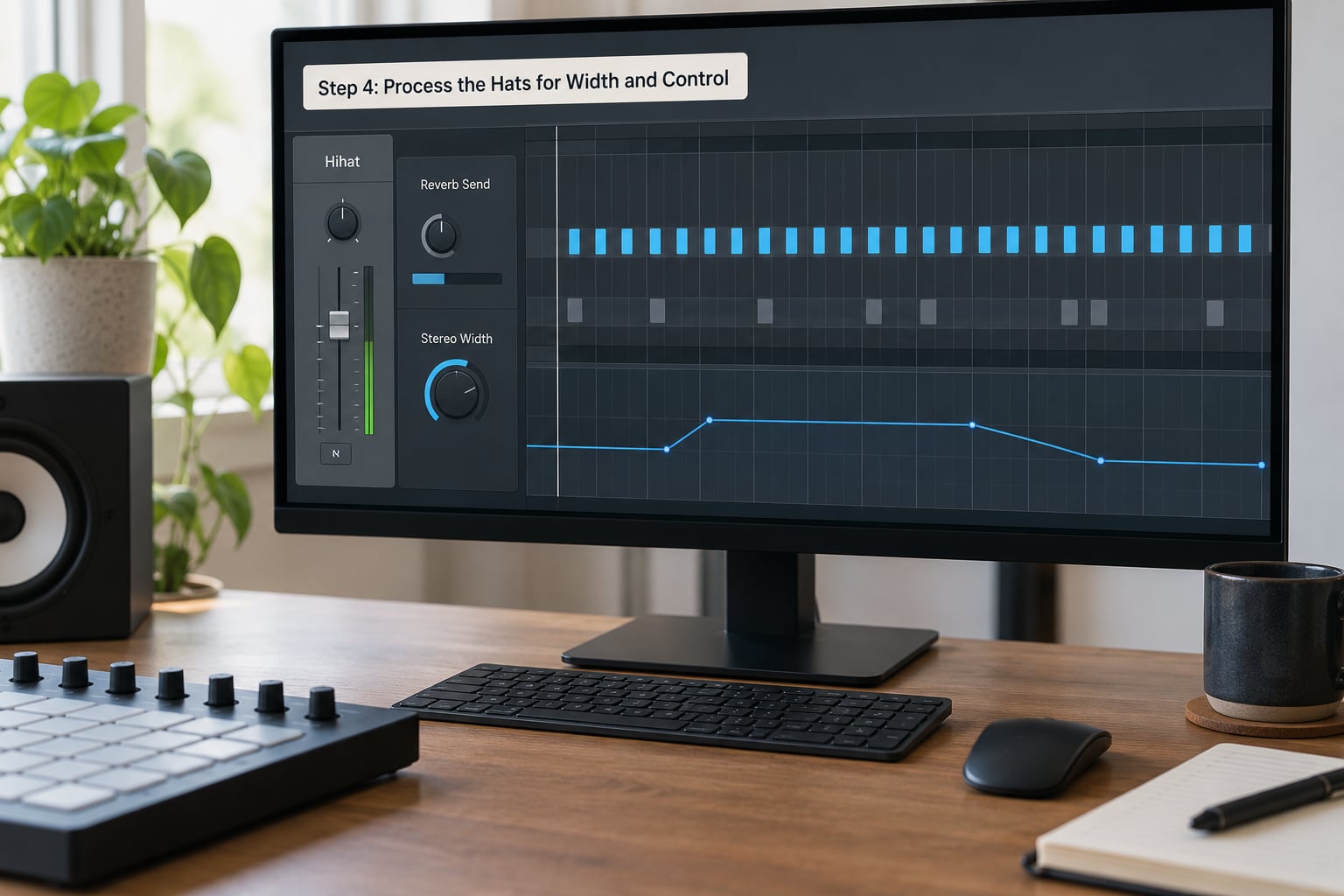
Shorten the open hat so it stops before the next downbeat. Two tools do this: a choke group that cuts the open hat when the next closed hat fires, or a short note length that truncates it at the end of the step. Choking is cleaner, note length is faster to dial in.
High-pass the hat bus around 300-500 Hz so the hats stop fighting the kick for low-mid space, and pan a second hat layer slightly for width. A little saturation glues the metal to the mix, and a short reverb send on the open hat only adds space without smearing the whole pattern.
Finish with light bus compression on the hats and pull them back under the kick and clap. If the hats disappear when the kick comes in, you have gone too far in the other direction.
Loop the section for a full minute before you judge it. Hats that felt wrong on the first pass usually settle by the fourth.
Common Mistakes
Almost every flat hat line comes from one of five habits. Each has a quick fix.
- An open hat on every beat. Open hats on 1, 2, 3 and 4 stack four long decays on top of each other and the groove turns to mud. Keep the open hats on the offbeats and the closed hats on the beats.
- Letting the open hat ring into the next downbeat. This is the single most common beginner failure and the reason so many mixes sound unclear. Add a choke group or shorten the note length.
- Identical velocity on every hit. A flat velocity line is the fastest way to make programmed drums sound cheap. Drop your offbeats 20-30 points below the downbeats and vary one note per bar.
- Swinging the entire groove. Global swing moves your kick and bass too and the track drags. Swing the hats alone, or use micro-timing nudges of 5-15 ms on the offbeats instead.
- Hats too loud in the mix. If the hats lead the arrangement instead of supporting it, pull them 3-4 dB under the kick and re-check with the kick soloed.
- Random variation. Adding a new accent every bar at random destroys the pulse. Change one element at a time and keep about 80% of the pattern identical.
A useful rule of thumb from drummers is the 80/20 split: keep roughly 80% of the pattern steady and let 20% carry the variation. The offbeat open hat works best as part of that steady 80%.
Frequently Asked Questions
What is the difference between a closed hihat and an open hihat?
A closed hi-hat is a short hit that cuts off almost immediately and is used to mark the pulse. An open hi-hat rings for roughly 200-500 ms and is used for accents and offbeat emphasis. Most grooves use both: closed hats on the beats, open hats on the ands. Notated, a closed hat gets an x note head and an open hat gets a small circle above it.
How do I notate an open hi-hat in standard notation?
Write the note on the correct line and space, then place a small circle above the note head to mark it open. A closed hat uses an x note head, a pedal hat uses a triangle, and an open hat is the only one with the circle. In tablature and drum notation software, use the open or choke-enabled variant of the hi-hat lane rather than the standard hat.
What software can I use to program offbeat open hats?
Any DAW with a step sequencer or piano roll will do. FL Studio uses the channel step sequencer and piano roll, Ableton Live uses Session View clips feeding a Drum Rack, and Logic Pro uses the Step Sequencer plus an articulation or sample cell. Third-party kits like Superior Drummer or Addictive Drums work in any of them and give you more control over the hat decay and choke.
How do I swing only the hi-hats without moving the kick and bass?
Keep the main grid at 100% and swing the hat pattern alone. In Ableton Live, enable swing on the hat MIDI clip or on individual notes inside the Drum Rack. In FL Studio, draw the hats in the piano roll and pull the swing handle on the offbeat notes only. In Logic Pro, apply swing to the hat region or nudge individual offbeats 5-15 ms late by hand.
Why do my open hi-hats sound muddy?
Almost always because the open hat is still ringing when the next downbeat hits. Choke it with the following closed hat, shorten the note length, or apply a faster release in your sampler. A long reverb send on the hat bus makes it worse, so cut that back and high-pass the bus around 300-500 Hz to clear room for the kick.
What BPM should I program offbeat hats at?
House sits around 124-128 BPM, UK garage 130-136 BPM, dance-pop 118-128 BPM, UK drill 140-142 BPM and hyperpop 150-160 BPM. The open hat pattern itself works at any tempo, but the swing amount should shrink as the tempo rises. Above 150 BPM, sixteen-step hat patterns read more clearly than eighths.
Conclusion
Start with one bar: closed hats on all eight eighth-note positions, open hats on steps 2, 6, 10 and 14, downbeats at 110 and offbeats around 85. Loop it for a minute, then work outward.
Once the shape sits, add 54-62% swing to the hats only, choke the open hat so it clears the downbeat, and vary one velocity per bar. Refine the timing by ear rather than by eye.
That is the whole method. Learning how to program offbeat open hats is really learning to hear where the kick leaves gaps and then filling them with restraint.