To make a psytrance bassline, you take a synced saw oscillator, sweep a low-pass filter downward with an envelope on every note, add saturation, and duck the whole thing against your kick with sidechain compression. The pattern underneath is usually a rolling kbbb (kick, bass, bass, bass) figure rather than a straight four-on-the-floor bass.
The whole sound takes about an hour to dial in once you know where each control lives. Most of the work is in three places: filter movement, saturation amount, and how tightly you tune the bass to the kick.
If you are starting from a thin, fizzy bass that disappears on small speakers, this guide walks through the fix in the order that works. The parameter values below match what long-time psy producers describe in production forums, so you can treat them as starting points rather than rules.
Table of Contents
- What You Need
- DAW
- Synth
- Effects
- Monitoring
- Step-by-Step: How to Make a Psytrance Bassline
- Step 1: Choose the Bass Note and Register
- Step 2: Build a Simple Initial Bass Sound
- Step 3: Shape the Timbre with Filter Movement
- Step 4: Add Distortion, Drive, and Harmonics
- Step 5: Write a Driving Bassline Pattern
- Step 6: Add Accents, Articulation, and Micro-Movement
- Step 7: Process the Bassline for the Mix
- Step 8: Arrange and Refine the Groove
- Common Mistakes and How to Fix Them
- The bassline sounds thin and has no sub weight
- The whole track is muddy
- The highs are fizzy or crusty
- The bassline disappears when the kick hits
- The groove feels flat or dead
- Resampling or transposing ruins the punch
- The sound is over-filtered and lifeless
- Frequently Asked Questions
- What synth is best for a psytrance bassline?
- Should I distort my psytrance bassline?
- How long should each psytrance bass note be?
- How do I make a bassline sound rolling instead of just pumping?
- What BPM and root note should I use for psytrance?
- Why does my psytrance bass vanish on small speakers and in the club?
- Conclusion
What You Need
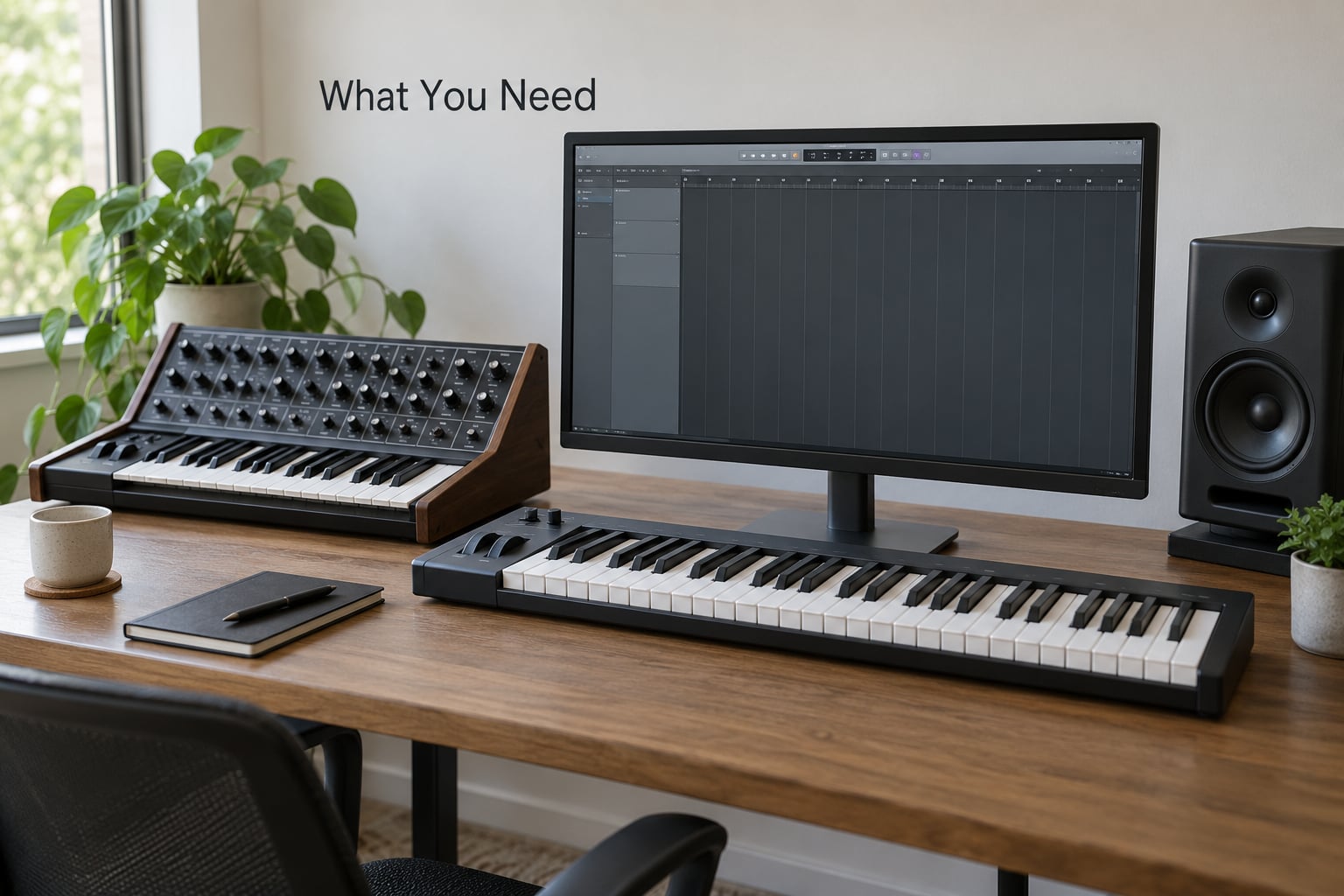
You need far less gear than people expect. A laptop, one synth, and three stock effects cover everything in this guide.
DAW
Any DAW handles this workflow. Ableton Live, FL Studio, Logic Pro, Cubase, Studio One, Bitwig and Reason all have the four pieces you need: a synth, an EQ, a saturator or waveshaper, and a compressor with a sidechain option. The exact menu names change, but nothing else does.
Synth
You need one oscillator that makes a clean saw wave, a resonant low-pass filter with its own envelope, and a pitch-enable or portamento control. Sylenth1, Xfer Serum, Spire, Native Instruments Massive, Access Virus and Dune all qualify. If you have none of those, TAL-Bassline and Vital are free and both can build a psy bassline, and Dune CM is a free channel-strip synth that handles oscillators, filter, drive and an amp envelope in one place.
Effects
A high-pass EQ, a low-pass EQ, a waveshaper or soft clipper, and a compressor with sidechain input make up the rest of the chain. Every DAW ships versions of all four. Voxengo Drumformer and BazzISM are useful if you want a second layer on the kick bus, but they are not required to get the bassline right.
Monitoring
Headphones plus one pair of nearfield monitors gets you most of the way. Small 5-inch monitors cannot show you much below about 30 Hz, which is exactly where bassline mud hides, so check your low end on headphones, on a phone speaker, and in a car at low volume before you call it finished.
Step-by-Step: How to Make a Psytrance Bassline
Step 1: Choose the Bass Note and Register
Pick one root note and put the bass between roughly 40 Hz and 60 Hz at the fundamental. Producers on r/psytrance describe G at around 50 Hz as a sweet spot near 145 BPM, and something closer to 60 Hz at 170 BPM where the kick gets shorter and busier.
Octave placement matters more than the note name. Too low and the bass collides with the kick’s fundamental. Too high and you lose sub weight and the track feels thin on a big system. If the kick sits around 50 Hz, try the bass root an octave up and let the low-pass filter carry the weight down instead.
Step 2: Build a Simple Initial Bass Sound
Load one saw oscillator, one square or triangle oscillator detuned a few cents, and set the amp envelope sustain to 100 percent. Ignore the filter envelope for a moment. You want a plain, slightly fat sustained tone before anything moves.
Turn on oscillator sync or phase sync if your synth has it. Sync locks the harmonic content between the two oscillators so the tone stays wide and solid rather than drifting. A unison stack of three to five voices with moderate spread also works, as long as you keep it in mono at the end.
Keep it boring at this stage. If the tone is not compelling on its own, no amount of rhythm will save it, but a complex patch that sounds exciting alone usually turns to mud once it is playing fast sixteenth notes.
Step 3: Shape the Timbre with Filter Movement
This is the step that makes it psytrance. On the low-pass filter, set the envelope to open the cutoff high, around 1 kHz to 3 kHz, then close it down to 40 Hz or 60 Hz over 60 to 150 milliseconds. Every note starts bright and ends dark, and that brightness-to-darkness arc is the “bump” people are chasing.
Add a small amount of resonance, maybe 10 to 20 percent, to give the filter some bite. Push resonance past 30 percent and the fizzy, sizzling edge comes back once you add saturation.
Many producers also notch or briefly sweep a resonant peak up an octave or two above the root during the decay. It reads as midrange presence on small speakers, which is how psy basslines stay audible when the sub cannot.
Step 4: Add Distortion, Drive, and Harmonics
Add a waveshaper or saturator after the filter, not before. Pre-filter distortion creates harshness you cannot EQ away later; post-filter distortion sits in the midrange where psytrance actually lives.
Start with mild drive, around 20 to 30 percent, and listen with the high-pass filter on. If the whole channel sounds dull, push drive further, because saturation only reads as power once there are harmonics above 300 Hz carrying it. If it sounds fizzy or crusty, back the drive off and lower resonance.
A single distortion stage is usually enough. A second gentle one in parallel with a high-pass at 200 Hz adds weight without adding the fizz.
Step 5: Write a Driving Bassline Pattern
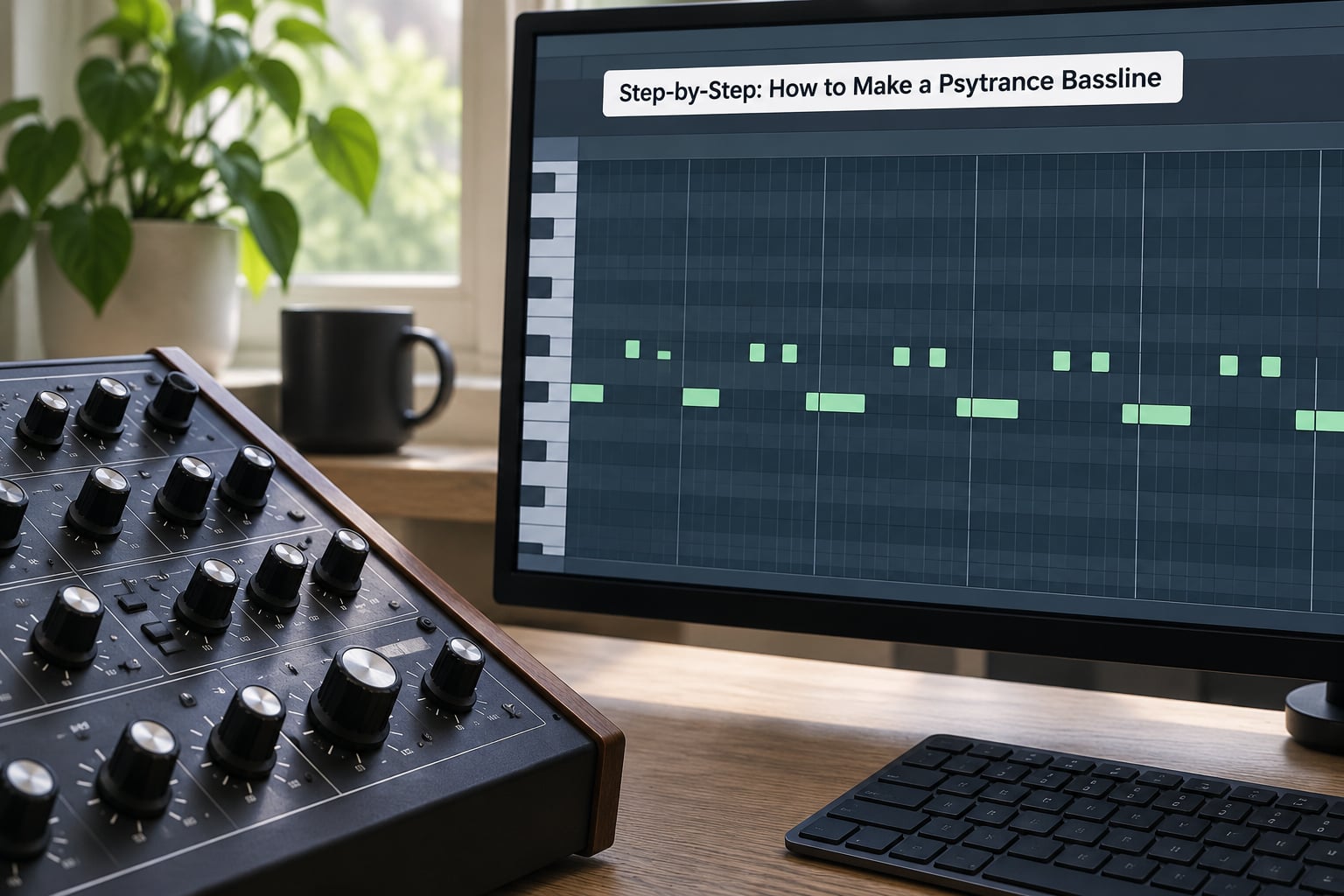
The kbbb pattern is the spine of the genre: kick on beat one, then bass notes on the second, third, and fourth sixteenth positions, repeating every bar. That rolling feel comes from the gap after the kick, and it is what people mean when they ask how to make a psytrance bassline roll.
Keep note lengths short, around 80 to 150 milliseconds, so each note gets its own filter sweep. Long notes overlap their own envelopes and the bump flattens out.
Common variations worth trying:
- kbbb with the third note dropped, leaving space for a vocal or a lead line
- k-b-bb, adding a sixteenth before the last note for extra push into the bar
- Octave jumps on the last note of every fourth bar, one octave up or down
- A two-bar pattern that repeats only on bar 3, so it takes four bars to fully cycle
Write it as MIDI first. Notes are easier to move and you can fix a bad transient later.
Step 6: Add Accents, Articulation, and Micro-Movement
A flat pattern gets old within four bars. Add velocity variation: push the note after the kick to around 110 percent and pull the others to 85 percent. Small changes, big effect.
Vary note length slightly between 90 and 140 milliseconds, and shorten the note right after the kick by a few milliseconds to leave a tiny pocket of space. That pocket is what makes the groove feel human rather than mechanical.
For micro-movement, automate filter cutoff by a few hundred hertz on alternating notes, or nudge resonance up slightly on the second beat of every fourth bar. Subtle pitch modulation of two to three cents on note starts adds life without turning the bassline into a lead.
Step 7: Process the Bassline for the Mix
Put a high-pass filter at 30 to 40 Hz on the bass bus. This is the single biggest fix for a muddy low end, and it costs you nothing but a bit of sub weight. Then EQ a small dip around the kick’s fundamental, usually 45 to 60 Hz, two to three dB wide.
Sidechain compression is what creates the pump. Route the kick into the compressor’s sidechain input on the bass, then set roughly these values:
| Parameter | Starting value |
|---|---|
| Ratio | 4:1 to 8:1 |
| Attack | 0.1 to 0.5 ms |
| Release | 80 to 160 ms |
| Threshold | Set so the bass drops 4 to 8 dB on each kick |
Keep the sidechain release under the tempo’s sixteenth note length, or the bass stays quiet and you lose energy into the next kick. At 145 BPM a sixteenth is roughly 103 ms.
Finally, automate the bass volume up slightly on the last sixteenth of every fourth bar, just before a drop, so the bass fills the gap. Check the result in mono, on headphones, and on a small speaker before moving on.
Step 8: Arrange and Refine the Groove
Build a two-minute loop with nothing but kick and bass. If it is not grooving on its own, arrangement will not fix it. Most problems at this stage are pacing rather than sound.
Remove the bass for one bar before a drop. That silence makes the bassline feel heavier when it returns than any amount of extra saturation would.
Compare the bass against the kick’s sub rather than against your lead. If the bass and kick occupy the same frequency range with similar level, shorten the kick decay or drop the bass an octave so the two stop competing. Frequency masking is the usual reason a psy bassline sounds weak in the low end.
For gliding or fly-around basslines, the trick is a portamento or glide setting of about 30 to 60 milliseconds on selected notes only, usually the first note of every fourth bar. The glide creates the swooping lead-like motion that appears in tracks by Omiki and Dunya. Keep the glide monophonic or it turns to mush.
Common Mistakes and How to Fix Them
The bassline sounds thin and has no sub weight
Cause: the amp envelope release is too short, so the note never reaches its lowest frequencies. Fix: lengthen the amp envelope release to around 150 to 250 ms, and raise the sustain to 100 percent. Add a pure sine sub oscillator an octave below the root at low level if you still need more fundamental.
The whole track is muddy
Cause: unfiltered sub energy stacking with the kick. Fix: high-pass the bass bus at 30 to 40 Hz with a 12 dB/octave slope. Then cut 2 to 3 dB around the kick’s fundamental frequency.
Do not use a gentle 6 dB/octave high-pass for this. The steeper slope is what actually removes the region.
The highs are fizzy or crusty
Cause: too much resonance or too much distortion. Fix: drop resonance to 15 percent or lower, move the waveshaper after the filter, and high-pass the distortion return at 200 Hz. If it is still crusty, you are almost certainly distorting pre-filter.
The bassline disappears when the kick hits
Cause: no sidechain compression, or a release that is too slow. Fix: sidechain to the kick with a 4:1 ratio and set release to about half the sixteenth-note length. If the bass is still being buried, duck the kick instead of boosting the bass.
The groove feels flat or dead
Cause: identical note lengths and velocities across a long loop. Fix: vary velocity between 85 and 110 percent, vary note length by 20 to 30 ms, and drop one note every eight bars to create space.
Resampling or transposing ruins the punch
Cause: resampled audio inherits the sample rate and phase relationships of the source, so an octave shift moves harmonics and transients. Fix: resample at the target pitch instead of pitching the file, use a resampler with phase control such as Elastique or Primeval, and re-run the high-pass and sidechain after resampling since both settings shift with the new fundamental.
The sound is over-filtered and lifeless
Cause: filter envelope decay too fast, or the sustain level of the filter set too low. Fix: pull the filter envelope decay out to 120 ms and raise the filter sustain so the note does not end fully closed. If it sounds thin after that, add drive rather than more filter.
Frequently Asked Questions
What synth is best for a psytrance bassline?
Sylenth1 is the classic choice and its filter still sets the standard, but the specific synth matters far less than the filter envelope. Any saw oscillator with a resonant low-pass and an amp envelope at full sustain will work. Xfer Serum, Massive, Virus and Dune all build the sound comfortably, and free options like TAL-Bassline and Vital cover the same ground if you have no paid plugins yet.
Should I distort my psytrance bassline?
Yes, but lightly for morning full-on and heavily for night and hi-tech styles. Start with drive at 20 to 30 percent, placed after the filter rather than before it. Full-on and progressive tracks stay smoother and rely on filter movement for weight, while night and hi-tech at 160 to 175 BPM are usually built around heavily saturated, stomping bass. If the sound turns fizzy, you have gone too far or pushed resonance too high.
How long should each psytrance bass note be?
Between 80 and 150 milliseconds for most rolling patterns. Short enough that every note gets its own filter sweep, long enough that the amp envelope reaches the low frequencies and you get sub weight. Longer notes overlap their own filter envelopes and the bump flattens out. If the bass sounds thin, lengthen the amp envelope release rather than the note length itself.
How do I make a bassline sound rolling instead of just pumping?
Rolling comes from the pattern, pumping comes from the processing. A rolling line uses the kbbb figure so the bass sits slightly after the kick and travels forward through the bar, and it keeps a steady note length so it never breathes. Pumping is the volume dip you get from sidechain compression. You can have both, but write the rolling pattern first and add sidechain after, otherwise the ducking hides the roll.
What BPM and root note should I use for psytrance?
Full-on usually sits at 140 to 150 BPM, progressive at 130 to 138, night psytrance around 160, and hi-tech at 170 to 175. A root note giving roughly 50 Hz at 145 BPM works well, and around 60 Hz suits 170 BPM where the kick is tighter. Move the bass an octave up or down to dodge the kick’s fundamental rather than changing the tempo to chase the sub.
Why does my psytrance bass vanish on small speakers and in the club?
Small speakers cannot reproduce much below 30 Hz, so if all your weight sits there it simply will not translate. Keep audible midrange presence around 200 to 600 Hz, where the filter sweep and distortion harmonics live, and high-pass the bass bus at 30 to 40 Hz so you are not wasting headroom on content nobody hears. Check the track on a phone speaker and in a car before you finish.
Conclusion
Open a synth, load one saw oscillator, set the filter envelope to sweep from about 2 kHz down to 50 Hz in about 100 ms, and write kbbb in MIDI at the tempo you want. That single pattern with no effects at all is your foundation.
Everything else in this guide is refinement: drive after the filter, a high-pass at 30 to 40 Hz, and sidechain compression with a release shorter than a sixteenth note. Add those one at a time and keep notes only when the groove improves.
Then loop it for two minutes against a kick, check it on headphones and a small speaker, and only then start arranging. If it does not move you at that point, no amount of arrangement will fix it.