There is no single winner. Trance leans on three modes: Aeolian (natural minor) for the emotional and progressive stuff, Phrygian for the darker psytrance and Goa flavors, and Mixolydian for euphoric, uplifting leads. The choice usually comes down to what emotion you need and what the chords underneath are already doing.
This guide walks through how to pick a scale, which modes suit which subgenre, and how to write a melody in any of them. It should take about ten minutes to read and the rest of your afternoon to actually try.
One thing worth saying early: the scale is the last decision, not the first. Pick your chord progression, then pick a scale that can sit on top of it.
Table of Contents
- What Scale Is Best for Trance Melodies?
- The seven modes and how each one behaves in trance
- How to Choose a Scale for Your Trance Melody
- What emotion does this section need to produce?
- What do the chords underneath already imply?
- Which element is carrying the melody?
- How much space is there above the bass?
- Best Scales for Uplifting Trance
- Mixolydian for the main uplifting hook
- Lydian for the weightless breakdown
- Ionian when you want the section to feel anthemic
- Harmonic minor when the chorus needs to ache
- Best Scales for Melodic and Darker Trance
- Aeolian as the default emotional scale
- Phrygian for psytrance and hypnotic drops
- Dorian as the minor scale that stays moving
- How to Write a Trance Melody in Any Scale
- 1. Choose the key first
- 2. Outline the chord progression in Roman numerals
- 3. Collect the notes the scale must contain
- 4. Write one short motif and do not develop it yet
- 5. Repeat with variation, then test it alone
- How to Make Scale Choices Work with Chords and Bass
- Chord tones on strong beats, color notes everywhere else
- Watch the intervals that turn to mud
- Borrow a chord for the drop
- How to Test the Melody in a Full Trance Track
- Check the range and the octave
- Check it against a vocal or chops
- Check the masking
- Run the final A/B
- Frequently Asked Questions
- What is the best scale for an uplifting trance melody?
- Should I use a major or minor scale for trance?
- Can I change scale during a trance melody?
- Which scale works best for trance vocals and chops?
- How do I avoid melodies sounding too predictable?
- Should the bass and melody use the same scale?
- Conclusion: Choose the Scale by Musical Job
What Scale Is Best for Trance Melodies?
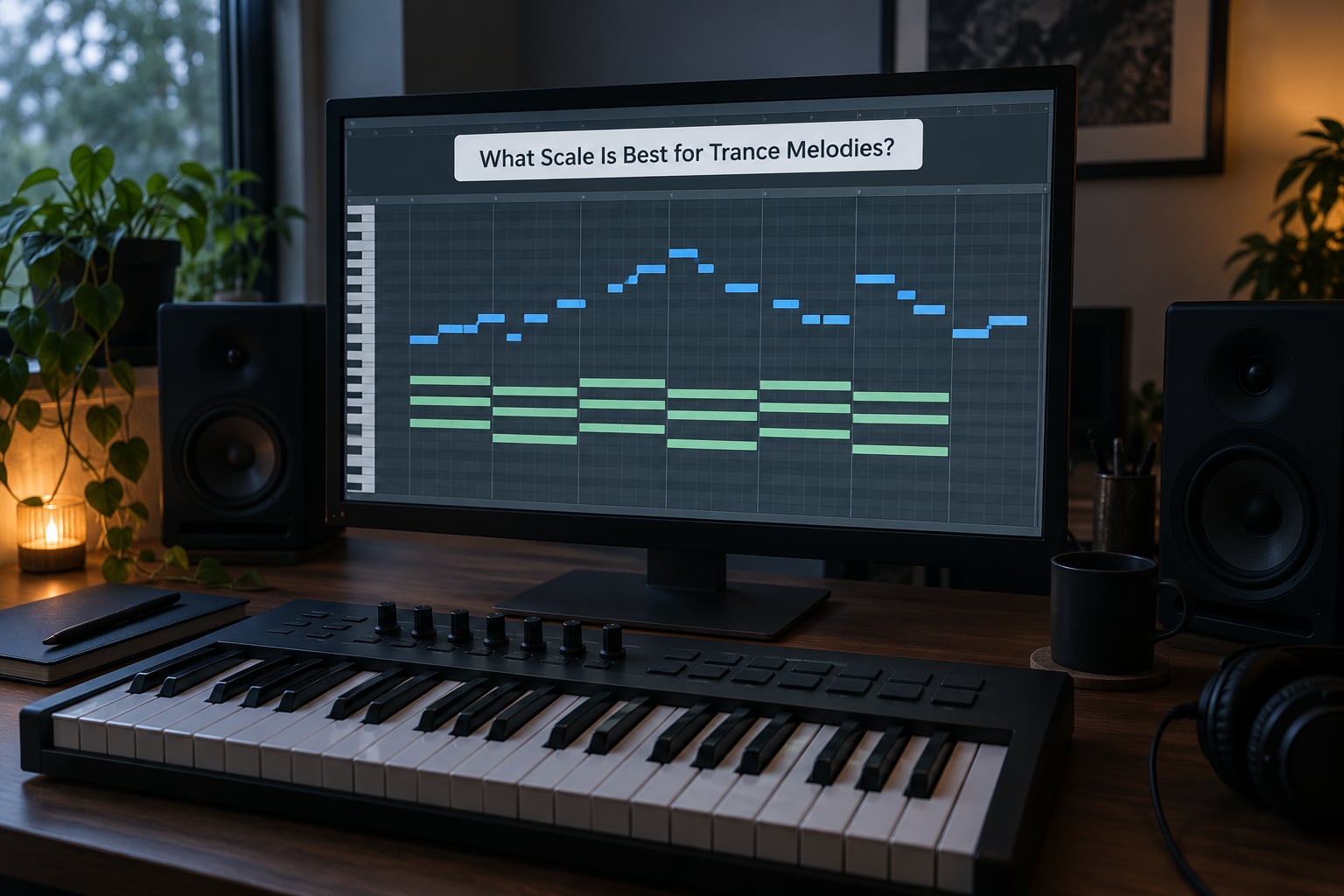
Three modes cover most trance: Aeolian, Phrygian and Mixolydian. Lydian and Ionian handle the bright, heavenly breakdowns, and harmonic minor gives you a tension note you can hold back for the drop. Which one is “best” depends entirely on the job the melody is doing in your track.
A scale sets the pool of notes you can draw from, and every note in that pool carries an emotional association you already know how to feel. Minor-key scales lean melancholy or tense, major-key scales lean open or heroic. In trance that gap gets exaggerated, because the genre spends minutes at a stretch on a single sustained chord with a vocal or a lead pad repeating over it.
That repetition is why scale choice matters more here than in a lot of electronic music. A four-note hook playing over an eight-minute breakdown exposes every awkward interval. Get the pool of notes wrong and you hear it for the entire section.
The seven modes and how each one behaves in trance
Roman numerals aside, modes are just interval patterns starting from a different note of the major scale. W means a whole step, H a half step. The table below lists all seven with the notes you’d get in C, plus how useful each one tends to be behind a trance lead.
| Mode | Interval pattern | Notes in C | Trance fit | Where it works |
|---|---|---|---|---|
| Ionian | W W H W W W H | C D E F G A B | 4/5 | Bright breakdowns, festival openers |
| Dorian | W H W W W H W | D E F G A B C | 3/5 | Minor keys that need to stay groovy rather than sad |
| Phrygian | H W W W H W W | E F G A B C D | 5/5 | Psytrance, Goa, hypnotic and darker drops |
| Lydian | W W W H W W H | F G A B C D E | 4/5 | Epic, weightless, “heavenly” breakdown moments |
| Mixolydian | W W H W W H W | G A B C D E F | 5/5 | Uplifting and euphoric leads, big vocal hooks |
| Aeolian | W H W W H W W | A B C D E F G | 5/5 | Emotional, progressive, melancholic breakdowns |
| Locrian | H W W H W W W | B C D E F G A | 1/5 | Rarely as a full melody scale, fine as a tension trick |
Locrian sits at the bottom for a reason. Its flattened second makes almost every sustained interval sound like a mistake, which is useful for a single held note in a breakdown and exhausting as a melodic home.
How to Choose a Scale for Your Trance Melody
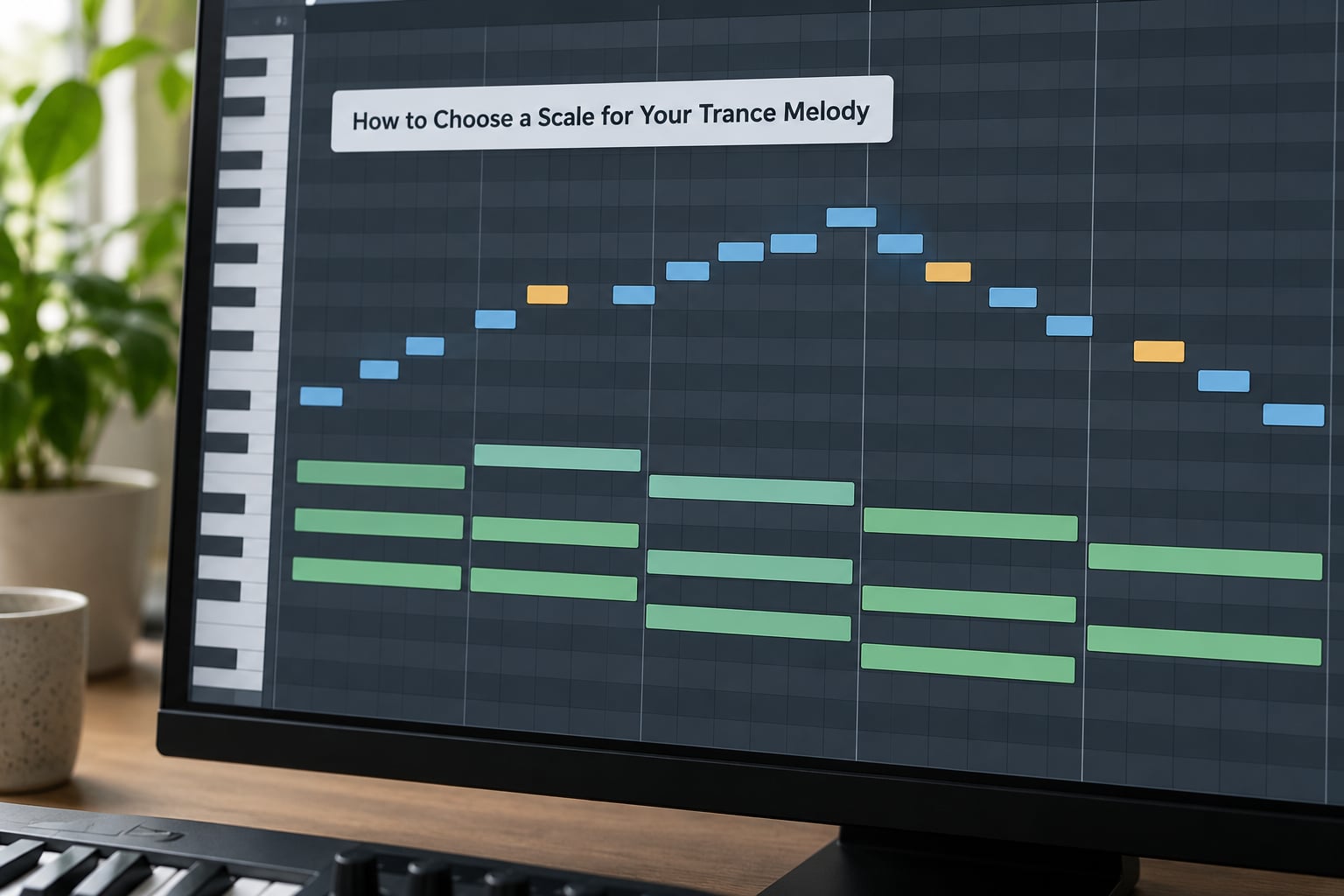
Work through four questions before you touch a note. Each one narrows the pool, and together they usually leave you with a single obvious answer.
What emotion does this section need to produce?
Aeolian and Phrygian for longing, unease, introspection. Mixolydian for momentum and optimism without the sweetness of a full major scale. Ionian and Lydian for lift and release. Harmonic minor when you want the melody to ache and then snap back to the tonic.
Decide the emotion first, in one word. “Longing” and “euphoria” point to completely different pools of notes, and both are perfectly valid in a trance track depending on which section you are writing.
What do the chords underneath already imply?
The chord progression constrains you harder than any scale choice. A minor chord contains three notes; the scale has to at least include all three, plus whatever you want to lean on melodically.
That is why the progression comes first. Once you know the chords, count which notes they already cover. For a trance track in A minor running i, VI, III, VII, those chords use A C E, F A C, C E G and G B D. You have A, B, C, D, E, F and G available. Every mode with an A root works, and the choice narrows to character.
Which element is carrying the melody?
A lead synth, a vocal chop and a pluck arpeggio are three different jobs, and they tolerate different scales. Vocal chops need a small, singable pool with mostly stepwise motion, because the syllable lengths come from the vocal anyway. Pluck arpeggios can handle wider intervals and modes with more bite, since each note is short. A pad can sit on almost anything, because it is not really a melody.
How much space is there above the bass?
Trance sub-bass occupies the bottom of the spectrum, and how it is voiced affects which keys feel best. Producers trading tips on EDM forums keep coming back to F, F sharp, G and G sharp as roots for sub weight, because the fundamental lands in a range where most sub speakers and club systems reproduce it cleanly, and where it will not fight a 32 Hz-ish rumble from a limiter or a master bus compressor.
Treat that as a strong starting point rather than a rule. The real test is always how the low end sounds on the system you will play it on.
Best Scales for Uplifting Trance
Uplifting trance needs melody that climbs. The four scales below all support a rising contour, and they differ in how much sugar they add.
Mixolydian for the main uplifting hook
Mixolydian is the major scale with the seventh note lowered a half step, so the melody gets the brightness of a major key without the pull toward a leading tone. That flat seventh is what makes Mixolydian feel settled and confident rather than yearning, and it is why it is the most common recommendation for an euphoric trance lead.
In G Mixolydian you have G, A, B, C, D, E and F. A hook that runs E, D, C, B, A, G sits entirely in the scale and lands firmly on the root. Pair it with a I-IV-V or a I-V-vi-IV progression and the whole thing feels settled and forward.
The catch is that a whole Mixolydian tune can start to feel like a surf instrumental. Use the flat seventh as a passing note on an off-beat rather than letting it carry every phrase, and reserve the other six notes for the actual line.
Lydian for the weightless breakdown
Lydian raises the fourth, giving a floating, slightly unreal quality that works well under a breakdown with strings or a vocal pad. F Lydian gives F, G, A, B, C, D and E. The B against an F chord is what creates the shimmer, and it is the note that will not resolve smoothly if you lean on it.
Chord-wise, Lydian sits naturally over suspended voicings and over a II chord in a major key, since the major II is the same four notes as IVmaj7. The classic pairing is a II-IV-I-vI, which is essentially the F Lydian collection over F major territory.
Ionian when you want the section to feel anthemic
Plain major is underused in trance, which is odd, because it is the mode that most reliably reads as triumphant. Ionian suits short vocal hooks and big festival breakdowns where the emotional job is uplift and nothing else.
Progression-wise, nothing exotic is needed. I, V, vi and IV cover it, and a I-V-vi-IV loop under a repeating vocal line will carry a full verse without a single passing note.
Harmonic minor when the chorus needs to ache
Harmonic minor is minor with a raised seventh, so you get the A, B, C, D, E, F and G sharp of A harmonic minor. The gap between the sixth and the raised seventh is an augmented second, and it is genuinely uncomfortable. That discomfort is the point.
Hold the raised seventh until the chord resolves, then drop it a half step into the tonic. Used once per phrase it makes a melody feel like it is straining toward release, which is exactly what a pre-drop needs.
Best Scales for Melodic and Darker Trance
Progressive and melodic trance sits in a different emotional place. The melody has to carry feeling while the arrangement stays restrained, so the scale has to supply interest without sounding restless.
Aeolian as the default emotional scale
Natural minor, or Aeolian, is the safest starting point and the one most producers learn first. It is the relative minor of the major scale, which means you can borrow chords from the parallel major later to lift a section without changing key.
In A Aeolian the notes are A, B, C, D, E, F and G. The characteristic interval is the minor third between A and C, and that single semitone defines the mood more than anything else. A i, VI, III, VII loop stays inside the scale the whole way, and the VII chord in particular, with its B, gives the progression a place to breathe.
What Aeolian does not do is create tension. Nothing inside the scale pulls urgently toward a resolution, so melodies written purely from it can feel a little flat once the listener has heard the loop three times. Borrow one note from harmonic minor and you have somewhere to go.
Phrygian for psytrance and hypnotic drops
Phrygian is built on a half step between the root and the second, and that single semitone is the whole personality. E Phrygian gives E, F, G, A, B, C and D. The F sits directly against the E and the E sits against a B, and the resulting clash is what gives psytrance and Goa their rolling, slightly uneasy motion.
Chords work as i and bII, and the bII major chord is the sound people actually recognise from the genre. Holding the second degree in the melody over that chord is where the tension concentrates.
Two rules keep Phrygian usable in trance. Resolve the half-step clash at least once per phrase, or it becomes a siren rather than a melody. And keep the peak of the phrase on a root or a chord tone rather than on the second, so the listener has somewhere solid to land.
Dorian as the minor scale that stays moving
Dorian is the mode between Aeolian and Mixolydian: a minor scale with a raised sixth. D Dorian gives D, E, F, G, A, B and C, and the natural B against the minor third is what gives it a hop to it. A Dorian melody at 138 BPM moves because the scale itself contains the lift that a natural minor lacks.
Pair it with i and IV chords, and treat the sixth degree as an accent note on the last beat of a bar rather than a passing tone. That placement is what keeps the groove instead of turning it into a lament.
Trance usually sits around 138 BPM, the tempo that comes with the standard kick pattern and the rolling bassline the genre grew up on. Scales do not care about tempo, but hooks do: at 138, a four-bar phrase is roughly seven seconds, and anything longer than that stops being a hook.
How to Write a Trance Melody in Any Scale
The process below works whether you are in Aeolian, Mixolydian or something stranger. It takes about ten minutes for a first pass, and most of the time goes on step one.
1. Choose the key first
Pick a root you can live with. If you are writing a track with a sub-bass you have already tuned, match the melody to it. If you are starting fresh, F, F sharp, G and G sharp are the roots most often recommended for trance, since the sub sits where a system reproduces it well. Check the result on headphones and on a small speaker, not only on a monitor.
2. Outline the chord progression in Roman numerals
Write the progression as numerals before you write any notes. i, VI, III, VII is the workhorse for emotional sections. I, V, vi, IV suits anthemic ones. i and bII is the psytrance pairing. Two bars of each, repeated four times, gives you sixteen bars to write against without losing the structure.
3. Collect the notes the scale must contain
List every note used by the chords, then add the mode’s character notes. The chords set the floor, and the mode decides what you can do on top. Write the pool on a piece of paper or as a MIDI region in your DAW, because working from memory is how melodies end up with notes that clash later.
4. Write one short motif and do not develop it yet
Four to six notes is plenty. Make it singable, keep the contour clear, and check it against the chords before anything else. A motif that works in one key position works in others later, so do not spend this stage on placement.
5. Repeat with variation, then test it alone
Set the motif to repeat every four bars. Change one element at a time: transpose it up a third, shift the rhythm by one sixteenth, drop the last note. On the third pass, change the ending rather than the beginning, since the end of a phrase is where listeners decide whether to come back.
Before you add anything else, play the loop on its own for a minute. If the melody is boring without drums, no amount of arrangement will fix it.
How to Make Scale Choices Work with Chords and Bass
The melody, the chords and the bassline are usually three separate parts in a trance track, and they occupy different registers. That separation is a gift, because it means the scale can be more adventurous than the chord voicing underneath it.
Chord tones on strong beats, color notes everywhere else
On the downbeat and the main snare hit, use chord tones. Anywhere else, use the mode’s character notes. This is a simple rule and it fixes most clashes on its own, because the ear hears the strong beats as the harmony and reads everything between them as decoration.
On a four-on-the-floor pattern, the kick plays on every quarter note, so the “strong” positions are the first and third beat of each bar. A tritone or an augmented second landing on beat one will sound like a mistake. The same interval on the “and” of beat two sounds intentional.
Watch the intervals that turn to mud
A minor second between the melody and the bassline sounds like a mistake, especially in the low register. A minor third works fine as long as both parts are not fighting in the same octave. A tritone between a pad and a lead can work as tension for one bar and then needs to resolve.
The practical fix is to move the melody up rather than thin out the arrangement. Most trance leads sit an octave or two above the bassline for exactly this reason.
Borrow a chord for the drop
Modal interchange is the fastest way to make a breakdown and a drop feel like the same song without a key change. In A minor, pull a G major chord from the parallel major into a section that otherwise only uses A minor chords. The G is an unusual, bright chord in that context and it raises the energy without you touching the scale.
It also works in reverse, and that version is more useful in trance. Move from a major chord to its minor counterpart partway through a breakdown, and the melody will drop into a darker place without anyone noticing the switch. Save it for one moment per track, at the moment of highest tension.
How to Test the Melody in a Full Trance Track
A melody that works in isolation can disappear in a full arrangement. Here is the check to run before you call a hook done.
Check the range and the octave
Trance leads usually live somewhere around the middle of the instrument’s range, with the vocal or the arpeggio occupying the space above. If your melody is a full octave lower than where it needs to sit, transpose it rather than adding volume. If it fights the arps, move the arps, not the hook.
Check it against a vocal or chops
Sing the melody over the track as if it were a vocal line. If you cannot sing it in one breath, the intervals are too wide for a chop or a lyric. Chopped vocals need a small range and mostly stepwise motion, and the mode matters less than the shape.
Check the masking
Sidechain compression on the kick ducks everything in the low end, including a melody that has crept down into the bass register. If the hook disappears on every kick hit, it is sitting too low. Raise it a full octave and the problem usually disappears without touching the compression settings.
Run the final A/B
Bypass the melody and listen. Then bypass the drums and listen. If the melody still works on its own, and the track still works without it, the scale choice is doing its job. If the track collapses without the hook, the hook is carrying the emotion rather than colouring it, which is a different and much harder problem to fix.
Then listen to it at low volume in one room, and loud in another. Melodies that reveal their weak spots at small volume are almost always sitting in a register the arrangement never supports.
Frequently Asked Questions
What is the best scale for an uplifting trance melody?
Mixolydian is the most reliable choice. It keeps the brightness of a major scale but lowers the seventh, so the melody feels confident rather than yearning, and it works over the I-IV-V and I-V-vi-IV progressions that underpin most uplifting trance. Lydian suits weightless breakdowns, and Ionian suits anthemic vocal hooks.
Should I use a major or minor scale for trance?
Both, and most trance tracks use both at different points. Major-key modes such as Mixolydian, Ionian and Lydian carry uplifting and anthemic sections, while Aeolian and Phrygian carry emotional, progressive and darker ones. A common structure is a major or Mixolydian intro and vocal section that drops into a minor breakdown before the return.
Can I change scale during a trance melody?
Yes, and it is often the difference between a melody that feels alive and one that loops flat. Most changes are small: adding a single note from harmonic minor, or swapping the sixth degree to move from Aeolian to Dorian mid-phrase. Larger shifts, such as borrowing a chord from the parallel major at the drop, need the surrounding chords to support them.
Which scale works best for trance vocals and chops?
Aeolian and Mixolydian are the safest for vocals because both give a small, singable set of notes with mostly stepwise motion. The scale matters less than the contour though. A chopped hook in Phrygian works if the melody is narrow and the half-step clash is left off the beat, and fails if the vocal range is wide.
How do I avoid melodies sounding too predictable?
Vary the ending before the beginning. Change the last note of the phrase, transpose the second half of the motif, or shift the rhythm by a sixteenth so the resolution does not land where the listener expects. Adding one tension note from a borrowed scale and delaying its resolution by a bar also helps, because it gives the loop somewhere to go.
Should the bass and melody use the same scale?
They should share a key and a tonal center, but they do not need the same notes. The bassline is usually playing root notes and fifths, which sit in almost every scale, so you can add character notes to the melody without touching the bass. Where they do conflict, keep the bass on chord tones and move the melody up an octave rather than removing notes from the scale.
Conclusion: Choose the Scale by Musical Job
There is no single best scale for trance melodies, and the honest answer is that your chord progression decides more of it than the label does. Start with the progression in Roman numerals, choose major or minor for the emotion you want in that section, add one or two characteristic notes from the mode, and revise the melody against the finished track.
Do the first version today. Write four bars in A minor over i, VI, III and VII, add the G sharp from harmonic minor as a passing note, and listen to it against a kick and a sub. An hour of that is worth more than another hour reading about modes.