What LUFS should EDM be mastered to? For most electronic releases going to streaming, start around -9 LUFS integrated and keep the master under -1.0 dBTP true peak. That sits well above the -14 LUFS people copy from streaming guides, because dance music competes in a loud field rather than a quiet one.
The number is a starting point, not a law. A melodic techno track and a hardstyle anthem both live somewhere near -8 to -10, but they arrive there with very different amounts of push and control. Genre, mix density, and where the track is going all change the final call.
LUFS measures the average level your ears read over the whole track. It does not measure punch, transient shape, or stereo width, and a master can hit exactly the same integrated reading as another one and still feel completely different. That is the part most of the conflicting advice online leaves out.
Table of Contents
- What LUFS Should EDM Be Mastered To?
- Quick answer by release type
- LUFS vs. Perceived Loudness in EDM Mastering
- Recommended LUFS Targets by EDM Style
- Dense styles: hardstyle, gabber and raw techno
- Ambient, progressive and downtempo: when quieter is the better call
- Reference matching as the tiebreaker
- How Many LUFS Should Streaming EDM Masters Use?
- How Loud Should a Club-Only EDM Master Be?
- What True-Peak Level Should an EDM Master Use?
- How to Set the Loudness Meter in Ableton Live, FL Studio, and Cubase
- A Practical EDM Mastering Workflow
- Common Loudness Mistakes to Avoid
- Frequently Asked Questions
- Is -9 LUFS a good target for EDM?
- Should EDM masters be louder than -10 LUFS?
- Does Spotify make -8 LUFS EDM sound quieter?
- What is the difference between LUFS and dBTP?
- What LUFS should I send to a mastering engineer?
- Do I need a separate master for streaming and clubs?
- Conclusion
What LUFS Should EDM Be Mastered To?
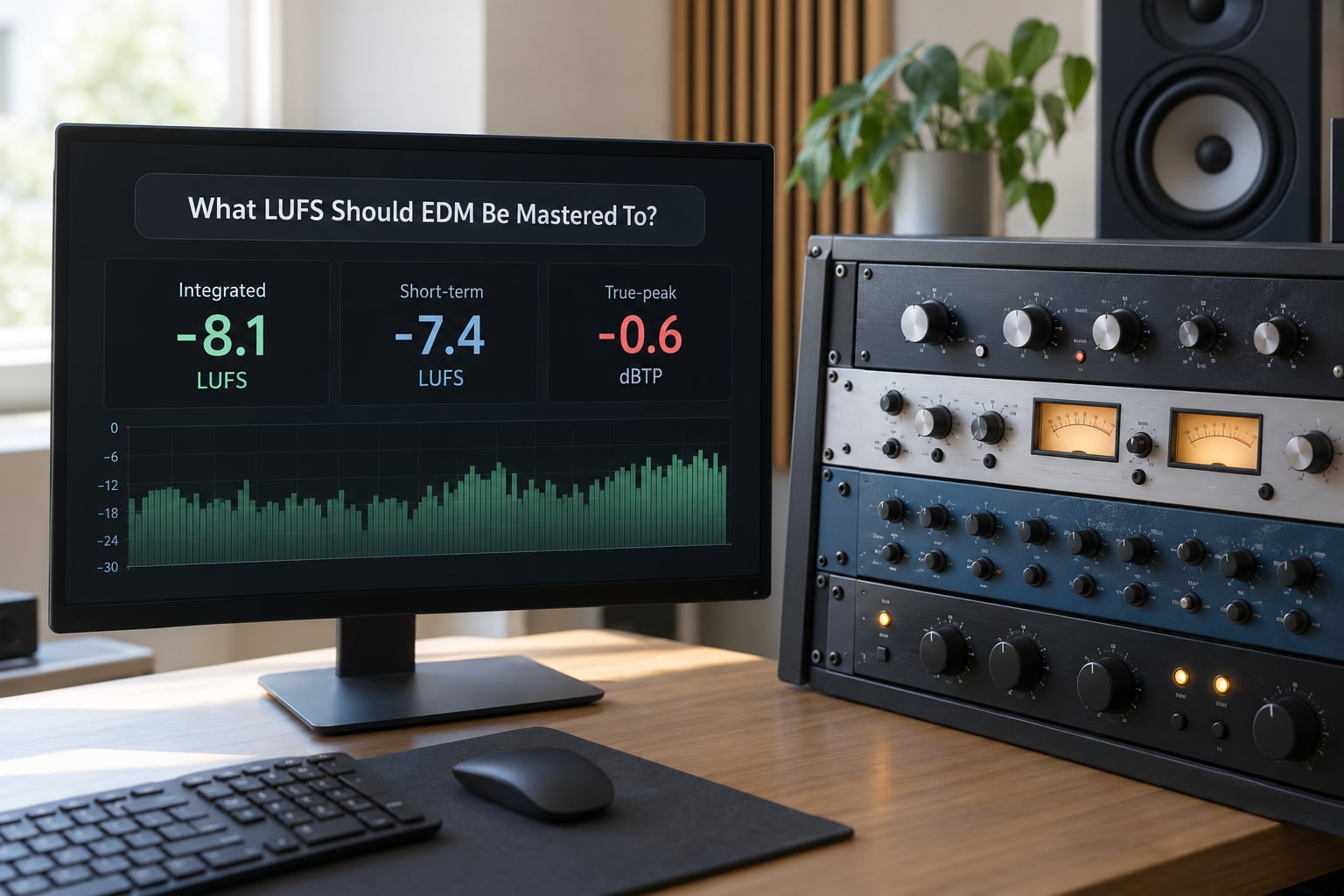
Master EDM to roughly -8 to -9 LUFS integrated, with melodic styles sitting closer to -10 and hardstyle, gabber and dubstep closer to -8. Cap true peak at -1.0 dBTP for streaming delivery.
That range is not invented. In April 2026, iZotope published a loudness and tonal analysis of ten tracks from the Billboard Hot Dance/Electronic Songs chart, measured from lossless Qobuz files so nothing was normalised first. The average integrated reading came out at -8.3 LUFS, plus or minus about 1 LU. The loudest track in the sample sat at -6.2 LUFS and the quietest at -11.3 LUFS.
Loudness range across those ten masters ran from 4.2 LU to 13.8 LU, averaging around 6.6 LU. Read that alongside the loudness numbers rather than separately: two masters at -8.3 is meaningless on its own, but a -8.3 with LRA near 5 is a different object than a -8.3 with LRA near 13. The first one is dense and controlled. The second one is loud and still breathing.
Quick answer by release type
| Release type | Integrated LUFS | True peak ceiling |
|---|---|---|
| Streaming EDM single, general | -8 to -9 LUFS | -1.0 dBTP |
| Melodic techno, progressive, deep house | -9 to -10 LUFS | -1.0 dBTP |
| Ambient, downtempo, chillout | -11 to -12 LUFS | -1.0 dBTP |
| Hardstyle, gabber, raw techno | -7 to -8 LUFS | -1.0 dBTP |
| Dedicated club / PA version | -7 to -8 LUFS | -0.8 dBTP |
| Dolby Atmos master | Not above -18 LUFS | -1.0 dBTP |
| Premix sent to an engineer | Around -18 LUFS | -6 dBFS sample peak |
LUFS vs. Perceived Loudness in EDM Mastering
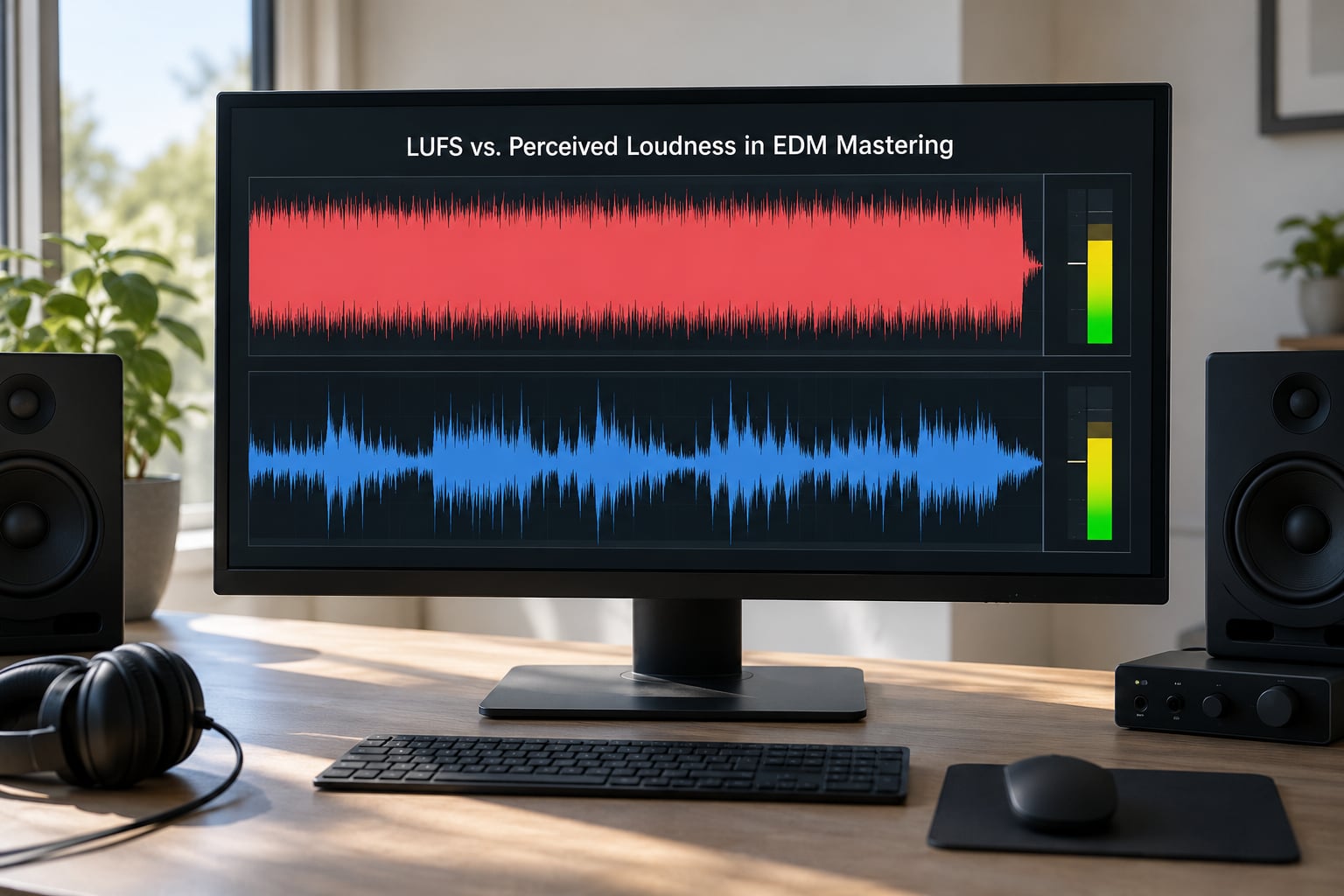
LUFS is a K-weighted average. A filter approximates how human hearing responds across frequencies, then the energy is averaged across the whole track to give an integrated number that aims to match perceived loudness. It is a better guide than raw peak or RMS, and it is still only an average.
| Reading | Window | What it tells you |
|---|---|---|
| Momentary LUFS | 400 ms | Instantaneous loudness, what hits hardest right now |
| Short-term LUFS (LUFS-S) | About 3 seconds | How loud a section reads, useful for chorus versus intro |
| Integrated LUFS | Whole track | The number you report and target |
| LUFS-M | Whole track, gated | Mean loudness that ignores silence, less twitchy than integrated |
| Loudness range (LRA) | Whole track | How much the loudness swings between quiet and loud |
| True peak (dBTP) | Instantaneous | Highest level including inter-sample peaks |
dBFS is a different unit entirely. It measures the digital sample peak, so a track peaking at -1 dBFS has not technically clipped, but the AAC or Ogg encoding on the streaming side can still push it over zero and crackle. dBTP catches those inter-sample peaks that exist in the reconstructed waveform between your samples.
RMS is the oldest of the three and the least useful for a target here. It counts average energy with no hearing weighting, so a bass-heavy master looks far louder in RMS than it sounds. Most of the confusion you find in forums comes from mixing these units up in the same sentence.
Two masters can both read -9 LUFS integrated and still feel nothing alike. Transient impact depends on peak-to-loudness ratio, frequency balance, stereo width, and how hard the limiter is working, not on the integrated figure. The iZotope analysis put peak-to-loudness figures alongside the LUFS numbers for exactly this reason: the tightest, loudest masters were not automatically the ones with the most energy.
Sidechain pumping and arrangement density drive that more than any knob on the master chain. A sidechained pad that breathes under the kick gives a -7.7 LUFS master real shape, while a heavily limited one at -6.2 LUFS can be flat mush.
Recommended LUFS Targets by EDM Style
These are creative starting points, not rules. Every one of them assumes a track mixed with real headroom rather than a premix already pushed to the ceiling.
| Style | Streaming target | LRA range | Club target |
|---|---|---|---|
| Big room house | -8 to -9 LUFS | 5 to 8 LU | -7 to -8 LUFS |
| Progressive house | -9 to -10 LUFS | 6 to 10 LU | -8 to -9 LUFS |
| Melodic house / melodic techno | -9 to -10 LUFS | 7 to 11 LU | -8 to -9 LUFS |
| Classic techno | -8 to -9 LUFS | 5 to 9 LU | -7 to -8 LUFS |
| Hardstyle / gabber | -7 to -8 LUFS | 3 to 5 LU | -6 to -7 LUFS |
| Dubstep / bass music | -8 LUFS | 4 to 6 LU | -7 to -8 LUFS |
| Future bass / melodic bass | -9 LUFS | 5 to 8 LU | -8 LUFS |
| Trance | -8 to -9 LUFS | 6 to 9 LU | -7 to -8 LUFS |
| Downtempo / ambient | -11 to -12 LUFS | 9 to 13 LU | -10 to -11 LUFS |
Dense styles: hardstyle, gabber and raw techno
These sit loud by design. A hardstyle master at -9 LUFS will feel timid next to the competition, and producers pushing to -6 to -7 report it sounding brilliant in the DAW and terrible everywhere else. Aim for -7 to -8 with LRA in the 3 to 5 range, and let the kick carry the weight rather than the master fader.
Ambient, progressive and downtempo: when quieter is the better call
Melodic techno and progressive house reward dynamics. Producers who force these to -8 usually end up with a dense master that loses the lift between breakdown and drop. -9 to -10 keeps the build readable, and downtempo or ambient can sit as low as -11 or -12 without sounding thin, because those records are judged on space and detail rather than impact.
Reference matching as the tiebreaker
When the numbers argue with each other, load three recent chart releases in your exact subgenre, measure their integrated LUFS and LRA, and sit your master next to them at a matched monitoring level. This is the advice the forums trust most, and it beats any universal rule because it reflects what listeners of that specific record are already calibrated to.
How Many LUFS Should Streaming EDM Masters Use?
A loud master around -8 to -9 LUFS suits competitive EDM, and streaming normalisation does not punish you for it. Normalisation turns playback volume down or up toward a platform target, but it does not re-compress your master or undo the tonal decisions you already made.
| Platform | Normalisation target | What happens to a -8 LUFS master |
|---|---|---|
| Spotify (normal mode) | -14 LUFS | Turned down at playback |
| Spotify (Loud mode) | -11 LUFS | Played close to your intended level |
| Apple Music | About -16 LUFS (Soundcheck) | Turned down further than Spotify |
| Tidal | -14 LUFS | Turned down at playback |
| YouTube | -14 LUFS | Turned down at playback |
| Deezer | About -15 LUFS | Turned down at playback |
| Amazon Music | About -14 LUFS | Turned down at playback |
| SoundCloud / Bandcamp | None | Played at your level, untouched |
Those figures were the normalisation points reported by EDMProd in April 2026. They change as platforms retune, so treat them as a snapshot rather than scripture.
They are also playback numbers, not mastering targets. You do not master to -16 LUFS because Apple Music normalises there. You master to what the style needs, and you accept that the platform decides how loud it plays back.
Two practical notes. First, Spotify’s Loud mode at -11 LUFS is the one setting that lets a dense master play almost untouched, and some dance labels deliver masters near it for exactly that reason. Second, you can preview the turn-down before you distribute: Youlean’s Loudness Penalty plugin models what Spotify, Apple Music, Tidal and YouTube will each do to your master.
How Loud Should a Club-Only EDM Master Be?
Clubs want more headroom and more punch than streaming does, and this is where the -8 versus -14 argument actually comes from. A dense -8 LUFS master can sound quieter through a system processor than a -14 master played before processing, because the processor is already managing level and a heavily limited track gives it less to work with.
The dual-master approach solves this cleanly. Keep your streaming master at -8 to -9 LUFS with a -1.0 dBTP ceiling, then print a second version for the DJ with more headroom and a touch more transients. YouTube and SoundCloud are useful here, since neither applies the same normalisation, so you can send a club-optimised version without it being turned into mud.
Check the mix in several places before you commit: headphones, nearfields, a phone speaker, and the car. A club mix that only works on the big system and disappears on earbuds is not finished.
If you only get to deliver one file, deliver the streaming version. Labels, playlists and the overwhelming majority of listeners are on a phone or a laptop.
What True-Peak Level Should an EDM Master Use?
Use -1.0 dBTP for EDM streaming delivery, and -0.8 dBTP if you are also handing the track to DJs and club systems. Sample peak and true peak are different measurements: your DAW reads the digital samples, while true peak reconstructs the waveform and catches the overshoot that appears between samples. That overshoot is exactly what a lossy codec pushes over the top and turns into distortion.
EDM breaks the ceiling easily. Kick drums with fast transients and supersaws full of high-frequency energy are both notorious for it, which is why -0.1 dBTP on a DAW sample meter can still crackle on a phone.
Enable oversampling in your limiter, use true peak rather than sample peak detection, and set the ceiling slightly under zero. Export at 24-bit if your chain allows it, and audition the bounced file rather than the session: true peak behaviour differs slightly between a live chain and a rendered bounce.
How to Set the Loudness Meter in Ableton Live, FL Studio, and Cubase
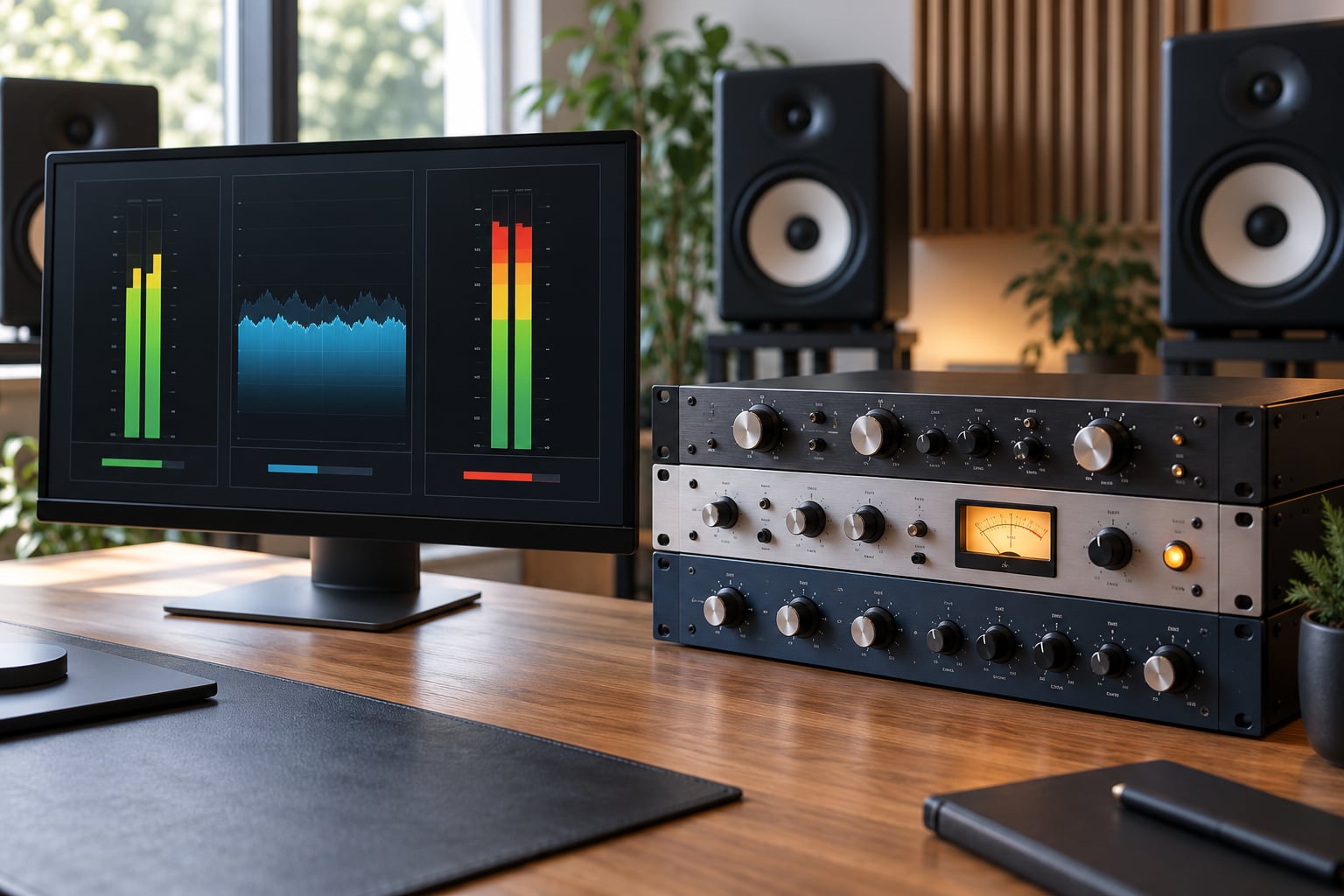
Put the meter last on the master bus, after every compressor and limiter. A meter placed earlier in the chain reads the loudness your master is about to have, not the one it ends up with, which is the most common metering mistake there is.
In Ableton Live, add the Meter device on the Master track and enable loudness analysis in its detail view to see momentary and short-term peaks. Live’s own meter reports peak and RMS rather than a full integrated LUFS figure, so add a dedicated LUFS plugin for that number. Menu paths shift a little between Live versions, so look in the device categories for Meter and Utility.
In FL Studio, there is no built-in LUFS readout on the master. Drop a free metering plugin on the Master track via the Plugin Picker instead. Youlean Loudness Meter 2 and LEVELS both give you integrated, short-term, momentary and true peak on one screen, and iZotope Insight 2 is the paid option that adds a spectrum and a correlation view in the same window.
In Cubase, insert a loudness meter on the audio track as the final insert. Set it to display integrated loudness and true peak, and enable maximum loudness and maximum true peak readouts so you can check the loudest moment of the track rather than only the average.
Whichever DAW you are in, measure a rendered export before you believe the number. The session view and the bounced file can disagree by a fraction of a LU, and the bounced file is what your listener actually gets.
A Practical EDM Mastering Workflow
- Check the mix first. If the low end is unbalanced or the kick is fighting the bass, more loudness will not fix it. Fix balance before level.
- Make corrective moves only where needed. A little EQ and compression on what is actually wrong beats a full chain on everything.
- Pull a reference. Load a recent release in your subgenre and match levels, not just numbers.
- Raise gain, then limit deliberately. Set the target from the subgenre table, watch gain reduction as you go, and stop when the limiter is doing roughly 1 to 2 dB of reduction rather than 6.
- Confirm integrated LUFS and true peak. Read both numbers off the render, not the session.
- Check the LRA. If it collapses below about 4 LU on a loud track, you have gone past the point of useful limiting.
- Compare at matched levels. Bypass the chain at unity gain and make sure your loud master still sounds right with the gain taken away.
- Export and audition elsewhere. Headphones, monitors, phone, and a proper system if you have access to one.
That whole sequence takes maybe forty minutes on a track that is already in decent shape. It is also the part producers skip when they are chasing a number, which is how a -8 ends up sounding like a -5.
Common Loudness Mistakes to Avoid
Chasing a single number. Fixing the LUFS figure while ignoring LRA is how two masters end up on the same playlist and only one of them works. Correction: read integrated LUFS and LRA together every time.
Comparing masters at mismatched playback levels. The louder one always wins that comparison, and you learn nothing. Correction: match the monitoring level first, then switch.
Over-limiting. Going to -5 or -6 because the limiter would allow it costs you transients and usually opens up sibilance. Correction: set a target from the table and stop there.
Pushing the low end to make it feel loud. Bass-heavy genres like dubstep already sit high, and adding more sub to hit a target usually just muddies the kick. Correction: get loudness from density and arrangement, not from more low end.
Trusting a single meter reading. One integrated number with no true peak check and no reference comparison tells you very little. Correction: check integrated LUFS, true peak, LRA and a reference before you export.
Mastering to -14 LUFS because it is what a blog said. That figure is a streaming normalisation point. A trance track at -14 next to competitors at -9 will sound thin and underpowered. Correction: target the style, let the platform handle playback.
Frequently Asked Questions
Is -9 LUFS a good target for EDM?
Yes. Around -9 LUFS integrated is a useful starting point for loud, modern EDM, especially trance, house and techno. It sits close to the -8.3 LUFS average iZotope measured across ten Billboard Hot Dance/Electronic tracks that April. It is not a mandatory number: melodic styles often work better at -10, and ambient sits lower still. Check the loudness range before you commit.
Should EDM masters be louder than -10 LUFS?
For most competitive dance releases, yes. Many sit between -8 and -9 LUFS integrated, and hardstyle and gabber go higher still. But a master does not have to exceed -10 LUFS to be professional. A melodic techno track at -9.5 with a loudness range of 9 will outperform a -8 with a range of 3 every time. The subgenre table gives the ranges I would start from.
Does Spotify make -8 LUFS EDM sound quieter?
Spotify normalises playback toward -14 LUFS in normal mode, so a -8 master gets turned down before anyone hears it. That does not make it a bad master. Normalisation changes volume, not the tonal balance or dynamics you baked in, so a dense -8 and a dynamic -14 end up close to identical in perceived level while sounding very different. Spotify’s Loud mode at -11 LUFS leaves more of your intent intact.
What is the difference between LUFS and dBTP?
LUFS measures perceived loudness across the whole track, with the integrated figure giving you an average. dBTP measures the highest true peak, including the inter-sample peaks that appear between digital samples. They answer different questions and both matter. Target roughly -8 to -9 LUFS integrated for EDM and cap the true peak at -1.0 dBTP so lossy encoding does not push it into audible distortion.
What LUFS should I send to a mastering engineer?
Send a premix around -18 LUFS integrated with stereo peaks no higher than -6 dBFS. That headroom lets your engineer use a real analogue or high-resolution chain instead of fighting a limiter you already engaged. If you are mastering it yourself, the mix stage level matters less, but keeping peaks out of clipping is still worth the effort.
Do I need a separate master for streaming and clubs?
Ideally, yes, and the two are close enough that it is a small job. Keep your streaming master at -8 to -9 LUFS with a -1.0 dBTP ceiling, then print a second version with more headroom and a slightly higher ceiling around -0.8 dBTP for DJ play. If you can only deliver one file, deliver the streaming version, since most listeners never hear it through a sound system.
Conclusion
Start at -9 LUFS integrated with a -1.0 dBTP ceiling, then move from there based on style. Before you export anything, read the integrated LUFS and the true peak off a rendered file, check the loudness range so you know whether your loudness cost you dynamics, and compare against a recent release in your subgenre at a matched monitoring level. Adjust toward the style and the destination rather than forcing an exact number, because a target that fits a hardstyle anthem will flatten a melodic techno record.