A demo submission email is a short, personalised message to a label’s A&R or demo inbox pitching one finished, unreleased track through a private streaming link, explaining why it fits that label’s catalogue, and ending with one clear ask. It should read in under two minutes, fit on a phone screen without scrolling, and never carry an audio attachment.
That is the whole genre in three sentences, and most people get it wrong in the same four places. The email is not judged on how hard you worked or how much you love the track. It is judged on whether the music sounds finished, whether it sounds like that label, and whether the person reading it can tell in ten seconds what you want them to do.
This guide is written for unsigned producers sending cold submissions with no manager, no warm introduction and no press. If you have a track finished and a shortlist of labels, you can have a credible email written and sent inside an evening.
Table of Contents
- What You Need Before You Write the Email
- Step-by-Step: How to Write a Demo Email to a Record Label
- Step 1: Research the Label and Choose the Right Track
- Step 2: Write a Specific Subject Line and Opening
- Step 3: Present the Track Without a Full Press Release
- Step 4: Make the Ask Easy to Answer
- Step 5: Proofread, Test, and Send
- Common Demo Email Mistakes and How to Fix Them
- A Complete Demo Email Example for an Electronic Producer
- How to Follow Up Without Being Pushy
- Frequently Asked Questions
- How long should a demo submission email be?
- Should I attach my demo to the email or use a link?
- Do record labels still accept unsolicited demos?
- Is Au0026amp;R still relevant for unsigned artists?
- Should I follow up if I do not hear back?
- Can I send the same demo to several record labels at once?
- Conclusion
What You Need Before You Write the Email
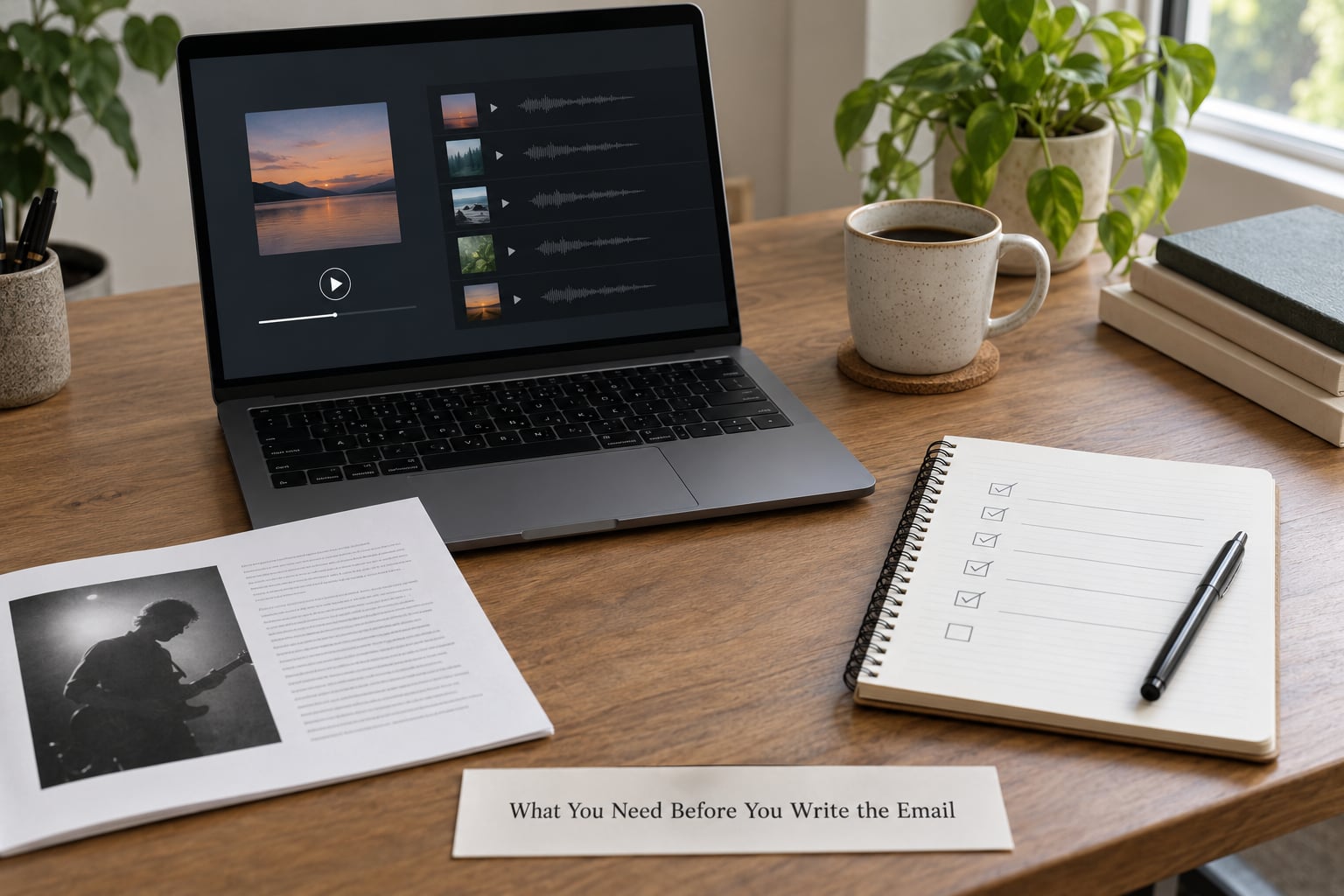
Most weak submissions fail before the first word of the email, because one of these seven things was missing. Gather them first and the writing part takes fifteen minutes.
- One finished track. Not a work in progress, not a phone demo, not a loop with a vocal chop over the top. The consensus on r/edmproduction is blunt about this: a demo should be a finished, good-quality song, because nobody is going to sign a rough. Finish one track properly instead of sending three that are nearly there.
- A private streaming link. Upload the track as private or unlisted on a streaming service, or use a file-sharing link with the download option enabled. Test it logged out of every account you own, on your phone, before you paste it anywhere.
- A file fallback. Have a 320kbps MP3 or a 16-bit WAV ready in case someone asks. Most A&R will never want it in the first email, but having it removes a reason for them to reply with just a question.
- The correct contact address. The label’s demo inbox, a named A&R, or the submissions address from the label’s own site. Never guess at a personal address from a pattern.
- A one-paragraph bio. Two sentences on who you are, what you have released, and any real traction, such as play counts, DJ support, playlist adds or live shows. Producers on r/WeAreTheMusicMakers get burned for inflated claims, and invented credentials are the fastest way to lose a listener’s trust.
- Release information. Key, BPM, track length, whether anything is already out, and your realistic release window. Some A&R use this to judge whether they could work with you on their schedule.
- One reason for contacting this label specifically. A named release that made you send it. This is the piece most first emails leave out, and it is the one that separates a submission from a mass blast.
Step-by-Step: How to Write a Demo Email to a Record Label
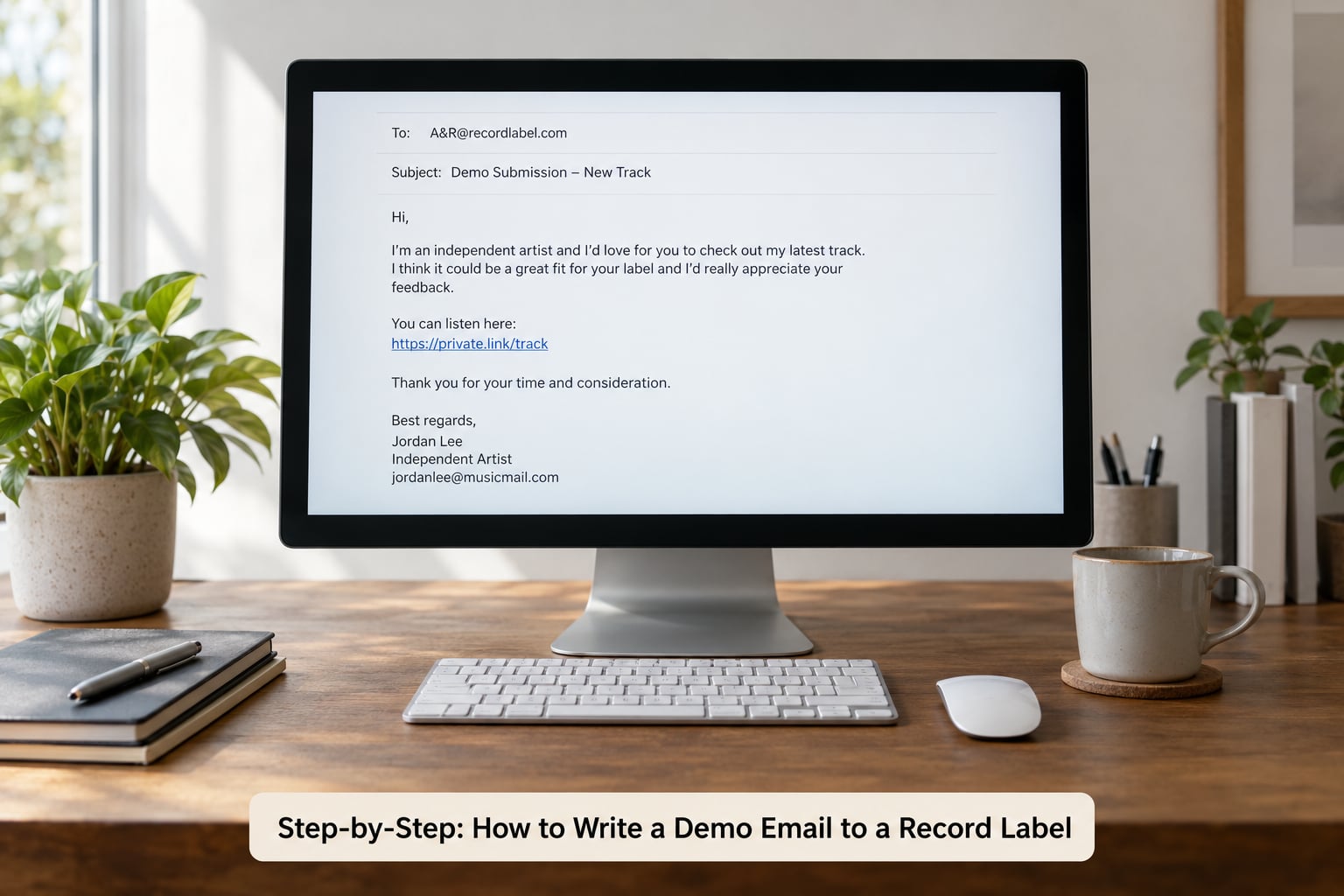
The process below is the same whether you are pitching an indie imprint, a major label A&R, a music blog or a playlist curator. Six steps, in this order.
Step 1: Research the Label and Choose the Right Track
Start on the label’s own website, not on a list of “labels accepting demos.” Look for a demos, submissions or contact page. Plenty of labels publish an explicit demo policy, and the small print matters more than it looks: some ask for a specific subject line, some want files linked rather than attached, and some ask for nothing but a private link. Copy their wording exactly where they have given it. Break a stated format and you are filtered before a human sees it.
Then check two things: whether the label accepts unsolicited music at all, and whether it accepts it by email. Larger imprints often route everything through a submission form or a paid third-party platform and ask you not to email their A&R directly. If the site says no unsolicited demos, respect it and move on. Sending anyway is the fastest way to be flagged.
For catalogue fit, do what producers on r/TechnoProduction describe as the sensible version of shopping music to labels: find an artist you admire, check who released them, and target that label. Read the last ten releases and ask whether your track would sit comfortably between two of them. If it would not, you have the wrong label, and no amount of good copy fixes that.
Now pick one track. Choose the one closest to the label’s sound, not the one you spent six weeks on. Some producers go further and write two or three tracks aimed at a specific imprint before pitching it, which is a slow but honest strategy. Once you have the track, verify the link: open it in a private window on your phone, confirm it plays without a login prompt, and check the title and artist name display correctly.
Step 2: Write a Specific Subject Line and Opening
The subject line does three jobs: it says who you are, what you are sending, and why this inbox. A workable formula is artist name, track title, genre tag, one specific reason. Keep it under about 60 characters so it survives mobile truncation. Here is the same idea across eight pairs:
- “Music for your consideration” becomes Hollow Coast, “Low Tide” (124bpm dub techno) for your autumn techno series — identifies artist, track, tempo, genre and the reason it reached this inbox.
- “Unsigned producer – please listen” becomes Mara Vale, “Paper Lanterns” – ambient EP track, private link — drops the apologetic framing and states what is attached.
- “Demo submission” becomes Demo submission – Juno Park, “Ferrous”, techno 138bpm — keeps the label’s requested wording and adds the details they scan for.
- “URGENT!!! Listen to my track!!!” becomes Ashen Field – “Nightshift”, leftfield house, 122bpm — removes the pressure tactics that read as mass outreach.
- “Great song for your label” becomes Rinse Theory, “Cold Open” – breaks and leftfield, private streaming link — names the lane, so the right A&R recognises it instantly.
- “Hello, I am a composer” becomes Nils Aker, “Signal Chain” – modular techno, unreleased — says what you make and whether the track is still available.
- “Please sign me” becomes Ota Bloom, “Undertow” – 128bpm deep house, one-track single — replaces a demand with a description of the release.
- “Check this out” becomes Sable Hours, “Glasshouse” – shoegaze, built for your current roster — shows the research was done before the send button.
The first line of the body should do the personalising. Openers that reference something specific beat openers that reference something generic. Producers on r/metalmusicians report keeping a reusable template with their own details swapped in per label, which is the right pattern as long as the specific sentence is genuinely rewritten.
- Your reissue of the Kesh Vela track has been on repeat for me this week.
- I have been following the label since the [artist] release and the way you have leaned into darker club records is why I am writing.
- Your [founder] interview about breaking your own masters changed how I finished this one.
- I saw you put out two records from the same studio this year and wanted to send something that sits next to them.
- Your playlist picks for [season] are the closest thing to my own taste I have found.
- I spent six weeks trying to make a track that would survive sitting next to [named release].
A weak opener: “My name is [artist] and I am a producer from [city]. I have been making music for many years and I believe my music would be a great fit for your label.” It says nothing a template could not say, and it asks the A&R to do the work of finding a reason to care.
Step 3: Present the Track Without a Full Press Release
Four things belong in the track paragraph: what the track musically is, its strongest specific detail, who it is for, and any context that affects the release. That is four sentences, not a paragraph of biography.
Before: “My new track is a really special song that I have put a lot of work and passion into. It has a really deep atmospheric vibe with a strong emotional journey. I think it would fit really well with your label.”
After: “The track is built on a single broken-boom loop with a dub chord held for most of the eight minutes, and the whole arrangement drops out for the last bar before the kick returns. It is aimed at late-night listening rather than the peak-hour floor. I wrote it after your [artist] release and it deliberately borrows that patience.”
The rewrite names what the track is made of, what happens in it, who it is for and why you sent it here. That is the entire job. If you need more than 150 words to describe one track, you are writing press material instead of a demo email.
Step 4: Make the Ask Easy to Answer
One email, one ask. The most common asks are permission to send more music, a listen and a reply either way, or a single placement. Say exactly which one you want, in one sentence, close to the end.
“If the track is close but not right, I would genuinely like to know which part landed and which did not.”
“Would you be open to hearing two more tracks from the same sessions?”
“If it is not a fit for the label, I would appreciate you letting me know so I can stop waiting.”
If the label only accepts submissions through a form, the form fields replace the body of the email. Read them carefully, because the field asking for a short description is doing the same job as your third paragraph, and the field asking why they should listen is your opening line.
Step 5: Proofread, Test, and Send
Read the finished email as a stranger on a phone. Check the recipient name and spelling, the subject line, every link, the sender address, and how the paragraph breaks look at narrow width. Send a test to yourself first if the email has tables or images.
Send during normal business hours in the recipient’s time zone. A demo that arrives at 2am local time reads as a batch job, and on r/edmproduction people are candid about noticing exactly that kind of pattern.
One warning about deliverability: never blind-copy a list of label contacts on a single send. Blasting a bought or scraped list is a good way to have your address filtered, and a filtered sender can struggle to deliver anywhere afterwards. It is also the fastest way to get flagged by a label you actually want to hear from. Send individually, one label at a time.
Log what you sent, to whom, and on what date. It sounds fussy, but it is the only way to avoid sending the same track to the same person twice after a month of silence.
Common Demo Email Mistakes and How to Fix Them
These are the eight problems that come up again and again in producer threads, each with a direct fix.
- Generic opening. “My music would fit your label” is interchangeable with any other email. Fix: name a specific release, artist or playlist from that label in your first sentence.
- Sending too many tracks. Sending a three-track package asks an A&R to make three decisions. Fix: one track in the email, one line offering more.
- Public or broken links. A link set to public looks careless; a dead link ends the pitch. Fix: test logged out, on mobile, right before you send.
- Vague description. Fix: use the four-part structure above, with one concrete musical detail.
- Demanding language. “Please sign me” or “I expect a response within a week” reads as pressure. Fix: ask for a listen, offer more, and accept a no.
- Missing release details. No key, no BPM, no realistic release window. Fix: put them in the subject line or the track paragraph.
- Sending to the wrong person. A mass-guessed address or a public booking email reaches nobody. Fix: use the label’s own submissions page or its published demo policy.
- Uncleared samples or a premature release. Sending a track built on uncleared loops can kill a deal at contract stage, and releasing a track you already pitched while talks are open breaks the agreement you signed. Fix: clear your rights before you pitch, and do not put the track out yourself until a deal is signed in writing.
Two more rules that come straight from label submission policies: avoid sending mashups or unofficial remixes of other people’s records, and check whether the label asks for exclusive submissions before you pitch the same track to a competing imprint.
A Complete Demo Email Example for an Electronic Producer
Here is the whole thing in one block. Swap the bracketed parts, keep the length, and delete anything you cannot back up with something real.
Subject: Demo submission - Hollow Coast, "Low Tide" (124bpm dub techno)

Hi Sam,

Your reissue of the Kesh Vela record has been on repeat for me this month, and the
way you have leaned into slower, dubbier club music is why I am writing.

I'm sending one track: "Low Tide", 124bpm dub techno, 8:12. It is built on a
single broken-boom loop with a dub chord held for most of the eight minutes, and
the arrangement drops out entirely for the last bar before the kick returns.
It's aimed at late-night listening rather than the peak-hour floor.

Private link (unlisted, no login needed):
[link]

320kbps MP3 and 16-bit WAV available if you'd prefer files.

A little context: I'm Hollow Coast, based in Bristol. I have released two singles
on my own imprint, played two support slots in [city] this summer, and "Undertow"
picked up around 40k plays and two independent playlist adds. I have no label
deal at the moment and I'm looking for a single release, ideally in [timeframe].

If the track is close but not right, I would genuinely like to know which part
landed and which didn't. And if you'd rather hear more, I have two other tracks
from the same sessions that lean further into the dub influence.

Thanks for your time,

[Name]
[Artist project name]
[Link to site or social profile]
[One-line contact detail]
What makes this work is not the polish. It is that every sentence either describes the music, proves something the A&R can check, or states the ask. There is no paragraph about how long the artist has been working on it.
Notice what is missing: no attachments, no press links, no paragraph about your influences, no claim of a response deadline, and no list of every other track you have ever made.
How to Follow Up Without Being Pushy
One follow-up, sent ten to fourteen days later, is the accepted limit. Some labels state outright in their policies that they would rather you did not follow up at all, so check first and treat that as the rule.
Reply in the same thread rather than starting a new one, keep it to three lines, reference the exact track, and give one reason to read it that did not exist the first time. Something new you finished, a live date in their city, a change in your release plan.
If there is still no reply after roughly a month, send a short close-off. It costs nothing, it ends the conversation cleanly, and it leaves the door open for next year. Producers on r/dubstep describe waiting a month with no answer as the normal outcome rather than a sign the email was badly written.
Two practical details. If the email bounces, the address was wrong or nobody monitors it, so hunt for the correct demo inbox rather than resending to the same dead address. And if the reply is a polite no, thank the person once, do not argue, and do not ask what you could have done better unless they offered to say.
The honest part: most labels will not reply, and that is the normal state of cold submissions. Producers on r/AdvancedProduction are blunt that blasting private links to anything called a label will not get responses, and that warm introductions matter more. If a friend, a promoter or a live sound engineer knows someone at the label, ask them for the introduction instead.
Frequently Asked Questions
How long should a demo submission email be?
Under 150 words of body text, and about 80 words if you are sending cold. That fits on a phone screen without scrolling, which is where most Au0026amp;R read between other work. Include a personalised opening line, a short description of the track, the private link, a few lines of real background and one clear ask. Anything longer reads as filler and gets cut off before the link.
Should I attach my demo to the email or use a link?
Use a private link. Attachments trigger spam filters, get blocked by size limits, and often reach the inbox with the file stripped out, which reads as a broken submission. Upload the track as private or unlisted on a streaming service, or use a file-sharing link with the download option enabled. Keep a 320kbps MP3 or a 16-bit WAV ready in case someone asks for the file directly.
Do record labels still accept unsolicited demos?
Yes, but far fewer than a decade ago and through narrower channels. Many imprints now route everything through a submission form or a paid third-party platform, and the largest labels almost never read cold email. Smaller independent labels are still the most responsive. The move is to check the label’s own submissions page, follow whatever process it lists, and email only when the label actually advertises a demo inbox.
Is Au0026amp;R still relevant for unsigned artists?
Yes. Artists and Repertoire staff are the people who decide what gets signed or released inside a label, and they still read submissions directly at smaller imprints. What has changed is that many are now also Au0026amp;R for publishers, sync agents or playlist teams, so one inbox may cover several jobs. For an unsigned artist the Au0026amp;R is still the right target, and the same short, personalised email applies.
Should I follow up if I do not hear back?
Follow up once, about ten to fourteen days later, by replying in the same thread. Keep it to three lines, reference the exact track name and add one new piece of information, such as a finished follow-up track or a live date. If the label’s policy says not to follow up, do not. After one follow-up and a short close-off around the one-month mark, stop contacting that label and move on.
Can I send the same demo to several record labels at once?
You can, but read the exclusivity terms carefully first. If a label requires an exclusive submission you must not pitch that track to a competing imprint while they hold it. A safer approach used by producers on r/TechnoProduction is to build tracks aimed at a specific label and send the same material to a second label only after a reasonable interval with no reply. Never blind-copy a list of contacts on one email, which damages future delivery.
Conclusion
Pick one label tonight. Read its last ten releases and its submissions page, choose the one finished track that sits closest to that catalogue, and send a single email of under 150 words with a private link and one clear ask. Everything else in this guide is refinement on top of that one action.
Keep the email short, keep the track finished, keep the ask modest, and send it one label at a time rather than as a batch. That is genuinely all that writing a demo email to a record label takes.