How to tell if a sample pack is actually royalty free comes down to one thing: the license that shipped with the download. Royalty free means a single payment buys you a perpetual right to use those loops in your own music, with no recurring royalties owed after that. It does not mean the samples are free of copyright, and it does not mean you can pass the raw files to anyone else.
That gap between the marketing word and the legal reality is where most trouble starts. On the KVR Audio forum, producers keep asking the same question, and the answer is almost always that they never opened the terms file. Free packs in particular are the worst offenders, since the same vendor that writes a clean commercial-use license for a paid pack often attaches personal-use-only wording to the free download.
It takes about fifteen minutes per pack if the files are in order. Below is the process I use: find the license, read what it grants, check what it restricts, confirm who granted it, then archive the proof before anything goes into a release.
Table of Contents
- What You Need
- Step-by-Step
- Step 1: Find the License That Applies to Your Use
- Step 2: Check What Royalty Free Actually Covers
- Step 3: Look for Commercial and Distribution Limits
- Step 4: Check Content ID, Stems, and Sample Reuse Rules
- Step 5: Confirm the Seller and Rights Holder
- Step 6: Save Evidence and Test Before Release
- Common Mistakes
- Frequently Asked Questions
- Does royalty free mean I can use a sample pack in a commercial song?
- Can royalty-free samples trigger Copyright Content ID claims?
- Is a sample pack free to use if I bought it once?
- Can I use royalty-free samples in music I sell to other artists?
- What should I do if a sample pack has no written license?
- Are samples from royalty-free packs copyright-free?
What You Need
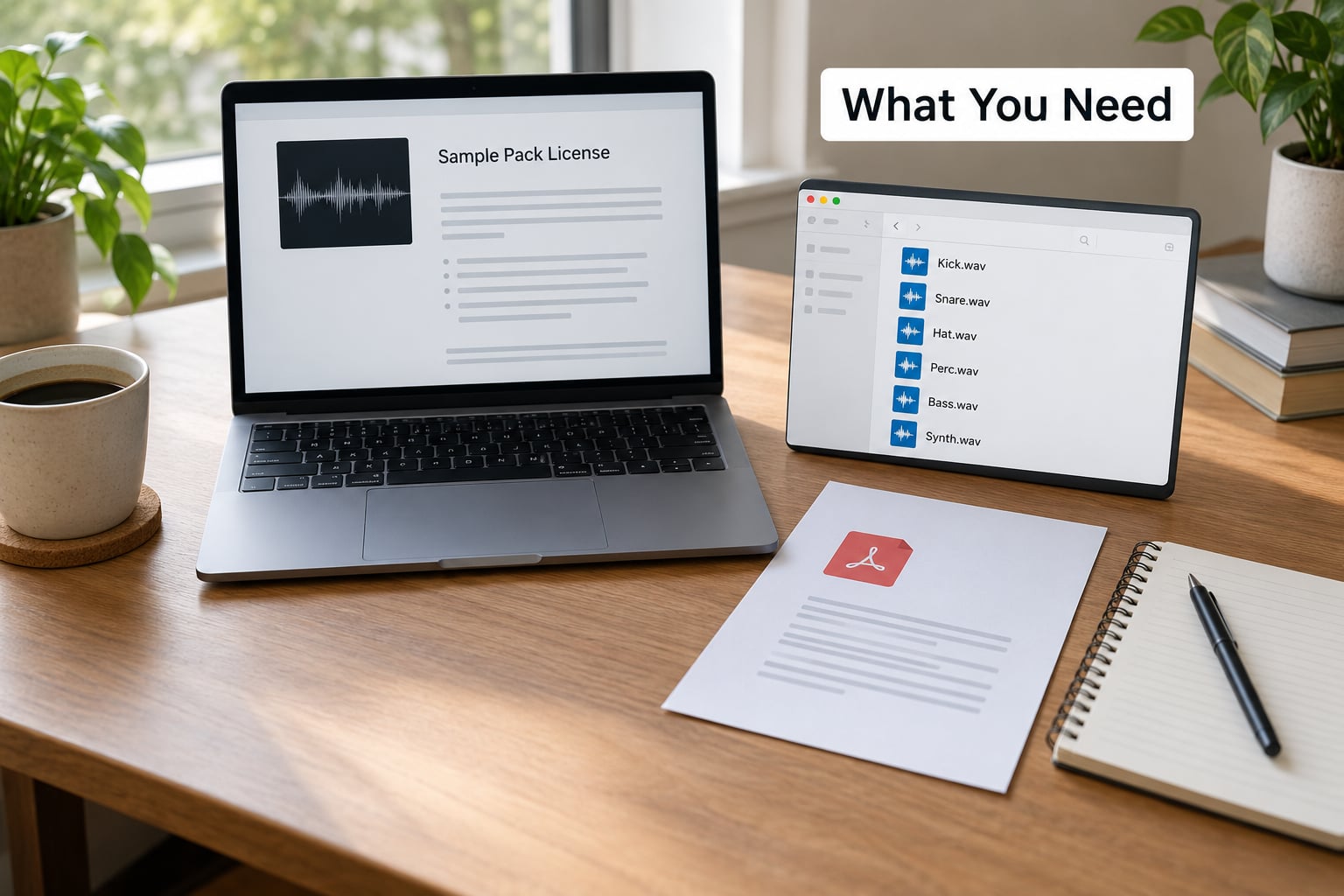
You do not need legal training. You need the documents that already exist and a way to keep them.
- The product page or license link — the URL you bought from, plus any link to terms of use.
- The full download — not just the audio files. License text usually ships as a PDF or TXT inside the same archive, sometimes in a folder named Legal or Docs.
- Your receipt or order confirmation — the email or account page showing the date, the pack name and the version number you received.
- The pack folder itself — keep it whole. Some terms distinguish the raw files from the loops, and you cannot tell which category a file belongs to if you renamed everything on day one.
- A notes file or spreadsheet — one row per pack, with the license summary and where the original file lives.
If your sample source is a subscription library, add the account terms page to that list. Producers on r/trapproduction describe Splice granting a broad royalty-free license covering use, reuse and remix inside your own music, while staying unclear on edge cases, so the current terms at the moment of download are the version that counts.
Step-by-Step
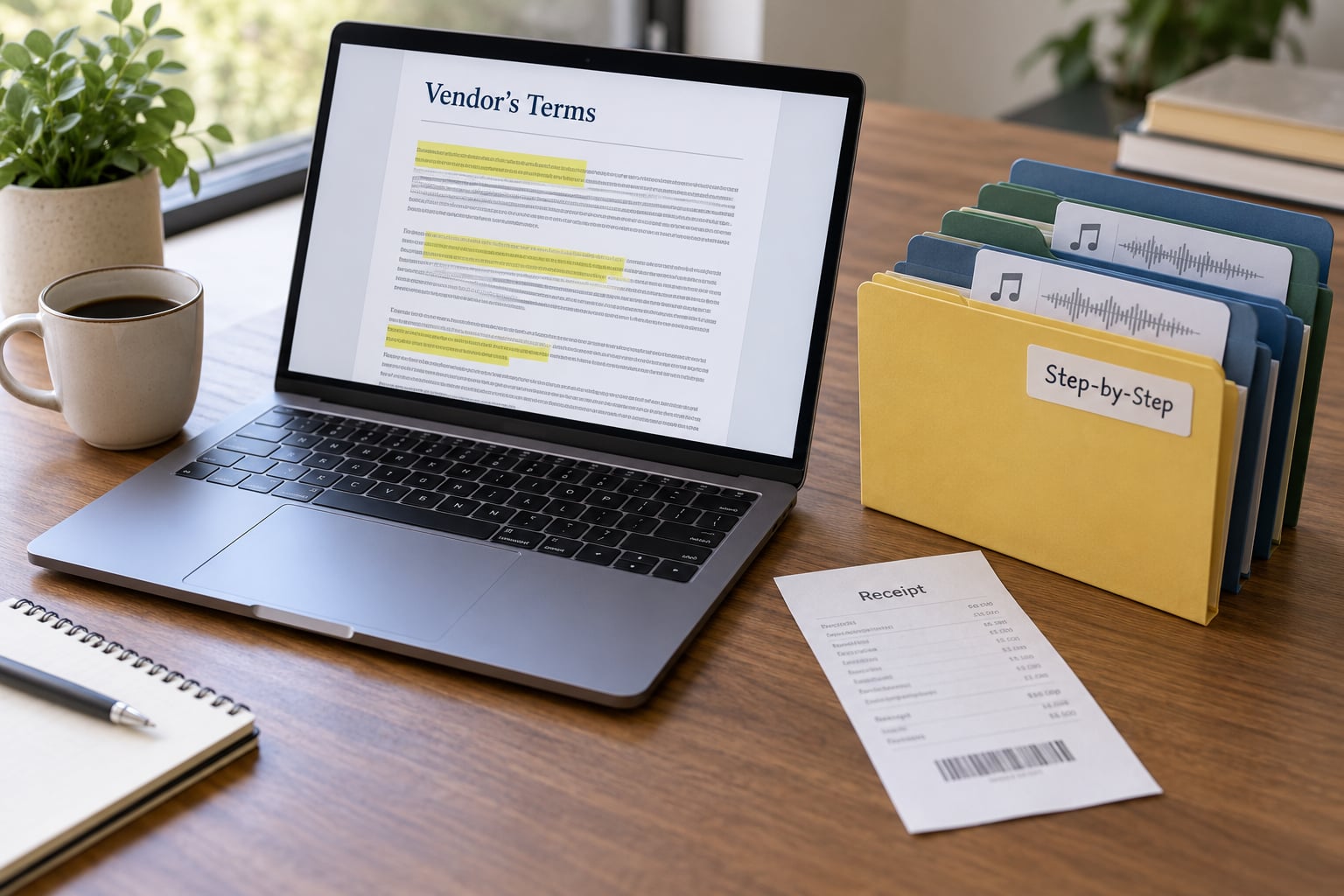
Step 1: Find the License That Applies to Your Use
Start at the source you actually downloaded from, not at the label on the pack cover. Product descriptions get rewritten, marketplaces resell older uploads, and a pack you bought from a third-party seller may not carry the same terms as the original creator.
Search the download folder for a PDF, a TXT file, or a file called License, EULA or Terms. If nothing turns up, open the seller’s site and look for a Terms of Use or License page linked from the footer or the product listing. That page is the governing document, and you should treat a missing license file as an unverified pack rather than as permission.
Note the date on whatever you find. Terms change, and a pack updated in a later version may carry different wording than the one that shipped with the download you paid for.
Step 2: Check What Royalty Free Actually Covers
Royalty free is a commercial term, not a legal category. It describes the payment arrangement: you pay once, no one is owed a percentage of your earnings from the sample. It says nothing about copyright, nothing about exclusivity, and nothing about whether you may resell the pack.
Four words get swapped for it constantly, and each one means something different:
- Copyright-free — the sample carries no protection at all. Genuinely rare, and mostly found in public-domain material such as US government recordings or works whose copyright expired.
- Free of charge — the download cost nothing. This is the most common substitute for royalty free, and it tells you nothing about usage rights.
- No attribution required — nobody will ask for credit. That is a courtesy term, not a usage grant.
- Rights-managed — the opposite arrangement. Use is licensed per project, often with a term limit and sometimes with reporting back to the licensor.
When a license says a pack is royalty free, the useful question is not whether that word appears. It is whether the same document also grants commercial use in a new musical work.
Step 3: Look for Commercial and Distribution Limits
Read for the permission and then read for the carve-outs. Most packs that are genuinely usable for releases contain language close to these, and most traps show up as a qualifier attached to an otherwise good sentence.
Good wording permits you to incorporate the samples into a new musical work, use that work commercially, distribute it, and reproduce it in unlimited streams. It usually names the creator as licensor and describes the grant as perpetual, worldwide and non-exclusive.
Bad wording to watch for:
- Royalty free for personal use only, or for non-commercial projects.
- Not for resale, which quietly covers finished tracks if the sentence is vague.
- No use in works registered with a performing rights organization, or no registration of your finished track with ASCAP, BMI or SESAC.
- Attribution required in the description, in the video, or as a visible credit, with the exact format specified.
- Synchronization rights excluded, or limited to personal social media use.
- Per-seat or per-person licensing, where a producer working with a co-writer is technically over the limit.
- Free for use in one commercial release, capped at a stated number of streams or copies.
The redistribution clause deserves its own attention because it appears in nearly every pack and is the one users report never reading. The standard line is that the samples may not be resold, redistributed, shared or included in another pack in any form. That clause covers the raw files only. Your finished track is not redistribution, which is the distinction producers on r/makinghiphop learn the hard way when they wonder whether their released song counts as a derivative work that must be declared.
Stream limits matter less than they used to, but check anyway. A pack capped at a specific number of streams has quietly run out on a track that took off, and the remedy is a separate license nobody has contacted yet.
Step 4: Check Content ID, Stems, and Sample Reuse Rules
Royalty free says nothing about fingerprinting. A loop can be licensed commercially and still sit in a Content ID system, because a third party registered the recording independently. Producers on r/AdvancedProduction describe exactly this, describing copyright watchdogs matching loops from libraries they had paid for, and wishing library makers could register their sounds to prove clearance in advance.
Two practical habits help. First, search the loop’s name in a reference tool before you commit a track, and accept that a match may be a false positive or a genuine competing claim. Second, keep a note of which pack each loop came from, so a claim can be disputed with evidence rather than memory.
Stems and construction kits carry separate wording in many packs. Check whether the license treats stems as the same material as the loops, since a pack may allow loop use and restrict stem redistribution, or allow stems only in projects that do not get resold as sample content.
Preset, MIDI and resample conversions are the greyest area. A license that covers recordings may not cover the underlying data. If a pack ships a synth preset built from someone’s patch, a MIDI file, or an audio-to-MIDI conversion, look for language that names those specifically. When it is silent, ask the seller in writing before you build a track on it.
Reuse rules are usually short and worth reading: can the same sample appear on two of your tracks, can it appear in a pack you sell, and can it go into a template. Most licenses allow unlimited use across your own releases, and most forbid the loop appearing in a product that competes with the pack itself.
Step 5: Confirm the Seller and Rights Holder
Clearance is a chain, and a beautifully worded license is worth nothing if the person granting it had no right to grant it. Confirm that a named company or creator stands behind the pack, that they can be contacted, and that the pack was recorded by them or licensed in from the performers who appear on it.
On the r/edmproduction threads about pulling samples, the consensus is consistent: legitimate libraries hold a license from the artist or label, and rip-based services plus packs shared on forums do not. A pack assembled from existing records, stretched, pitched or filtered until it is hard to recognise, is the failure mode you cannot detect by ear alone.
Tells for a rip-based pack include a pack name copied from a well-known record, cover art referencing an artist, samples that sound like recognisable excerpts under any processing, and a vendor with no catalogue, no history and no support contact.
Marketplace listings and beat sellers deserve their own check. A pack listed on a marketplace may be a re-upload by someone other than the creator, and the original licensor may not have granted redistribution rights. If the listing does not link back to a source you can verify, the chain of title is thin.
The final check is whether the terms mention a performing rights organization or a publisher. A pack built from session players rather than an in-house team may carry PRO registration obligations on the composition side, which is a separate layer from the recording itself.
Step 6: Save Evidence and Test Before Release
Verification only counts if the evidence still exists in eighteen months, which is when a distributor, a sync agent or a content ID claimant gets in touch. Build one folder per pack and put four things in it: the raw download, the license file as it shipped, the receipt, and a plain-text note summarizing the grant in your own words.
Screenshot the terms page as well, with the URL and date visible. Websites get reorganized, and an archived copy of the page you agreed to is stronger evidence than a memory of what it said.
Then run a pre-release pass on the track itself:
- List every third-party element in the track, one row each, with its pack name and license summary.
- Confirm each element is cleared for commercial use and for the specific release type you are shipping, whether that is a DSP release, a YouTube upload, a podcast intro or a client project.
- Check that no element is capped at a stream count you have already reached.
- Search for any element that is likely to be fingerprinted, and decide in advance whether you will dispute a claim or replace the loop.
- Keep the master files and stems archived alongside the paperwork, so a replacement is fast if a claim lands.
This takes a few minutes per release and it is the difference between answering a claim in an afternoon and losing weeks while you argue.
Common Mistakes
Treating a free download as a free license. A free pack is frequently personal-use-only, and the free-versus-paid terms on the same vendor’s site are often not the same document. Fix: read the free pack’s terms separately, every time, and never assume the paid pack’s wording carries over.
Trusting the pack’s marketing copy instead of its license. Descriptions get written for conversion, and phrases like no credit required or 100 percent cleared are not legal grants. Fix: the PDF in the download wins over any sentence on the product page.
Assuming unlimited streams. The standard trap. Some packs cap streams, some cap physical copies, and some restrict use to one commercial project. Fix: grep the terms for stream, copies, physical and unlimited, and note any number that appears.
Reselling raw files by accident. A pack of loops uploaded to a shared folder, sent to a collaborator as a zip, or bundled with your own sample pack is redistribution, not use. Producers on KVR Audio hear this from vendors constantly. Fix: share the track, never the samples.
Building on a subscription grant and canceling later. Check whether the license you received is perpetual or tied to an active account, and save a copy of the terms while you still have access. Producers on r/trapproduction describe this as the least understood edge case in subscription libraries.
Ignoring the sync carve-out. A pack cleared for streaming is often not cleared for film, television, advertising or a video game trailer, and those are the placements that pay. Fix: treat sync as a separate purchase and budget for it.
Stopping at the recording and forgetting the composition. One grant can cover the sound recording while the underlying musical composition stays unlicensed. Fix: check whether the pack claims to clear both, and whether the source is public domain or original.
Two habits cut most of this. Buy from sources that publish a named licensor, a dated license file and a support contact, and send one short email asking for written confirmation on the specific use you care about. A vendor who answers clearly is telling you something useful about every other pack they sell.
Frequently Asked Questions
Does royalty free mean I can use a sample pack in a commercial song?
Usually, yes, but not automatically. Royalty free describes the payment: one fee, no ongoing royalties. Whether you may release the result commercially depends on the license text, so look for wording that explicitly permits use in a new musical work and distribution of that work. If the only mention of commercial use sits inside a personal-use-only clause, the pack is not cleared for release.
Can royalty-free samples trigger Copyright Content ID claims?
They can. Content ID matches audio fingerprints, not permissions, and a third party may register a recording that you hold a valid commercial license to. Producers on r/AdvancedProduction describe paying for loops from legitimate libraries and still receiving claims. Keep the license and receipt for every sample in your track, note the pack each loop came from, and dispute claims with that evidence attached.
Is a sample pack free to use if I bought it once?
That is the intended meaning of royalty free: one purchase grants a perpetual license, and you are not billed again when your track earns money. The catch is that some subscriptions and some licenses tie the grant to an active account. Read for the word perpetual, check whether the grant survives cancellation, and save a copy of the terms while you still have access to the library.
Can I use royalty-free samples in music I sell to other artists?
In most cases the finished work is yours to sell, because a client buying a track is not buying the sample. Two things change the answer: a work-for-hire or client-work clause that requires written permission, and the redistribution clause, which forbids handing over the raw files. Deliver the mixed track and separate stems, never the source loops, and check whether your license counts client work as commercial use.
What should I do if a sample pack has no written license?
Treat the pack as unverified and do not use its samples in anything you release. Look once more in the download folder, then check the seller’s terms page, and if that is missing too, email the seller and ask for written permission covering commercial release. Keep the reply. If you get no answer, replace the element rather than carrying the risk, because an unlicensed loop can end a release through a claim or a takedown request.
Are samples from royalty-free packs copyright-free?
No. Royalty free and copyright-free are different things. Royalty free describes how you pay for permission; copyright-free would mean the material has no owner, which is true only of public-domain recordings and expired works. Every genuine royalty-free sample pack contains material that is copyrighted and licensed to you, which is why you may not resell the files and why the creator’s grant matters to you.
Open the pack you are about to use, find the license file, and read the commercial-use sentence. That single paragraph tells you whether the pack is genuinely royalty free or just free to download. If the file is missing, ask the seller in writing and keep the answer next to your receipt. Fifteen minutes now is cheaper than a claim, a takedown or a re-release later.