A bass line that follows the chords works because it outlines the harmony instead of fighting it. Start with the root note of each chord on the downbeat, locked to the kick drum, then add the third, fifth and seventh on the beats where the energy is highest. Connect one chord to the next with the smallest move possible. About 45 minutes for a four-bar loop once the method is in your hands, and it works in any DAW.
I still come back to this method whenever a mix stops holding together, most recently while reworking an uplifting trance loop in October 2026. The rule set below is what I actually reach for, not a theory lecture. It is written for bedroom and semi-pro producers working in Ableton Live, FL Studio, Logic or Bitwig, and it holds up whether your bass is a sampled 808, a soft synth patch or a recorded DI.
Table of Contents
- What You Need
- Step-by-Step
- Step 1: Identify the Chord Tones
- Step 2: Choose a Bass Register and Rhythm
- Step 3: Connect Chords With Voice Leading
- Step 4: Add Movement Without Creating Mud
- Step 5: Shape the Bass Around the Arrangement
- Step 6: Check the Line in Context
- Common Mistakes
- Frequently Asked Questions
- Should my bass line just play the root note?
- How many notes should I play per bar?
- When should I use notes that are not in the chord?
- How do I move smoothly between chord changes?
- How do I make a bass line powerful without sounding muddy?
- What is the 3 fret rule on bass?
What You Need
Almost nothing. That is the nice part about this approach. You need four things, and three of them already exist in the project you are working on.
- A chord progression you are happy with. If the harmony is still moving around, fix that first. A bass line written against a progression you are about to rewrite is wasted work.
- A bass sound. A sine-wave sub, a reese, a plucky synth, or a sampled electric bass. For the first pass, whatever is already in the session is fine.
- A MIDI lane or audio track. MIDI in the piano roll is the fastest way to see note choices. Audio works too, and the timing advice later applies either way.
- Optional shaping tools. An EQ, a compressor, a little saturation and a low-pass filter for movement. Three of the six steps below do not need any of them.
One honest note about hardware. Plenty of electric bass players get stuck because they are thinking with the fretboard instead of with the chord. The fret numbers never appear in this guide. Pick the note you hear in your head, find it, move on.
Step-by-Step
Step 1: Identify the Chord Tones
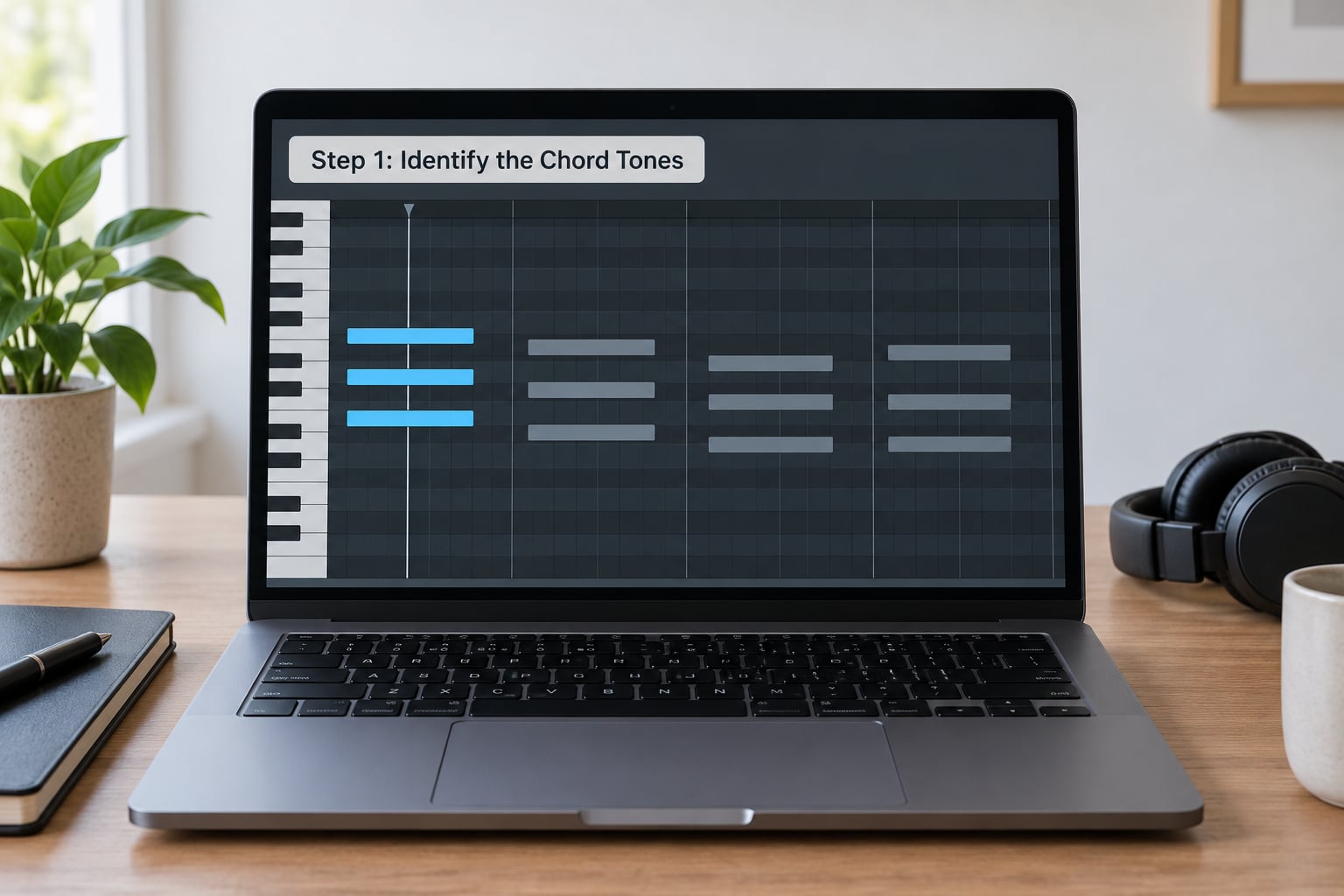
Every chord has a small set of notes that define it: the root, the third, the fifth, and often a seventh. Those are the only notes guaranteed to sound correct at any point in the bar, which makes them the material your bass line is built from.
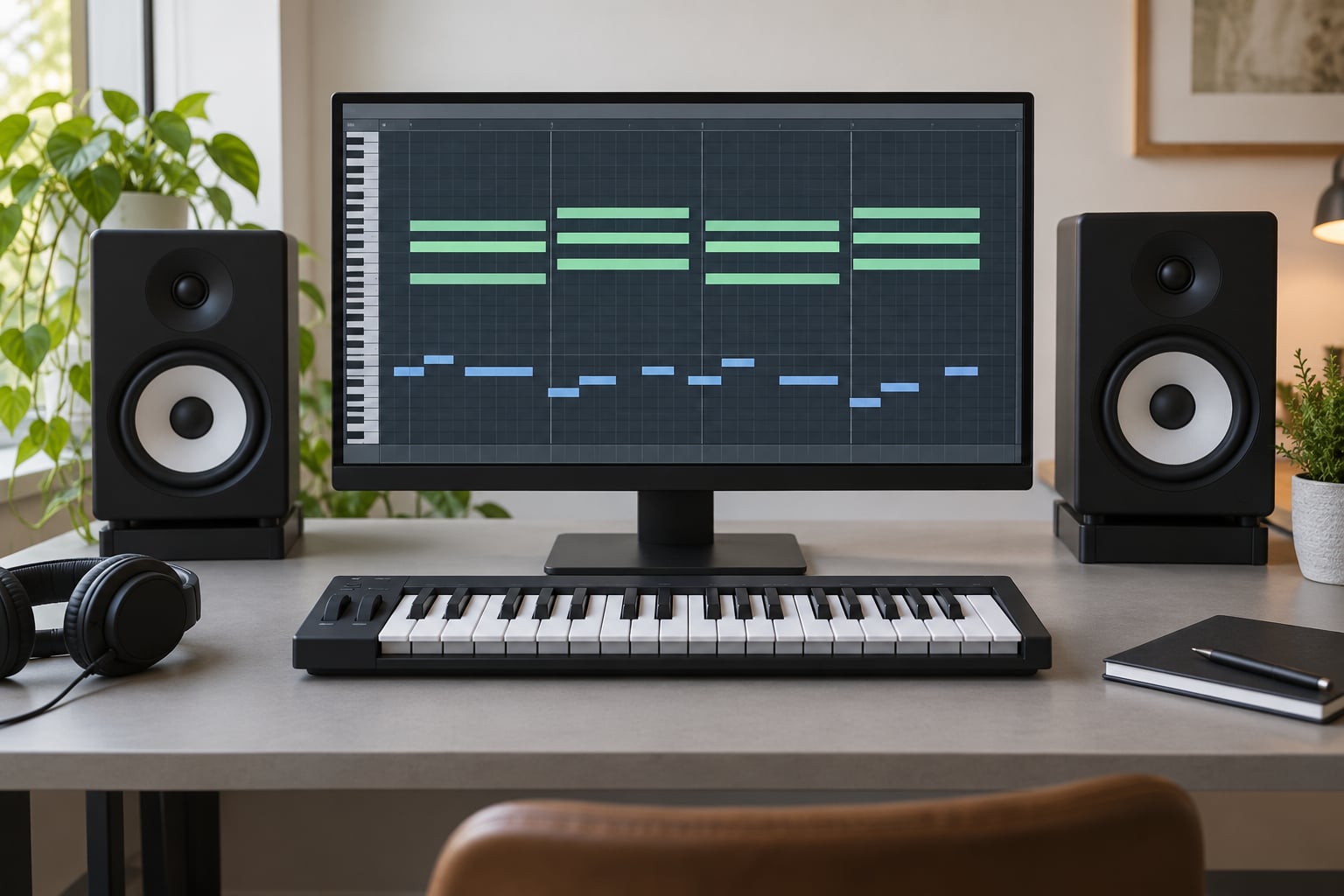
Write your progression out in plain notation first. A common EDM loop is Am, F, C, G, so your available bass notes are A, F, C and G, with C and E sitting over Am, F and A over F, E and G over C, and B and D over G. Sixteen notes of raw material, no theory degree needed.
The mistake here is thinking the bass has to duplicate the chords. It does not. A synth pad playing a four-note Am voicing and a bass playing a single A an octave down is a completely different and better arrangement, because the two parts occupy different registers and different jobs.
How do you know the step worked? Mute everything except bass and drums, then play the progression under it. If the bass still sounds like it is going somewhere, the notes are right. If it sounds like random wandering, you have probably grabbed a note that is not in the chord.
Step 2: Choose a Bass Register and Rhythm
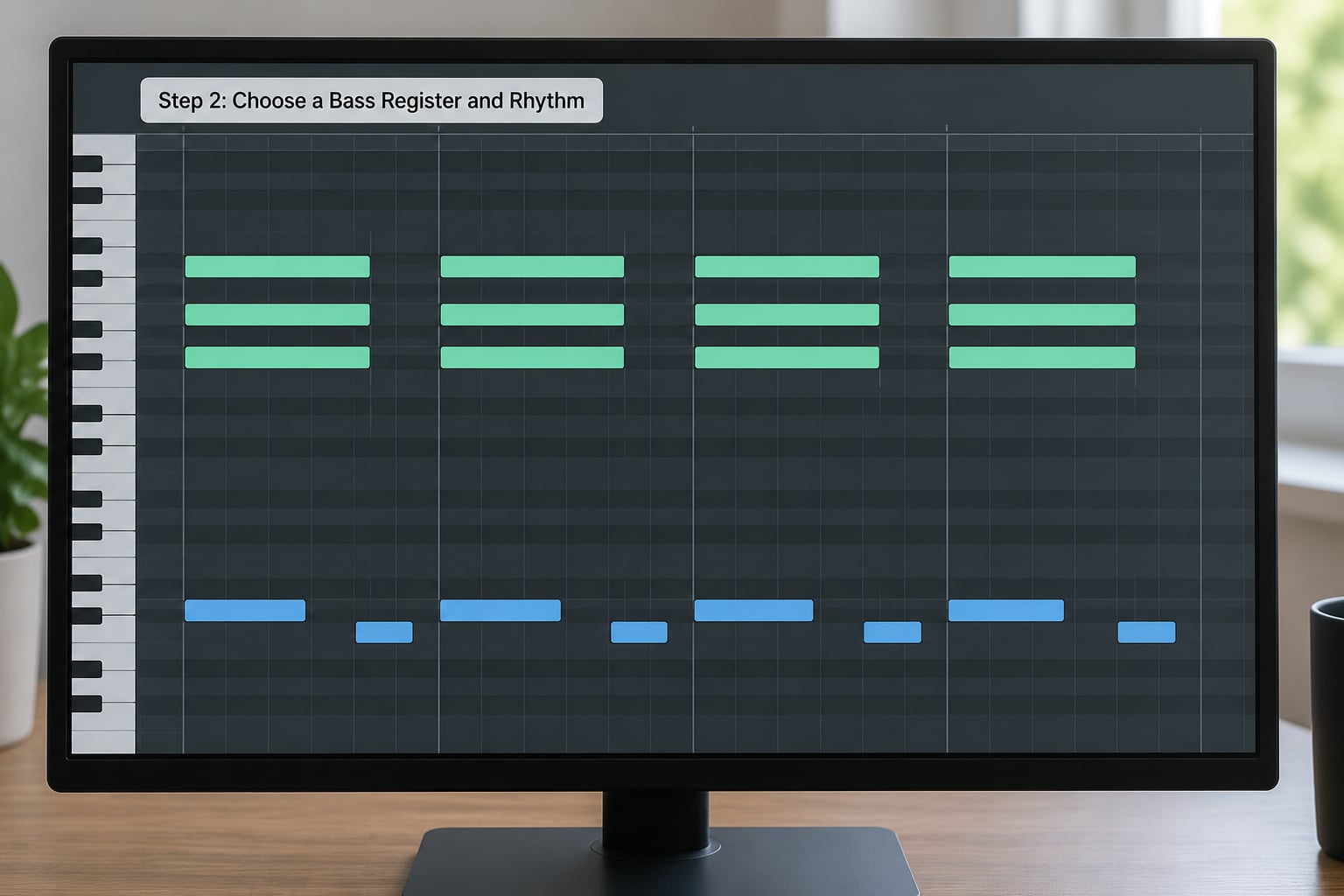
Pick the register first, then the rhythm. In electronic music the bass usually lives between roughly 40 and 100 Hz, and the fundamental note of a low A sits near 55 Hz on a synth you tuned to A. Staying in that area keeps room for a kick drum above it and avoids the crowded low-mid mess you get when a bass climbs into the range of the chords.
Rhythm follows the energy of the section, in a fairly predictable order. Sustained whole notes sit under a breakdown. Root notes on the downbeat and the and-of-three cover a verse. Straight eighths, sixteenths, or offbeat stabs belong to the drop.
Lock the downbeat to the kick and nothing else. A bass note landing a few milliseconds late on beat one reads as lazy, and a bass note hitting exactly with every kick hit reads as one fat block with no internal movement. The most useful trick I know is to let the bass and kick share beat one, then have the bass pull slightly ahead of the kick on the notes between. That complementary timing gives a groove without any real effort once it is in place.
Check the result by soloing the bass. Clap on beat one and play along. If your foot starts tapping in the gaps, the rhythm is doing something.
Step 3: Connect Chords With Voice Leading
Bass lines that follow chords well are mostly about the gap between one chord and the next. The move is simple: land on the closest available chord tone of the following chord, and repeat the current note if the nearest one is more than a third away.
Two chords a fourth apart, like Am to F, sit comfortably in one register. A fifth jump, like F to C, is the one that sounds awkward, and there are three ways out of it. Drop an octave, hold the F as a pedal and let the chords change above it, or walk down through a passing tone on the way to C.
A passing tone is a note that is not part of either chord and is placed between them, usually on a weak beat or a sixteenth. From F to C you would travel F, E, D, C, and the E and D are pure motion. Keep them short. A passing note that lingers on a strong beat stops being a passing note and starts sounding like a mistake.
One short hold across two bars can do a lot of work. Take a bass line that repeats one note under four moving chords and you get tension without a single wrong note in it. It is the oldest trick in the book and it still makes mixes feel bigger.
Step 4: Add Movement Without Creating Mud
Once the notes are correct and the rhythm holds together, you can start decorating. The safest decorations come first: a fifth instead of a repeated root, an octave jump at the end of a bar, a short slide into the downbeat, a rest before the drop.
The fifth is the workhorse. It is stable enough to sound right and open enough to stop a long line from turning into a drone. The octave is the second, and it works because it adds punch without adding any harmonic information at all.
Rests are the one most producers skip. Leaving two beats empty in a pre-drop section creates more tension than any note you could put there, and it gives the low end somewhere to breathe. If the bass plays every sixteenth for sixteen bars, the drop has nowhere to go.
For a funky or live feel, ghost notes add more than they cost. Light, quiet notes on the sixteenths, at a fraction of the velocity of the main notes, keep the line moving under a strong chord and still leave the emphasis on the root. A fingerstyle or slap player will do this naturally; in MIDI it is a velocity lane and nothing more.
Watch the register again here. A jump of a tenth or more between two notes in the same vocal range smears against the chords no matter how good the note choices are.
Step 5: Shape the Bass Around the Arrangement
A finished track never uses one bass line for four minutes. Most electronic arrangements cycle through the same four-bar phrase, so the work is deciding what changes in each section.
Start the intro with a filtered or pitched-down version of your main line, often an octave below where it will end up. In the build, raise the filter and add rhythmic density, so the same line progressively reveals itself. At the drop, give it the full frequency range and the fullest pattern you wrote. In the breakdown, strip it back to sustained roots or drop it out almost entirely.
Two automation moves carry most of that job. A low-pass filter opening over eight or sixteen bars makes a static line feel like it is building, and a short volume dip right before the drop puts more impact on the return. Sidechain compression to the kick is the third, and in house and techno it does more for the low end than any EQ setting.
Keep at least one section of every track with no bass at all. It costs you nothing and it makes the next entrance land.
Step 6: Check the Line in Context
The last check happens in the full mix, and it is mostly about translation. Solo the bass, mute it, and ask whether the track still works. If the whole thing falls apart, your bass is carrying too much and other parts need to step up.
High-pass anything above roughly 250 Hz, gently, and listen on small speakers as well as monitors. A low-pass anywhere near 5 kHz, applied as a separate layer, keeps low subs from fighting the mid-bass for the same space. Compression with a slow attack and a medium release evens out note lengths so the low end does not disappear on every rest. A little saturation on the top octave adds harmonics that survive on a phone speaker.
Two reference habits are worth keeping. Play your bass line under three well-known tracks in the same style and notice how much of theirs is a single repeating figure, not a solo. Then check the mono button, because a bass that disappears in mono means something in the low end is doubling up on itself.
Common Mistakes
Six things come up again and again, and each has a quick fix.
- Root note on every beat. It sounds static and the third and seventh never get a chance to colour the line. Fix: play the root on beat one, the fifth on beat three, and leave the rest empty.
- Notes from outside the chord. Useful in small doses, terrible as a default. Fix: only add a non-chord note on a weak beat or as a pass between two chord tones.
- Bass sitting too high. It muddies the chords and steals the midrange from vocals. Fix: drop it an octave and let the sub do the weight.
- Too many notes per bar. Sixteenths from bar one leaves no room to build. Fix: save full density for the drop and simplify everywhere else.
- Ignoring the chord change entirely. A line that never moves, or moves to a note from three chords ago, loses the listener. Fix: check every bar against the chord sitting under it.
- Quantizing everything to the grid. It is the reason programmed bass can feel dead. Fix: leave the notes on the main grid and pull the in-between ones a hair early, then compare both versions.
Two habits from bass players are worth stealing even if you never touch an instrument. The first is to think in terms of the lowest few notes of the chord rather than the full voicing, which is a fast way to avoid clashes. The second is to play the line, bad notes and all, before editing a single one. Good bass writing is partly muscle memory.
Frequently Asked Questions
Should my bass line just play the root note?
For an intro, a breakdown or the first hour of learning, yes. Roots on the downbeat are the safest foundation you can build on, and most EDM grooves start there. As soon as the track gets busy, alternate: root on beat one, fifth on beat three, and save the third and seventh for the drop, where they add the colour that makes a line sound finished rather than sketched.
How many notes should I play per bar?
In house and techno, two or three per bar is plenty, usually a downbeat root plus a moving note. Funk and progressive styles can handle four or more sixteenths without clutter because the chords are doing less work above them. As a rule, play fewer notes than you think you need, then add one back if the section feels empty. Space in the low end reads as confidence.
When should I use notes that are not in the chord?
Use them in three situations: as a passing note travelling between two chord tones, as a chromatic approach a semitone below the next chord’s root, or as a single held note under changing chords. Keep them short and on weak beats. A non-chord note on a strong beat has to be a deliberate colour choice, because the ear will read it as a mistake in most arrangements.
How do I move smoothly between chord changes?
Always land on the nearest chord tone of the new chord, and if that is more than a third away, repeat the note you are already holding or drop an octave instead of leaping. When the jump is a fifth, walk down through a passing tone over a sixteenth or two. Small movement sounds intentional, big leaps sound like the bass is reacting to the chord rather than leading it.
How do I make a bass line powerful without sounding muddy?
Keep one note in the low sub range and everything else above it, and high-pass the low layer above about 250 Hz. Short sidechain release times let the kick push the bass out of the way without the whole line pumping. Saturation on the upper octave adds harmonics that survive on small speakers, which is where most listeners first hear your mix.
What is the 3 fret rule on bass?
It is a shortcut used by bass players: if you keep your line inside about three frets of a position, you can reach most of the notes in a chord without large hand movement. The underlying idea is exactly the voice leading described in this guide, since three frets is roughly the span of a fifth. On a fretless bass it means keeping the line in one area, on a fretted one it means not sliding your hand all over the neck.
Start with roots on the downbeat, matched to the kick, and do not add a single other note until that part feels locked. Then introduce the fifth on beat three, connect the chords with the smallest possible move, and save the full pattern for the drop. That order is what makes this method work, and once it is in your hands you can apply it to any progression in about the length of one coffee break.