A seventh chord is a triad with one extra note stacked a seventh above the root: C, E, G and B for Cmaj7, C, E, G and Bb for C7. In dance music that fourth note does most of the work, taking a flat three-note loop and giving it movement and colour. Learning how to use seventh chords in dance music is mostly a matter of voicing, register and choosing the right chord quality for the section you are writing.
You do not need a music theory degree for any of this. Every step below happens in the piano roll of Ableton Live, FL Studio, Logic Pro, Bitwig or Studio One, and the whole thing comes down to four notes, a good spot in the frequency range and a progression that goes somewhere.
Table of Contents
- What You Need to Build Seventh Chords in a DAW
- Step-by-Step: How to Use Seventh Chords in Dance Music
- Step 1: Pick the chord quality before you pick the notes
- Step 2: Stack the fourth note and shape it with Drop 2
- Step 3: Should seventh chords in EDM sit under the melody or on top of it?
- Step 4: Connect chords so the seventh moves instead of jumping
- Step 5: Write a progression that pushes toward your drop
- Step 6: Give the chords a rhythm and movement
- Common Mistakes and How to Fix Them
- Mud sitting under the kick
- A major 7th that sounds out of tune
- Dominants that never resolve, or always resolve
- Four notes crammed into every register
- A seventh on every chord of every loop
- Frequently Asked Questions
- How are 7th chords used?
- Are 7th chords dissonant?
- What is the forbidden chord in music?
- Can you give me some examples of songs that use major seventh chords?
- What is the difference between a minor 7th and a minor-major 7th?
- Why do my 7th chords sound muddy in a dance mix?
- Conclusion: Start With One Chord Loop
What You Need to Build Seventh Chords in a DAW
Before the theory, the tools. You need far less than a producer shopping list suggests, because a seventh chord is four MIDI notes and a synth that will play all four at once.
- A DAW with a piano roll. FL Studio calls it the piano roll, Ableton Live and Logic Pro call it the MIDI editor, Bitwig calls it the grid. Any of them will do the job.
- A polyphonic synth. It must hold four notes at once, which rules out monophonic plucks used for basslines. A supersaw pad, a poly synth or a sampled electric piano all sustain chords nicely.
- A scale reference. A chart on your phone or a scale-detection plugin keeps you from guessing whether the seventh is a major seventh or a minor seventh.
- An EQ and a high-pass filter. Both come with every synth. They are how you keep seventh chords out of the kick’s territory.
- A folder of reference tracks. A/B-ing your loop against something you already like tells you more in five minutes than an hour of theory.
That is the whole kit. If you want to skip the scale chart and play by ear instead, more power to you, but keep one reference point for the seventh.
Step-by-Step: How to Use Seventh Chords in Dance Music
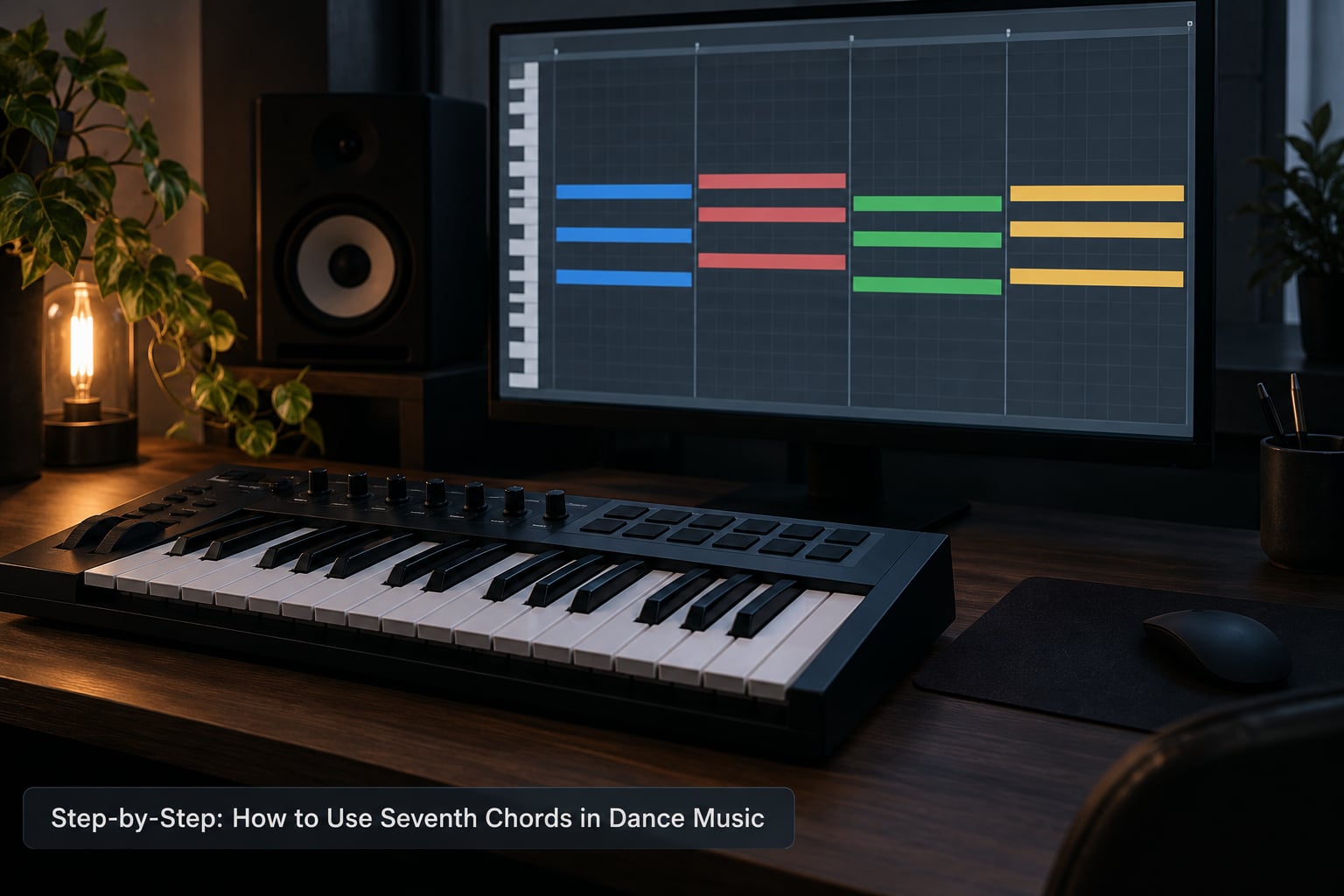
Six steps, in order. Each one has a quick test that tells you straight away whether it worked.
Step 1: Pick the chord quality before you pick the notes
Most beginners start by picking notes and end up with something that sounds accidental. Start with the quality instead, because each seventh chord has a job in a track: some colour, some tension, some lift.
| Chord | Notes in C | Intervals from root | Character | Where it works in a dance track |
|---|---|---|---|---|
| Maj7 | C E G B | 1 3 5 7 | Bright, floating, open | Intro pads, breakdowns, melodic leads |
| m7 | C Eb G Bb | 1 b3 5 b7 | Warm, soulful, grounded | Deep house, Afro house, groovy stabs |
| mMaj7 | C Eb G B | 1 b3 5 7 | Dreamy, unresolved, aching | Ambient breaks, vocal intros, tension |
| 7 (dom) | C E G Bb | 1 3 5 b7 | Tense, magnetic, wants to move | The bar before a drop, build-ups |
| m7b5 | C Eb Gb Bb | 1 b3 b5 b7 | Dark, cinematic, uneasy | Techno and tech house breakdowns |
| dim7 | C Eb Gb A | 1 b3 b5 bb7 | Tense, unstable, symmetrical | Short tension hits, not long loops |
Notice that Cm7 and C7 sit one note apart. Cm7 has Eb where C7 has E, so the third decides whether the chord sounds soulful or tense, and the shared seventh is what keeps both in the same family.
Test: play each one on a held pad with no drums. You should be able to name the mood before you read the table.
Step 2: Stack the fourth note and shape it with Drop 2
Draw the triad first, then add the seventh a whole step (major seventh) or a half step (minor seventh) above the top note. That is the honest way to build a seventh chord, and it is fine for a pad.
For stabs and bass-register work, use Drop 2 instead. Take a close voicing of four notes, drop the second note from the top down an octave, and put it under the rest. The chord thins out, the seventh becomes audible and you stop fighting the kick.
A producer on r/musictheory described swapping triads for 7ths and Drop 2 voicings almost entirely, then asking other people for progression formulas. The voicing is the easy half; the formulas are below.
Test: drop the bass note out for a second. If the chord collapses into nothing, your voicing is too low and needs the octave moved up.
Step 3: Should seventh chords in EDM sit under the melody or on top of it?
Under it, usually. A seventh chord in the middle register competes with vocals and lead melodies for the same space, so it reads as clutter instead of colour.
Two reliable register rules for dance music:
- Keep the chord body above the bass fundamentals, roughly middle C and higher, and high-pass it around 200 to 300 Hz.
- Let the seventh live in the 1 to 4 kHz range. That is where the ear reads colour rather than weight.
When the seventh does need to be on top, use it as a single note rather than the whole chord. A maj7 top note against a minor bass is a familiar deep-house trick, but the full voicing usually gets crowded fast.
Test: solo the chord while the kick plays. If the chord vanishes on every downbeat, it is too low. If it slices through the kick, you are too bright.
Step 4: Connect chords so the seventh moves instead of jumping
Voice leading is the part that separates a loop that sounds played from one that sounds programmed. Keep common tones where you can and move everything else by the smallest step available.
Go from Cmaj7 to Am7. C stays, E drops to D, G stays, B drops to A. Two notes hold, two move by a tone. The change is audible but not clattering, which is exactly what you want under a groove.
That principle is also why dominant 7ths feel magnetic. The tritone inside C7 sits between E and Bb, and when you play those two as the top voices the pair wants to spread outward by a semitone. That pull is the whole reason a dominant wants to move.
Test: sing or hum the top line of your progression on its own. If it leaps more than a fifth anywhere without a rhythmic reason, simplify the voicing.
Step 5: Write a progression that pushes toward your drop
A loop of one chord is fine and often the right choice. When you want more, borrow progressions that already have tension built in rather than stacking random sevenths.
| Subgenre or section | Progression | Why it works |
|---|---|---|
| Deep house | Fmaj7 – Em7 – Dm7 – Cm7 | Diatonic loop, every chord moves by a step, no drama needed |
| Afro house | F#m7 – Dmaj7 – Am7 – Em7 | Minor 7ths under a bright melody, sevenths do the soulful work |
| Progressive house and trance | Bm7 – Amaj7 – Gmaj7 – F#m7 | Minor and major sevenths alternating keeps it melodic without a bassline fight |
| Tech house and techno | Am7 held for 16 bars, plus an Eb9 stab on the last beat of every 4 | One chord held long enough to become an instrument, not a progression |
| Breakdown or breakdown-adjacent | Fm(maj7) – Cm7 – Dbmaj7 – Bbm7 | The minor-major 7th floats without resolving, which suits a section with no drums |
| The bar before a drop | Dm7 – G7 – C | A ii-V in C, the standard turnaround, with the G7 doing all the pulling |
That last row is the one most producers never try. A dominant 7th sitting unresolved for eight bars in the build-up, with the tritone exposed, then cutting to the drop chord, gives you tension you did not have to write a single new sound for. Leaving the dominant out is the most boring option in a lot of modern EDM, and this is the fix.
Test: loop the progression at the BPM of your track and leave it for a minute. Anything that grabs you on second listen is worth keeping.
Step 6: Give the chords a rhythm and movement
Two chords played straight for eight bars sound static no matter how good the voicing is. Dance producers fix this with rhythm, not with more notes.
- Push the chord off the grid. Landing on the and of 2 or the last 16th of the bar is what turns a pad into a groove.
- Swing it. Swing the eighth notes by roughly 55 to 60 percent. A commenter on a jazz guitar page argued the swung eighth pulse is the real genre marker, and the same holds for house chord stabs.
- Vary velocities per note. A seventh a few dB louder than the others becomes the note your ear follows, which is how you direct attention inside a four-note chord.
- Filter and automate. Open the top end on the drop, or sweep the chord across the breakdown. Movement in the filter does the same job as adding harmony.
- Sidechain it. The standard pumping on the chord is usually expected in house and trance, and it keeps the chord from competing with the bass.
Test: mute the drums and listen. If the chord line still has a pulse, the rhythm is doing its job.
Common Mistakes and How to Fix Them
Mud sitting under the kick
Almost every muddy 7th chord is a register problem. Move the voicing up, high-pass it above your bass fundamentals, and cut any note within a few semitones of the bass note. If the seventh duplicates the root an octave below the chord, delete that duplicate rather than detuning it.
A major 7th that sounds out of tune
The major seventh interval between the root and the seventh is a wide, unusual gap. On a badly tuned synth it reads as a mistake, and against certain melody notes it clashes harder still. Sharpen the tuning of your synth, and when a melody note lands near the seventh, drop the seventh out for that one chord instead of fighting it.
Dominants that never resolve, or always resolve
Forums genuinely disagree on this. The practical answer is context: a dominant 7th held under a groove for eight bars sounds fine, and one that appears for a single beat and is cut off sounds like an error. Use resolution where you want forward motion and hold the tension where you want to stay in the moment.
Four notes crammed into every register
Playing all four chord tones in a low octave gives you a thick cluster that eats the kick’s low end and smears its transient. Use three notes low and let the seventh sit alone an octave up, which is basically Drop 2 in practice.
A seventh on every chord of every loop
Sevenths lose their effect when they are the default. Leave a few chords as triads so the seventh stands out when it arrives, and check whether the loop still works if you take the seventh out of every other chord. A progression on r/musictheory went out asking for patterns because substituting 7ths everywhere gets you sound without structure.
Frequently Asked Questions
How are 7th chords used?
A seventh chord adds a fourth note, a seventh above the root, to a triad. That extra note supplies colour and a slight pull: Cmaj7 (C E G B) sounds rounder and brighter than a plain C major, while C7 (C E G Bb) adds friction that wants to resolve. Dance producers lean on sevenths in chord stabs, pads and arpeggiated loops.
Are 7th chords dissonant?
Not inherently. Major sevenths and minor sevenths are treated as consonant in most modern writing, and the minor-major 7th is the signature sound of dreamy, unresolved tracks. Dominant 7ths do contain a tritone, which is genuinely unstable, but that instability is the point. If a 7th chord sounds harsh, the cause is usually voicing or a clash with another part.
What is the forbidden chord in music?
It is the tritone, an interval of six semitones, historically called diabolus in musica and banned in medieval church harmony. Its unstable sound comes from two notes that pull away from each other. That same tritone sits inside every dominant 7th chord, between the third and the seventh, which is exactly why a dominant wants to resolve downward by a semitone.
Can you give me some examples of songs that use major seventh chords?
Stevie Wonder’s You Are the Sunshine of My Life is the example most people name first, and Boyz II Men’s End of the Road leans on the same open, floating quality. In dance music the maj7 tends to show up as a pad under a bassline rather than as a guitar line, which is why it reads as softer and more ambient in a mix.
What is the difference between a minor 7th and a minor-major 7th?
Cm7 is C Eb G Bb and CmMaj7 is C Eb G B. Both share the minor third, so both feel stable enough to loop, and the seventh is what separates them. Bb keeps the chord grounded and soulful, while the major seventh B adds an ache that never fully resolves. In practice m7 sits under grooves and vocals, and mMaj7 sits under breakdowns and ambient pads.
Why do my 7th chords sound muddy in a dance mix?
Two things cause mud almost every time. First, the chord sits too low, so the seventh lands in the same frequency range as the bass and kick. Move the voicing up and high-pass it above your bass fundamentals. Second, the chord doubles the bass note an octave or two down, which thickens the low end and smears the kick transient. Solo the chord against the kick to hear which one it is.
Conclusion: Start With One Chord Loop
Take one existing triad loop in your project and add a seventh to two of its four chords. Voice both above middle C, high-pass them around 300 Hz, and check the result against a reference track before you write anything else.
That single change is where most of the value lives, because it teaches you the two decisions that actually matter: which chord quality carries which emotion, and where it sits in the mix. Once that feels natural, add a Dm7 – G7 – C bar before a drop and hear how much tension one dominant 7th buys you.