Learning how to write chord progressions for uplifting trance is less about theory than restraint: pick a minor key, choose four chords that actually move, and voice them wide enough to sit under a supersaw. A bedroom producer can go from blank session to a loop that works in roughly an hour, and the hard part is deciding when to stop adding chords.
This guide walks through the whole process — choosing an emotional center, building the progression, voicing it, adding movement, and testing it inside a real arrangement.
Table of Contents
- What You Need to Write Uplifting Trance Chord Progressions
- Step-by-Step: How to Write Chord Progressions for Uplifting Trance
- Choose the Emotional Center and Key
- Build the Core Progression for Uplifting Trance Chords
- Voice Chords for the Release
- Add Motion Without Losing Clarity
- Test the Progression in a Trance Arrangement
- Common Mistakes
- Frequently Asked Questions
- What key is best for uplifting trance chord progressions?
- Should I use major or minor chords for uplifting trance?
- How many chords should I use in a trance progression?
- What chord extensions work well in trance music?
- How do I make a chord progression sound more emotional?
- Should I use a different chord voicing for the breakdown?
- Conclusion
What You Need to Write Uplifting Trance Chord Progressions
Uplifting trance sits around 138 BPM and almost always runs in a minor key. The harmony is deliberately plain — four chords, often repeated in four- or eight-bar loops — because the energy comes from the melody, the sidechained kick and the layered synths, not from the chord changes. One forum veteran put it plainly: club tracks regularly use chord progressions simpler than most pop.
That plainness is good news. You need four things to start:
- A DAW. Ableton Live, FL Studio and Logic Pro all handle this fine. Nothing in the workflow is DAW-specific.
- A basic chord vocabulary. If you can play Am, F, C and G on a keyboard, or drag them in from a chord palette, you have enough. Learn major and minor triads, then add seventh chords when you want them.
- Two or three reference tracks. The fastest way to internalise the genre is to transcribe one breakdown. People on production forums swear by this exercise: find the key, find the primary chords, play them back.
- Optionally, a scale-snapping MIDI tool. Serum, Sylenth1 and Massive all have scale or chord-follow functions that keep notes in key while you experiment. Handy, not required.
That’s the whole kit. No music theory degree, no piano teacher.
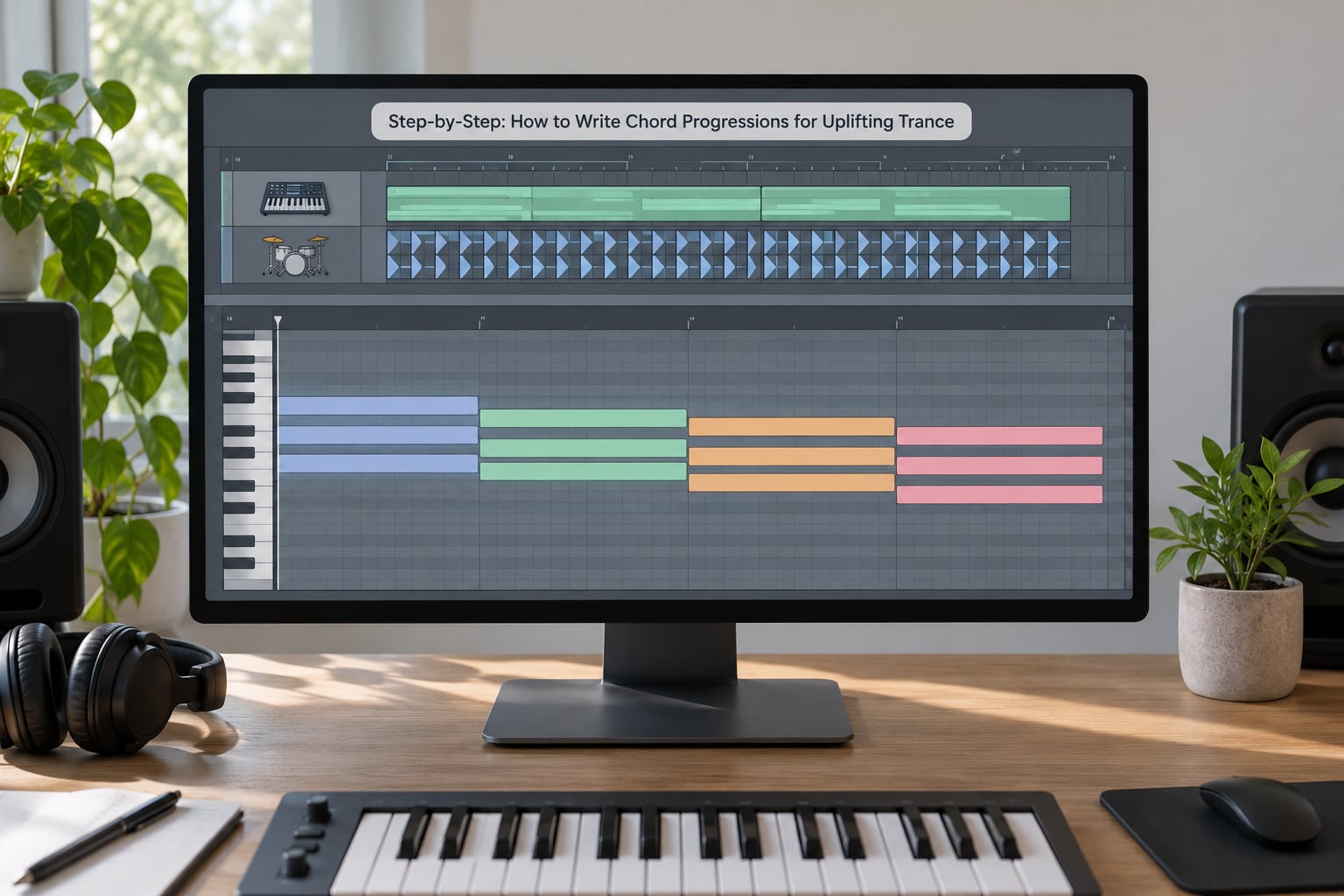
Step-by-Step: How to Write Chord Progressions for Uplifting Trance
Choose the Emotional Center and Key
Start by naming the feeling you want before you touch a note. Uplifting trance rarely sounds purely happy — it sounds like hope with an edge of melancholy, which is exactly what a minor key gives you. Decide whether the loop should read as hopeful, nostalgic, expansive, or slightly dark.
Then pick the key. A minor and D minor are the genre’s gravitational centres because so many trance records sit there, but any minor key works — you are transposing for your own MIDI range, not for a chart position. Keep every part of your track in the same key, including the sidechained bass, so the root note underneath never fights the chord.
One decision here matters more than the rest: major or minor. Major progressions in trance usually feel like sunrise finales — energetic but slightly soft. Minor progressions carry the tension the genre is built on. Many producers write the track in minor, then raise the final chord of the phrase to major for a single bar before the drop lands.
Build the Core Progression for Uplifting Trance Chords
Build a four-chord loop first, then decide whether you need eight. Four chords, one per bar, is the format that survives the genre best because it lines up with the four-on-the-floor phrase and with the arpeggio patterns that sit on top of it.
Write each loop as chord names plus roman numerals so you can transpose it later. These six give you most of what uplifting trance needs:
- Am – F – C – G (i – VI – III – VII). The most overused loop in the genre, and it still works. Warm, forward, endlessly repeatable.
- Am – F – Dm – E (i – VI – iv – V). The E is the harmonic-minor chord, borrowed from outside A minor, and it adds a small hook of tension right before the loop restarts.
- Am – C – G – F (i – III – VII – VI). Brighter than Am – F – C – G because the G-to-F fall is gentler. Good for a first breakdown.
- Am – G – F – E (i – VII – VI – V). The strongest cadence of the six. It wants a riser behind it, because it resolves rather than drifts.
- Dm – B♭ – F – C (i – VI – III – VII). The same shape as the first loop in a different key. Transpose a working loop rather than inventing a new one when you’re stuck.
- Am – F – G – Am (i – VI – VII – i). A four-bar loop with a homecoming at the end. Works when you want the harmony to arrive before the melody does.
Here is the trick worth knowing: the pop progression 1-6-3-7 is the same four chords as i-VI-III-VII in a minor key. In C major, 1-6-3-7 is C – Am – F – G; in A minor, i-VI-III-VII is also C – Am – F – G once you name the chords by root. The numbers change, the emotional reading changes, the notes on your piano do not. That is why pop-grade progressions sit so comfortably in trance.
Hold every chord for one bar to begin. Chords that change every beat feel nervous in this genre — the kick drum already supplies that push.
Voice Chords for the Release
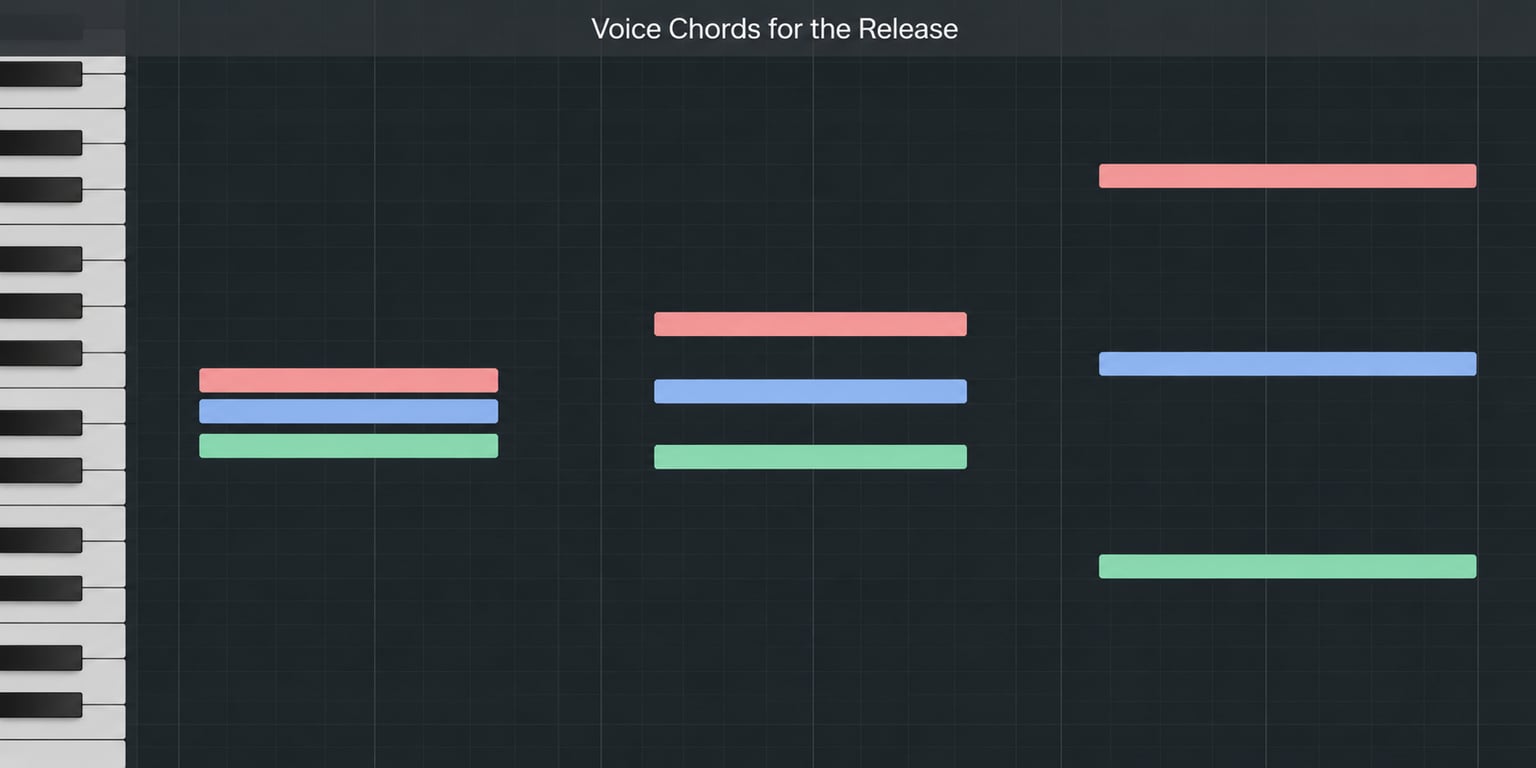
Voicing decides whether your chords sound like a pop ballad or like a trance release, and the same four notes arranged differently will make an immediate difference. Three arrangements cover almost everything:
- Close voicing. Root position, all four notes in the space of a sixth or so — A3, C4, E4, A4. Clear and punchy, but sits right in the middle of your mix where the lead wants to live.
- Open voicing. The same notes reordered and spaced out — A3, E4, A4, C5. Wider and more atmospheric, the standard choice for a pad or a pluck layer in a breakdown.
- Octave-spread voicing. The bass note drops an octave while the top stays put — A2, A3, E4, C5. This is the supersaw shape. Big, bright, and it leaves the whole middle of the spectrum open for your melody.
Keep the low end honest. If your chord’s lowest note and your bass note both live around A1 to A2, they will fight and muddy the kick. Either drop the chord’s root an octave below and sidechain it with the kick, or lift the whole chord up a tenth so the bass owns the bottom and the chords float above it.
For a supersaw, duplicate the voicing two or three times with slightly different timing and detune, then spread the unison across roughly a semitone per voice. Give it a slow attack and let the filter open through the bar. For piano-style trance chords, use the open voicing and play it with a soft attack and a long decay, then let the reverb tail carry through the bar line.
Add Motion Without Losing Clarity
A static four-chord loop is a fine foundation, but a few moves make it feel alive. Add one at a time and listen each time, because every one of these costs clarity if overused.
- Extensions. Turn triads into minor sevenths, add9 or maj7 chords. In a minor key, add9 on the tonic (Am9) is the single easiest upgrade — it makes a plain Am glow without changing the function.
- Passing tones. Slip a single note between two chords rather than moving all the voices. On the Am – F – C – G loop, letting the G slide through A into Am is enough; you don’t need a new chord.
- Inversions. Flip the bass note of a chord while keeping the upper notes. Moving F to F/A on the second bar removes the root from the bottom and smooths the whole loop.
- Bass movement. Give each chord its own bass root, or add a passing note in the offbeat 1/8 bassline. This is often more noticeable than changing the chords themselves.
- Arpeggios. The genre’s signature pattern groups sixteenth notes as three, three, two. Because it re-aligns every three bars it fights the four-bar phrase slightly, which is exactly the tension you want under a straight four-on-the-floor pulse.
- Rhythmic changes. Once the loop sits, stretch one chord to two bars and re-harmonise what follows. Letting a chord last two bars is the practical fix for a track that feels stuck in its own 8-bar loop.
Whichever moves you pick, the melody wins. If a passing tone sits on the same note your lead sings, drop the passing tone.
Test the Progression in a Trance Arrangement
A progression that works in isolation can fall apart the moment drums arrive. Place it into the track and listen for tension and release, not just for correctness.
Run the loop through the standard section order. Start with an intro — pad only, no kick, filter closed. Move to a build, adding the kick and opening the filter across eight or sixteen bars. Put the full loop in the breakdown with a pluck or supersaw on top. Then hit the drop with the supersaw octave-spread voicing and the chords sidechained to the kick.
Three checks matter here. Does the progression support your melody note by note? Is the energy in the drop clearly higher than the breakdown? And does anything in the chord range fight the lead melody — usually in the 1 to 4 kHz region where a bright chord and a saw lead overlap?
If the melody came first, harmonise it backwards: for each melody note, find the chord tone in the current chord, then adjust the chord so the melody note becomes the root, third, fifth or seventh. When a melody note fits no chord tone in the key, move the chord by step rather than leaping.
Finally, test the loop in context against a reference track you trust. Play both at matched loudness and ask one question: would a listener name yours as generic? If every section sounds identical, mutate one chord in the bridge — a borrowed chord or a single sustained bar is usually enough.
Common Mistakes
Most disappointing trance chords come from one of a handful of repeated errors, and every one of them has a simple fix.
- Choosing every chord for complexity. Four triads with good voice leading beat seven extended chords every time. If it needs a name to be interesting, it is overworked.
- Crowding the midrange. Close-voiced pads and a bright lead occupy the same frequencies. Lift the pad or spread the voicing before you reach for EQ.
- Using the same voicing everywhere. A loop that never changes register reads as one long note. Re-voice the drop an octave wider and the intro narrow — same progression, different scale.
- Ignoring bass movement. A static root under a moving chord flattens everything. Give each chord its own bass note and check the low end against the kick.
- Letting the progression fight the melody. Writing four chords and then forcing a melody onto them is the fastest route to a track that feels stuck. Harmonise the melody, not the other way round.
- Changing chords too often. One-bar chords are the norm. Anything faster reads as nervous against a steady kick.
- Mixing major and minor without a plan. A major chord landing in a minor loop can feel like a mistake unless it is placed deliberately — usually as the payoff bar before a drop or at the end of a bridge.
- Over-voicing the supersaw. More unison voices raise the perceived level, not the impact. Three detuned copies with a wide spread sound bigger than seven tight ones.
A few habits that keep progressions moving: write in four- or eight-bar phrases and change something at every phrase boundary; keep a pad, a pluck and a bass on the same progression but never the same register; and transcribe one new reference track each month instead of recycling the same loop forever.
Frequently Asked Questions
What key is best for uplifting trance chord progressions?
A minor and D minor are the most common because so many records sit there, but any minor key works. Choose based on your MIDI range and your melody, not on convention. The real requirement is that every element in the track shares one key, including the sidechained bass, so the root note never fights the chords. If your melody already exists, transpose the progression to fit it instead of moving the melody.
Should I use major or minor chords for uplifting trance?
Minor is the genre’s default. Minor chords carry the tension the style needs, and the sense of lift comes from the melody, the filter opening and the drop rather than from major harmony. A common approach is to write the whole track in minor and raise one chord to major for a single bar at the end of a bridge, so the payoff lands with a brighter chord than the listener expects.
How many chords should I use in a trance progression?
Four is the standard, one chord per bar, which lines up with the four-on-the-floor phrase and the sixteenth-note arpeggios that sit on top. Eight-bar loops work too, especially when a chord holds for two bars. More than four distinct chords in a loop usually means the harmony is competing with the melody, and you lose the simplicity that makes the genre feel wide and open.
What chord extensions work well in trance music?
Minor sevenths and add9 chords are the safest upgrades because they add colour without changing the chord’s function. Am9 in particular makes a plain tonic sound open and glowing, which is exactly the trance character. Maj7 and add9 also work on major chords. Use suspended 2nds and 4ths sparingly in breakdowns, where they soften the attack nicely, and avoid stacking extensions on more than one chord per loop.
How do I make a chord progression sound more emotional?
Movement creates emotion more than complexity does. Try a borrowed chord from harmonic minor, such as E major in A minor, so the loop has a small moment of tension before it restarts. Add a passing note between two chords instead of jumping, re-voice one chord in inversion so the bass line moves, and place your most tension-filled bar right before a drop or riser. Placement does more work than extra notes.
Should I use a different chord voicing for the breakdown?
Yes. The breakdown is where the harmony is exposed, so it deserves its own voicing. Use a close or open voicing with a soft attack and a long reverb tail, keep it out of the middle of the spectrum, and drop the kick out for at least part of the section. Save the wide octave-spread supersaw voicing for the drop, so the release hits harder and the two sections sound like different treatments of the same progression.
Conclusion
Start with three decisions and the rest gets easier. Pick a minor key, choose a four-chord loop that moves — Am – F – C – G or Am – F – Dm – E both work straight away — and then re-voice it around your melody and bass rather than around your presets.
Everything after that is iteration: hold a chord for two bars, swap a voicing, borrow one chord from harmonic minor. Progression writing for uplifting trance is a short loop you keep refining, not a puzzle you solve once. Write four chords in 2026, and start moving.