Modes are the seven different ways of ordering the same seven notes of the major scale. Each one starts on a different degree, which gives it its own interval pattern, its own tonic chord and its own emotional color, and changing modes changes which notes your melody lands on and how it resolves.
Table of Contents
- What Are Modes and How Do They Change Your Melody?
- How Do Modes Work in Music?
- How do you memorize all seven?
- What Are the Major Modes?
- Ionian: the plain major scale
- Lydian: major with a raised 4th
- Mixolydian: major with a lowered 7th
- What Are the Minor Modes?
- Aeolian is the natural minor scale
- Dorian is minor with a raised 6th
- Phrygian is minor with a lowered 2nd
- Locrian is minor with a lowered 5th
- Harmonic minor and melodic minor are not modes
- How Does a Mode Change a Melody?
- Why a melody sometimes refuses to change mode
- How Do Modes Affect Chords and Emotional Mood?
- How Can You Use Modes in a DAW or Synth?
- Modes Versus Major and Minor Keys
- Frequently Asked Questions
- What are the 7 types of modes in music?
- How do I memorize the 7 modes?
- What is the saddest musical mode?
- What is the difference between modes and keys?
- Why does my melody sound the same no matter which mode I select?
- Are harmonic minor and melodic minor modes?
- Conclusion
What Are Modes and How Do They Change Your Melody?
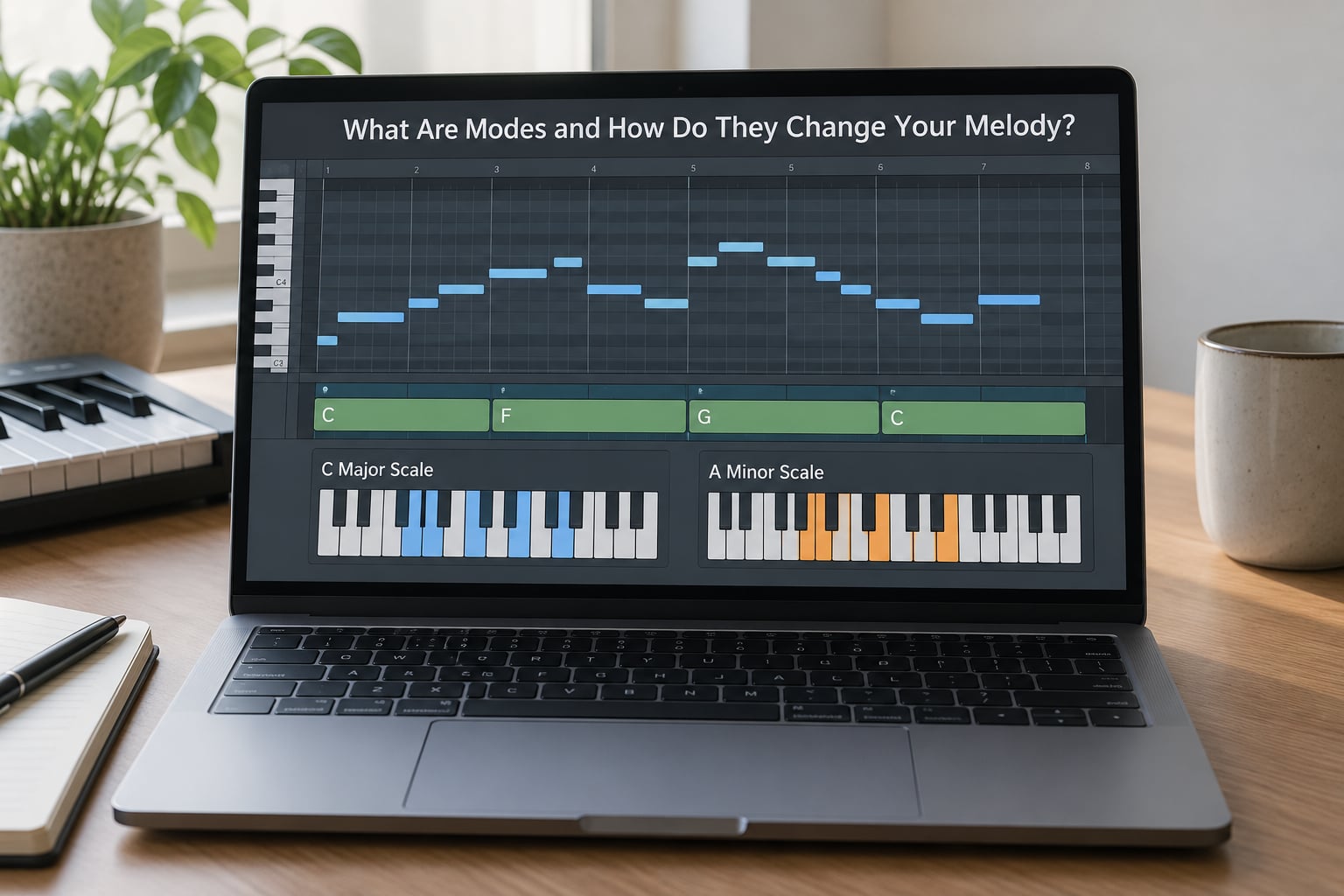
The short version for producers: a mode is a palette, not a rule. Nothing about your session, your tempo or your drum bus changes. You are only telling your ears which note is home, and everything else rearranges around that choice.
Here are the five things worth holding on to before the detail.
- A scale is a set of pitches. A mode is that same set plus a decision about which note is the tonic. A chord is three or more notes stacked at once.
- The mode changes the intervals above the tonic, which is what your ear actually hears as mood.
- Most modes differ from plain major or plain minor by one single note. Lydian raises the 4th, Mixolydian lowers the 7th, Dorian lifts the 6th.
- A mode only announces itself if the bass, the chords and the melody all agree on the tonic. Miss that and it collapses back into major or minor.
- Use modes for color, not for correctness. Most listeners never notice you used one, which is exactly the point.
How Do Modes Work in Music?
A mode is defined by two things: which note is the tonic, and the pattern of whole steps and half steps climbing up to the octave. That pattern is the interval formula, and it is the entire fingerprint of the mode.
The major scale in C is C D E F G A B, and its formula is whole, whole, half, whole, whole, whole, half. Start the same seven notes on D and you get D E F G A B C, which is W H W W W H W, the Dorian formula. Same notes. Different starting point. Different ladder.
| Mode | Formula (W = whole, H = half) | Formula (T = tone, S = semitone) | Scale degrees | Notes in C | Color note | Tonic chord |
|---|---|---|---|---|---|---|
| Ionian | W W H W W W H | T T S T T T S | 1 2 3 4 5 6 7 | C D E F G A B | none, this is the plain major scale | Major |
| Dorian | W H W W W H W | T S T T T S T | 1 2 b3 4 5 6 b7 | C D Eb F G A Bb | Raised 6th, the major 6th | Minor |
| Phrygian | H W W W H W W | S T T T S T T | 1 b2 b3 4 5 b6 b7 | C Db Eb F G Ab Bb | Flattened 2nd | Minor |
| Lydian | W W W H W W H | T T T S T T S | 1 2 3 #4 5 6 7 | C D E F# G A B | Raised 4th, the sharp 4 | Major |
| Mixolydian | W W H W W H W | T T S T T S T | 1 2 3 4 5 6 b7 | C D E F G A Bb | Lowered 7th | Major |
| Aeolian | W H W W H W W | T S T T S T T | 1 2 b3 4 5 b6 b7 | C D Eb F G Ab Bb | none, this is natural minor | Minor |
| Locrian | H W W H W W W | S T T S T T T | 1 b2 b3 4 b5 b6 b7 | C Db Eb F Gb Ab Bb | Flattened 5th, the tritone above the root | Diminished |
Two framings exist and confusing them is the single most common source of forum arguments. In the relative view, you keep the same notes and move the tonic, which is how you get from C major to A minor without changing a single pitch. In the parallel view, you keep the root and change the note collection, which is how C major becomes C Dorian with an E flat instead of an E.
That second view is the one that changes your melody, so it is the one this guide keeps coming back to.
How do you memorize all seven?
Stop memorizing names. Learn one anchor and derive the rest from it.
- Take C major and start it on C. Write Ionian and stop thinking for the day.
- Play the same notes again starting on D. That pattern, W H W W W H W, is Dorian.
- Repeat on E, F, G, A, B, and label each one by the note you started on until the names arrive on their own.
- Reverse the run, starting on B and walking back down to C. The descending order Locrian, Aeolian, Mixolydian, Lydian, Phrygian, Dorian, Ionian sticks faster than any chart.
- Say the mood words out loud with the formulas: Ionian bright, Dorian hopeful, Phrygian Spanish, Lydian floating, Mixolydian bluesy, Aeolian sad, Locrian tense.
What Are the Major Modes?
Three of the seven build a major triad on their tonic, so they feel related: Ionian, Lydian and Mixolydian. Each is the major scale with exactly one note altered, and that single note is the whole personality.
Ionian: the plain major scale
Ionian is C major with nothing added and nothing removed. Its tonic chord is major, the 7th degree creates a leading tone that wants to resolve upward, and it lands hard on the 1 and the 5. The emotional read is resolved and bright, which is why it shows up in nearly every pop chorus and EDM drop. Africa by Toto is the obvious reference point.
What it does to a melody: nothing. A melody that works in Ionian already sits on notes the scale allows.
Lydian: major with a raised 4th
Lydian lifts the 4th degree a semitone, which changes the 4th from a stable note into something that leans upward. That F sharp over C makes the scale sound suspended and open rather than settled, and it is the sound of wide, weightless pads and film-score strings. The theme from The Simpsons, written by Danny Elfman, is the reference most producers recognize instantly.
What it does to a melody: raises the ceiling. Phrases written in Ionian that arc upward land on brighter notes, and the melody sounds like it is floating rather than arriving.
Mixolydian: major with a lowered 7th
Mixolydian flattens the 7th, which kills the leading tone pull and hands you a dominant 7th chord built on the tonic. That single change turns a resolved major sound into a bluesy, relaxed, slightly rootless one, and it works over almost any dominant 7th groove. Sweet Home Alabama by Lynyrd Skynyrd is the standard example.
What it does to a melody: it barely does. Mixolydian and Ionian differ on one note, the 7th, so a melody that never touches the 7th sounds identical in both.
What Are the Minor Modes?
Here is the part that trips people up. The four modes with a minor tonic chord are Dorian, Phrygian, Aeolian and Locrian, but only one of them is what most people mean by minor.
Aeolian is the natural minor scale
Aeolian, the plain natural minor, uses degrees 1 2 b3 4 5 b6 b7. Both the 6th and the 7th are lowered, so it never hints at the major key sitting a third above it. It is the saddest of the seven in most listeners’ experience, mostly because it is the mode Western harmony has trained people to associate with sadness. Another One Bites the Dust by Queen is a widely cited example.
Dorian is minor with a raised 6th
Dorian differs from natural minor by one note: the 6th is raised. That single major 6th over a minor tonic removes most of the grief while keeping the minor third, which is why Dorian reads as soulful, hopeful or cool rather than sad. It is the most overused mode in film trailers and lo-fi hip-hop for exactly that reason. Sailing by Christopher Cross sits squarely in it.
Phrygian is minor with a lowered 2nd
Phrygian drops the 2nd a semitone, creating a half step between the root and the note right above it. That interval sounds ominous, which is why Phrygian is the default choice for tension, metal riffs and anything Spanish-flavored. The Habanera from Carmen is the textbook example, and the opening riff of Enter Sandman is built on a Phrygian-type figure for the same reason.
Locrian is minor with a lowered 5th
Locrian lowers the 5th, which puts a tritone between the root and the note built on it. The tonic chord stops being stable and becomes a half-diminished shape, so the music has nowhere settled to rest. It is the least common of the seven because it is genuinely unstable, and producers usually pull one chord or one phrase out of it as a color rather than building a whole track on it.
Harmonic minor and melodic minor are not modes
Raising the 7th in natural minor gives harmonic minor, and raising the 6th and 7th gives melodic minor. Both are scale variations rather than rotations of the major scale, so they are not part of the seven modes. They still matter: melodic minor is the source of the four melodic minor modes, which include Lydian dominant and the altered scale, both staples in jazz and film harmony.
How Does a Mode Change a Melody?
Here is a concrete demonstration. Take an eight-note melody in C major: C D E F G F E D. It uses scale degrees 1 2 3 4 5 4 3 2, so it stays entirely inside the first five degrees of the scale.
| Mode on C | Melody notes | Which notes moved | Result |
|---|---|---|---|
| C Ionian | C D E F G F E D | none | Plain major, resolved |
| C Dorian | C D Eb F G F Eb D | 3rd degree down a semitone | Minor warmth, keeps the major 6th available |
| C Phrygian | C Db Eb F G F Eb Db | 2nd and 3rd down a semitone | The Db lands hard against C, tense and Spanish |
| C Lydian | C D E F# G F# E D | 4th up a semitone | Brighter, floating, no place to settle on 4 |
| C Mixolydian | C D E F G F E D | none, because the 7th is never played | Sounds identical to Ionian |
| C Aeolian | C D Eb F G F Eb D | 3rd down a semitone | Same notes as Dorian here, darker because the 6th is also flat |
| C Locrian | C Db Eb F Gb F Eb Db | 2nd, 3rd and 5th move | Unstable, the Gb pulls against the C |
Two things jump out. First, Phrygian, Lydian and Locrian change the melody noticeably even though only one or two notes moved. Second, Dorian and Aeolian produced identical notes here, because the melody never visits the 6th, which is the only note separating them. And Mixolydian produced no change at all.
That is the practical answer to how modes change your melody: only the notes you actually play matter. A mode cannot color a passage through notes that never appear in it.
Why a melody sometimes refuses to change mode
Set a scale plugin to Dorian, write a melody on E, and nothing about it sounds modal. The reason is that the ear hears motion, not note lists. If your melody and bass outline a V-I or a i-VI-V pattern, your ear reconstructs a major or minor key regardless of what the scale selector says, which is why producers on forums keep hitting this wall.
To make a mode audible, give the tonic somewhere to return to. Hold a pedal or drone on the root under the whole phrase, let the melody land on the root and the fifth often, and avoid leading-tone semitone pulls toward the 7th. A modal cadence that just stops on the 1st or the 5th does more work than any setting inside a plugin.
How Do Modes Affect Chords and Emotional Mood?
Each mode stacks its own triad on the tonic, and that chord quality is the fastest way to predict the mood before you write anything.
Ionian, Lydian and Mixolydian give you a major triad on the tonic. Dorian, Phrygian and Aeolian give you a minor triad. Locrian gives you a diminished triad, which is why it never resolves.
| Use case | Mode to reach for | Why |
|---|---|---|
| EDM drop or trance hook | Lydian or Mixolydian | The raised 4th adds lift, the lowered 7th adds grit without a cadence |
| Lo-fi hip-hop loop | Dorian | Minor third with a major 6th, warm rather than mournful |
| Melodic techno or deep house | Dorian | Long modal vamps read as sophisticated instead of sad |
| Film underscore or tension bed | Phrygian | The flattened 2nd sits right against the root |
| Metal riff | Phrygian or Phrygian dominant | The b2 works with power chords and pedal tones |
| Hopeful bridge or sunrise moment | Lydian | Major harmony with no place to resolve, so it keeps moving forward |
| Blues, garage, roots rock | Mixolydian | Dominant 7th tonic fits almost any blues groove |
| Grief, stillness, cinematic sadness | Aeolian | Both 6th and 7th lowered, the plain minor sound |
Modal interchange is the shortcut version of all this. Take one chord from the parallel mode and drop it into an existing progression: Just the Two of Us by Bill Withers is built on a Dorian vamp, and the maj7 chords that arrive on the fourth are borrowed straight from the major scale sitting a third above it. One borrowed chord tells the listener the key has loosened without rewriting the progression.
How Can You Use Modes in a DAW or Synth?
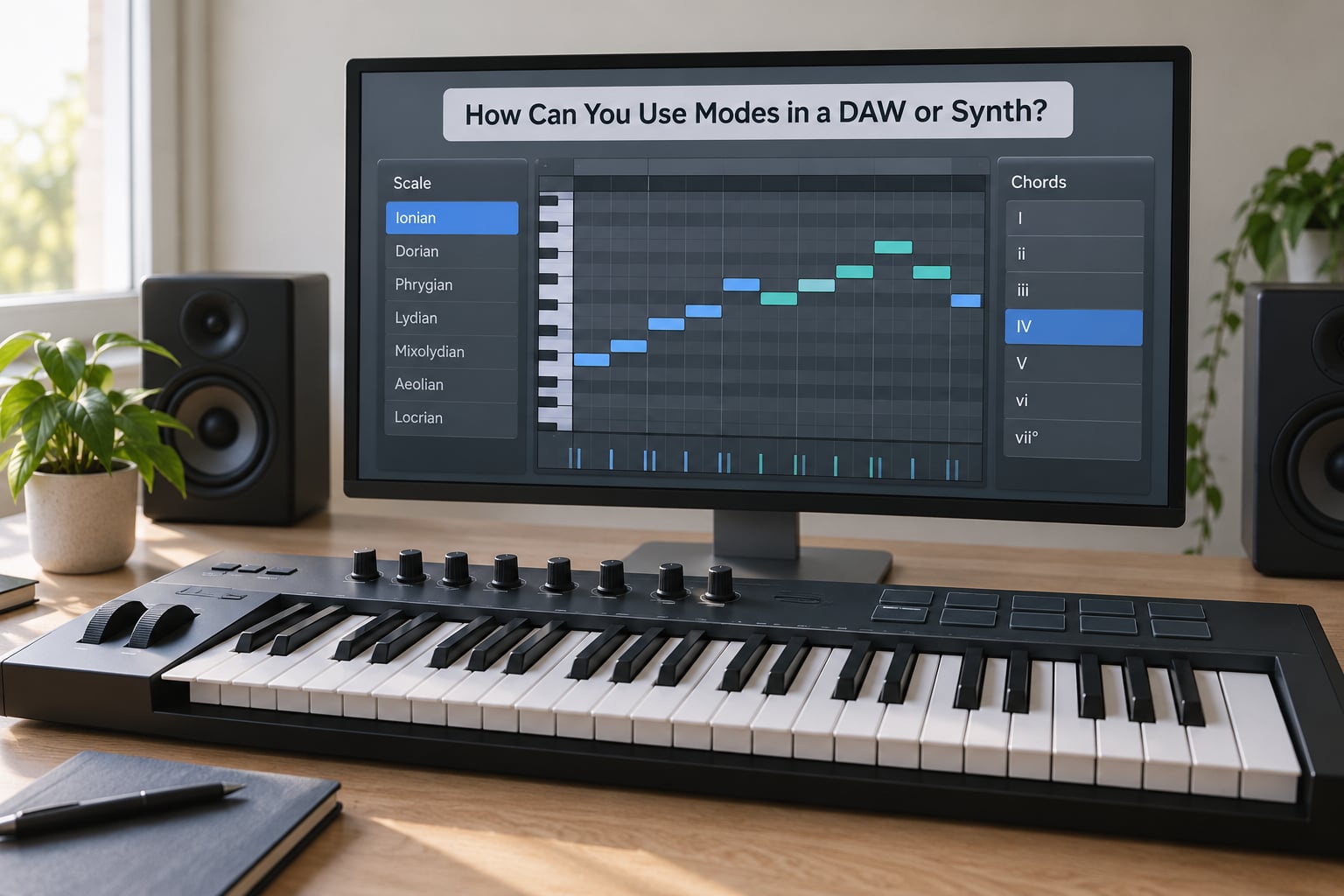
Reading about modes changes nothing. These five steps put a mode under your fingers in about ten minutes.
- Load one sustained note. A single low root on a pad or a plucked long sample, looping for eight bars. No chords yet. This is your drone.
- Turn on the scale filter. Most DAWs have one somewhere in the piano roll or in a MIDI effect. Ableton Live ships a Scale effect on MIDI tracks, FL Studio has the Stamp tool with a scale selector, and Logic Pro offers scale quantize from its function menu. Menu names move between versions, so look for the words scale, quantize or snap in your piano roll first.
- Pick the mode and the root, then improvise. Reach for the color note repeatedly. Lydian means living on the raised 4th, Mixolydian on the lowered 7th, Phrygian on the flattened 2nd.
- Land on the root. Let the phrase finish on 1, 5 or b6 rather than ending on the color note. That is what makes the mode sound intentional.
- Add chords last. Build diatonic chords from the same scale, keep the bass on the root, and stop resisting the urge to add a dominant 7th that pulls everything home.
For hearing practice, skip the chords entirely for a few sessions. Solo against the drone and try to phrase on the color note. The gap most people hit here is melodic, not theoretical, as the Music.SE threads about practicing D Dorian over a C major backing keep showing.
If you play a fretboard instrument, the modes have shapes worth memorizing: the E minor shape gives you Phrygian, the A minor shape gives Aeolian, the D major shape gives Mixolydian, the G major shape gives Ionian, the E major shape gives Lydian and the A major shape gives Dorian. On a keyboard, use white and black key landmarks instead: the gap between E and F sits at degrees 3 and 4 in Ionian, 4 and 5 in Lydian and 5 and 6 in Aeolian, which is a fast way to locate a mode’s signature interval.
Modes Versus Major and Minor Keys
A key is a tonal center plus a set of chords built around it, and Western keys assume a strong pull between the 1st and the 5th degree. A mode keeps that pull deliberately loose.
So when is a passage modal? Listen for three things: whether the melody rests on the root, whether any dominant 7th chord appears, and whether one chord sits underneath the whole section. If a progression moves through I, IV, ii and V and resolves home, it is a major key that happens to use the major scale. If it sits on two chords for sixteen bars without resolving, it is modal.
The practical distinction for a producer is about speed. Writing in a new key means rewriting the bass line, the chord voicings and the melody. Borrowing a mode, or one chord from a mode, keeps everything you already like and changes only the color.
Frequently Asked Questions
What are the 7 types of modes in music?
The seven modes are Ionian, Dorian, Phrygian, Lydian, Mixolydian, Aeolian and Locrian. Each one is the major scale started on a different degree, which changes its interval pattern, its tonic chord and its emotional color. Ionian is the plain major scale, Aeolian is natural minor, and the other five are major or minor with one note altered: Dorian raises the 6th, Phrygian lowers the 2nd, Lydian raises the 4th, Mixolydian lowers the 7th and Locrian lowers the 5th.
How do I memorize the 7 modes?
Stop memorizing names and memorize one anchor instead. Play C major, then replay the same notes starting on D, then E, then F, and label each run by the note it starts on. That single exercise covers Dorian, Phrygian, Lydian, Mixolydian, Aeolian and Locrian in about five minutes. Then walk the order backwards from B down to C and pair each mode with one mood word, which is what makes the sequence stick.
What is the saddest musical mode?
Aeolian is usually heard as the saddest, because it is natural minor with both the 6th and the 7th lowered, which removes the major-key brightness that Dorian and Phrygian keep in reserve. Listeners react to it partly because Western harmony trained them to pair minor with grief. Some people hear Phrygian as darker still, since its flattened 2nd rubs against the root, but it reads as tension and menace rather than sadness.
What is the difference between modes and keys?
A key is a tonal center plus chords built around it, and it expects a strong pull between the tonic and the dominant. A mode uses the same tonic but loosens that pull, usually by avoiding the leading tone and resting on the root or fifth instead of resolving. A passage that moves through I, IV, ii and V and lands home is in a key even if it only uses major-scale notes. A passage that sits on two chords for sixteen bars is modal.
Why does my melody sound the same no matter which mode I select?
Two reasons, and both are common. First, the mode only colors the notes your melody actually plays, so a phrase written on degrees 1 through 5 sounds identical in Ionian and Mixolydian. Second, your bass, pads and chord voicings are still outlining a major or minor key, and the ear hears that motion more strongly than the scale selection. Hold a drone on the root, finish phrases on the root or fifth and remove the dominant 7th, and the mode appears.
Are harmonic minor and melodic minor modes?
No, they are not part of the seven modes. Harmonic minor raises the 7th of natural minor, and melodic minor raises both the 6th and the 7th, so neither is a rotation of the major scale. They matter anyway, because melodic minor generates four more scales worth learning, including Lydian dominant and the altered scale. Lydian dominant, a major triad with a minor third and flattened 7th, is the go-to sound for bluesy dominant chords in jazz and film scoring.
Conclusion
A mode is the same set of notes with a different note treated as home, and the emotional shift comes entirely from which intervals sit above that home note. What are modes and how do they change your melody, in practice? Only through the notes you actually play, and only when your bass, chords and endings agree on the tonic.
Here is what to do first. Open a session, drop a single sustained C, and replay the melody C D E F G F E D over it in Phrygian and then in Lydian. Listen to which version you like, build the chords from that mode, and stop there. Modes are a palette, not a correctness test, and the fastest way to hear them is to hear one change.